Request Demo
Are prodrugs patentable?
21 May 2025
Introduction to Prodrugs
Prodrugs are pharmacologically inactive compounds that undergo transformation in the body to release an active drug. This transformation often involves enzymatic processes that convert the prodrug into its active form. The concept of prodrugs is designed to improve the pharmacokinetics, bioavailability, and safety profiles of therapeutic agents. By masking certain chemical properties, prodrugs can enhance absorption, reduce adverse effects, and provide targeted delivery, ultimately optimizing therapeutic outcomes.
Patentability Criteria
The patentability of prodrugs is governed by standard patent laws that apply to pharmaceutical inventions. For an invention to be patentable, it must meet several criteria: novelty, non-obviousness, and utility. These criteria ensure that the invention is new, involves an inventive step, and has practical applicability.
1. Novelty
The novelty criterion requires that the prodrug be new, meaning it has not been previously disclosed or known in any form. This includes any public disclosures prior to the filing date of the patent application. A prodrug can be considered novel if it represents a new chemical entity or a new formulation of an existing compound that has not been previously patented or published.
2. Non-Obviousness
The non-obviousness requirement demands that the prodrug invention should not be evident to a person having ordinary skill in the art, based on prior knowledge. In the context of prodrugs, this means that the transformation of an active drug into its inactive form must involve an innovative and non-trivial modification. The development of new linkage techniques or the discovery of unique biotransformation pathways can contribute to the non-obviousness of a prodrug patent application.
3. Utility
The utility criterion necessitates that the prodrug has a specific, substantial, and credible utility. In pharmaceuticals, this typically translates to therapeutic benefits, such as improved drug delivery, enhanced efficacy, or reduced side effects. The prodrug must demonstrate a clear advantage over existing drugs or formulations to satisfy this requirement.
Challenges in Patentability
While prodrugs can meet standard patentability criteria, they also face unique challenges. One significant obstacle is the potential overlap with existing patents on the active drug itself. If a prodrug merely releases a patented active pharmaceutical ingredient (API), it may infringe on the original drug patent unless it demonstrates sufficient novelty and non-obviousness. Additionally, the patentability of a prodrug can be contentious if the modifications do not yield significant therapeutic advantages.
Moreover, as scientific knowledge and techniques evolve, the distinction between innovative and routine modifications can become blurred, making it harder to establish the non-obviousness of certain prodrug developments. Patent offices often require robust evidence to substantiate the inventive nature and therapeutic benefits of prodrugs.
Conclusion
Prodrugs have the potential to revolutionize drug delivery by enhancing the effectiveness and safety of therapeutic agents. However, their patentability is contingent upon satisfying the fundamental criteria of novelty, non-obviousness, and utility. While these criteria are well-defined, the application in the context of prodrugs can be complex due to the intricate nature of chemical modifications and existing patent landscapes.
Inventors and pharmaceutical companies seeking patent protection for prodrugs must carefully craft their patent applications to highlight the innovative aspects of their inventions and demonstrate clear therapeutic advantages. By navigating these challenges, prodrugs can secure patent protection and contribute significantly to advancing pharmaceutical science and patient care.
Prodrugs are pharmacologically inactive compounds that undergo transformation in the body to release an active drug. This transformation often involves enzymatic processes that convert the prodrug into its active form. The concept of prodrugs is designed to improve the pharmacokinetics, bioavailability, and safety profiles of therapeutic agents. By masking certain chemical properties, prodrugs can enhance absorption, reduce adverse effects, and provide targeted delivery, ultimately optimizing therapeutic outcomes.
Patentability Criteria
The patentability of prodrugs is governed by standard patent laws that apply to pharmaceutical inventions. For an invention to be patentable, it must meet several criteria: novelty, non-obviousness, and utility. These criteria ensure that the invention is new, involves an inventive step, and has practical applicability.
1. Novelty
The novelty criterion requires that the prodrug be new, meaning it has not been previously disclosed or known in any form. This includes any public disclosures prior to the filing date of the patent application. A prodrug can be considered novel if it represents a new chemical entity or a new formulation of an existing compound that has not been previously patented or published.
2. Non-Obviousness
The non-obviousness requirement demands that the prodrug invention should not be evident to a person having ordinary skill in the art, based on prior knowledge. In the context of prodrugs, this means that the transformation of an active drug into its inactive form must involve an innovative and non-trivial modification. The development of new linkage techniques or the discovery of unique biotransformation pathways can contribute to the non-obviousness of a prodrug patent application.
3. Utility
The utility criterion necessitates that the prodrug has a specific, substantial, and credible utility. In pharmaceuticals, this typically translates to therapeutic benefits, such as improved drug delivery, enhanced efficacy, or reduced side effects. The prodrug must demonstrate a clear advantage over existing drugs or formulations to satisfy this requirement.
Challenges in Patentability
While prodrugs can meet standard patentability criteria, they also face unique challenges. One significant obstacle is the potential overlap with existing patents on the active drug itself. If a prodrug merely releases a patented active pharmaceutical ingredient (API), it may infringe on the original drug patent unless it demonstrates sufficient novelty and non-obviousness. Additionally, the patentability of a prodrug can be contentious if the modifications do not yield significant therapeutic advantages.
Moreover, as scientific knowledge and techniques evolve, the distinction between innovative and routine modifications can become blurred, making it harder to establish the non-obviousness of certain prodrug developments. Patent offices often require robust evidence to substantiate the inventive nature and therapeutic benefits of prodrugs.
Conclusion
Prodrugs have the potential to revolutionize drug delivery by enhancing the effectiveness and safety of therapeutic agents. However, their patentability is contingent upon satisfying the fundamental criteria of novelty, non-obviousness, and utility. While these criteria are well-defined, the application in the context of prodrugs can be complex due to the intricate nature of chemical modifications and existing patent landscapes.
Inventors and pharmaceutical companies seeking patent protection for prodrugs must carefully craft their patent applications to highlight the innovative aspects of their inventions and demonstrate clear therapeutic advantages. By navigating these challenges, prodrugs can secure patent protection and contribute significantly to advancing pharmaceutical science and patient care.
Discover Eureka LS: AI Agents Built for Biopharma Efficiency
Stop wasting time on biopharma busywork. Meet Eureka LS - your AI agent squad for drug discovery.
▶ See how 50+ research teams saved 300+ hours/month
From reducing screening time to simplifying Markush drafting, our AI Agents are ready to deliver immediate value. Explore Eureka LS today and unlock powerful capabilities that help you innovate with confidence.
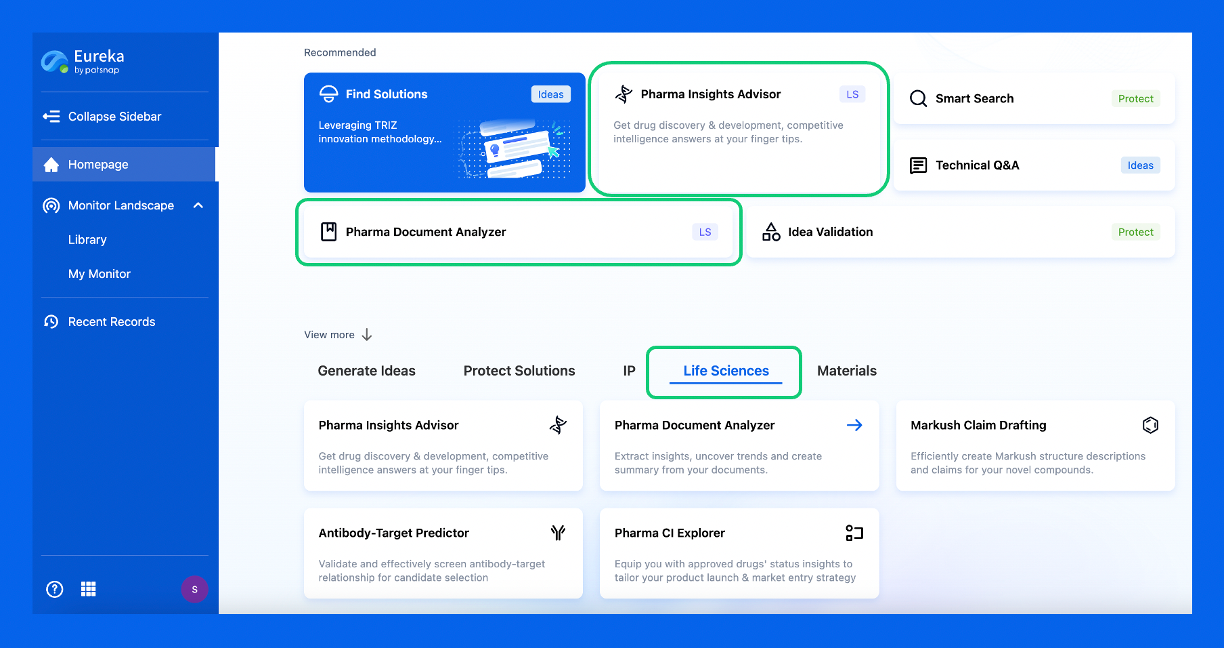
AI Agents Built for Biopharma Breakthroughs
Accelerate discovery. Empower decisions. Transform outcomes.
Get started for free today!
Accelerate Strategic R&D decision making with Synapse, PatSnap’s AI-powered Connected Innovation Intelligence Platform Built for Life Sciences Professionals.
Start your data trial now!
Synapse data is also accessible to external entities via APIs or data packages. Empower better decisions with the latest in pharmaceutical intelligence.