Request Demo
What are ADAM18 modulators and how do they work?
25 June 2024
ADAM18 modulators are a fascinating area of study in the field of molecular biology and pharmacology, representing a promising avenue for therapeutic interventions in various diseases. ADAM18, a member of the ADAM (a disintegrin and metalloproteinase) family, plays a crucial role in cell signaling and communication, particularly in reproductive biology. Understanding how ADAM18 modulators work and their potential applications can offer significant insights into improving treatments for several conditions.
ADAM18 modulators interact with the ADAM18 protein, affecting its activity in physiological processes. The ADAM family of proteins is characterized by a unique structure that combines a disintegrin domain, which mediates cell adhesion, and a metalloproteinase domain, which enables the cleavage of various substrates. ADAM18, specifically, has been identified as an important protease in sperm maturation and fertility. Modulators can either enhance or inhibit the activity of ADAM18, leading to varying biological outcomes.
The mechanism of action of ADAM18 modulators involves intricate biochemical interactions. These modulators can be small molecules, peptides, or even monoclonal antibodies designed to bind to specific sites on ADAM18. By binding to these sites, modulators can alter the conformation of ADAM18, thus impacting its ability to interact with substrates or other cellular components. For instance, an inhibitor might prevent ADAM18 from cleaving a target protein, thereby blocking a downstream signaling pathway. Conversely, an activator could enhance ADAM18's proteolytic activity, promoting the cleavage of substrates that facilitate cellular communication and function.
The specificity of ADAM18 modulators is crucial for their effectiveness. Given the conserved nature of metalloproteinases across the ADAM family, achieving selective modulation of ADAM18 without off-target effects on other ADAM proteins is a significant challenge. Advances in computational biology and high-throughput screening technologies have aided in the identification and optimization of selective modulators, enhancing their therapeutic potential.
ADAM18 modulators hold promise for a variety of clinical applications due to their ability to influence key biological processes. One of the primary areas of interest is reproductive health. Since ADAM18 is implicated in sperm maturation, modulators can be used to address male infertility issues. For instance, an ADAM18 inhibitor might be developed as a contraceptive agent by impairing sperm function, whereas an activator could be used to enhance fertility in men with certain types of infertility.
Beyond reproductive health, ADAM18 modulators also have potential in treating cancer. Dysregulation of proteolytic activity is a hallmark of cancer progression, and ADAM18's role in cell adhesion and migration makes it a target of interest. By modulating ADAM18 activity, it may be possible to inhibit tumor growth and metastasis. Furthermore, the anti-inflammatory properties of some ADAM18 modulators could be beneficial in treating chronic inflammatory conditions, where excessive protease activity contributes to tissue damage.
Neurological disorders are another promising area for ADAM18 modulator application. Proteolytic processing of membrane proteins by metalloproteinases is critical in neural development and function. Therefore, ADAM18 modulators might help in the treatment of neurodegenerative diseases by regulating the cleavage of substrates involved in neuronal survival and communication.
In conclusion, ADAM18 modulators represent a versatile and promising tool in the therapeutic arsenal. Their ability to specifically target and modulate the activity of ADAM18 offers potential benefits across various fields, from reproductive health and oncology to inflammation and neurology. Continued research and development in this area are likely to uncover even more applications for these modulators, paving the way for innovative treatments that address unmet medical needs. As our understanding of ADAM18 and its modulators deepens, the possibilities for therapeutic interventions will expand, offering hope for improved health outcomes in numerous conditions.
ADAM18 modulators interact with the ADAM18 protein, affecting its activity in physiological processes. The ADAM family of proteins is characterized by a unique structure that combines a disintegrin domain, which mediates cell adhesion, and a metalloproteinase domain, which enables the cleavage of various substrates. ADAM18, specifically, has been identified as an important protease in sperm maturation and fertility. Modulators can either enhance or inhibit the activity of ADAM18, leading to varying biological outcomes.
The mechanism of action of ADAM18 modulators involves intricate biochemical interactions. These modulators can be small molecules, peptides, or even monoclonal antibodies designed to bind to specific sites on ADAM18. By binding to these sites, modulators can alter the conformation of ADAM18, thus impacting its ability to interact with substrates or other cellular components. For instance, an inhibitor might prevent ADAM18 from cleaving a target protein, thereby blocking a downstream signaling pathway. Conversely, an activator could enhance ADAM18's proteolytic activity, promoting the cleavage of substrates that facilitate cellular communication and function.
The specificity of ADAM18 modulators is crucial for their effectiveness. Given the conserved nature of metalloproteinases across the ADAM family, achieving selective modulation of ADAM18 without off-target effects on other ADAM proteins is a significant challenge. Advances in computational biology and high-throughput screening technologies have aided in the identification and optimization of selective modulators, enhancing their therapeutic potential.
ADAM18 modulators hold promise for a variety of clinical applications due to their ability to influence key biological processes. One of the primary areas of interest is reproductive health. Since ADAM18 is implicated in sperm maturation, modulators can be used to address male infertility issues. For instance, an ADAM18 inhibitor might be developed as a contraceptive agent by impairing sperm function, whereas an activator could be used to enhance fertility in men with certain types of infertility.
Beyond reproductive health, ADAM18 modulators also have potential in treating cancer. Dysregulation of proteolytic activity is a hallmark of cancer progression, and ADAM18's role in cell adhesion and migration makes it a target of interest. By modulating ADAM18 activity, it may be possible to inhibit tumor growth and metastasis. Furthermore, the anti-inflammatory properties of some ADAM18 modulators could be beneficial in treating chronic inflammatory conditions, where excessive protease activity contributes to tissue damage.
Neurological disorders are another promising area for ADAM18 modulator application. Proteolytic processing of membrane proteins by metalloproteinases is critical in neural development and function. Therefore, ADAM18 modulators might help in the treatment of neurodegenerative diseases by regulating the cleavage of substrates involved in neuronal survival and communication.
In conclusion, ADAM18 modulators represent a versatile and promising tool in the therapeutic arsenal. Their ability to specifically target and modulate the activity of ADAM18 offers potential benefits across various fields, from reproductive health and oncology to inflammation and neurology. Continued research and development in this area are likely to uncover even more applications for these modulators, paving the way for innovative treatments that address unmet medical needs. As our understanding of ADAM18 and its modulators deepens, the possibilities for therapeutic interventions will expand, offering hope for improved health outcomes in numerous conditions.
How to obtain the latest development progress of all targets?
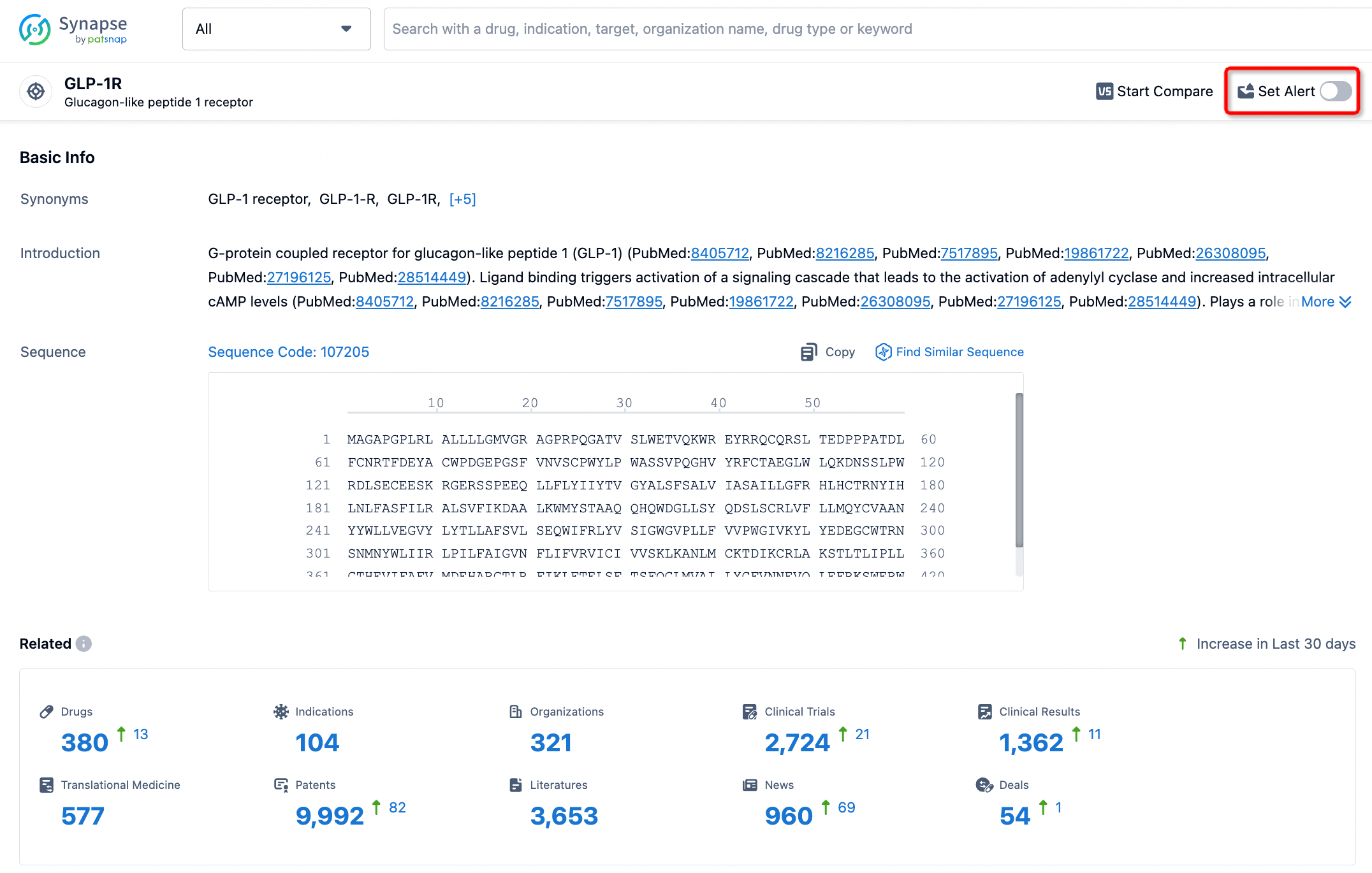
In the Synapse database, you can stay updated on the latest research and development advances of all targets. This service is accessible anytime and anywhere, with updates available daily or weekly. Use the "Set Alert" function to stay informed. Click on the image below to embark on a brand new journey of drug discovery!

AI Agents Built for Biopharma Breakthroughs
Accelerate discovery. Empower decisions. Transform outcomes.
Get started for free today!
Accelerate Strategic R&D decision making with Synapse, PatSnap’s AI-powered Connected Innovation Intelligence Platform Built for Life Sciences Professionals.
Start your data trial now!
Synapse data is also accessible to external entities via APIs or data packages. Empower better decisions with the latest in pharmaceutical intelligence.