Request Demo
What are ALPK1 agonists and how do they work?
25 June 2024
Introduction to ALPK1 agonists
Alpha-kinase 1, commonly referred to as ALPK1, is a serine/threonine kinase that has been drawing significant interest in the field of biomedical research. This enzyme is implicated in various cellular processes and has a unique kinase domain that sets it apart from conventional protein kinases. ALPK1 is involved in immune responses, inflammation, and even tumorigenesis, making it a focal point for therapeutic interventions. One of the most promising avenues of research in this area involves the development of ALPK1 agonists. These compounds activate ALPK1 and hold immense potential for treating a variety of diseases.
How do ALPK1 agonists work?
To understand how ALPK1 agonists work, it's essential to first delve into the mechanism of ALPK1 itself. ALPK1 functions as a kinase, an enzyme that transfers phosphate groups to specific substrates, thereby modulating their activity. Unlike traditional kinases that target serine, threonine, or tyrosine residues, ALPK1 belongs to a unique family of alpha-kinases that phosphorylate substrates on serine and threonine residues within alpha-helical structures.
ALPK1 agonists are small molecules or peptides designed to bind to the ALPK1 enzyme and enhance its activity. These agonists can either mimic the natural substrates of ALPK1 or stabilize the enzyme in an active conformation. By doing so, they amplify the phosphorylation of downstream targets, leading to a cascade of cellular events. For instance, ALPK1 is known to phosphorylate myosin IIA, which plays a crucial role in actin filament organization and cell motility. Activation of ALPK1 can thus impact various cellular functions, from immune cell activation to epithelial barrier integrity.
What are ALPK1 agonists used for?
The potential therapeutic applications of ALPK1 agonists are vast, owing to the diverse roles of ALPK1 in cellular physiology. Here are some of the primary areas where these agonists could make a significant impact:
1. **Inflammatory Diseases**: One of the most promising applications of ALPK1 agonists is in the treatment of inflammatory diseases. ALPK1 is a key player in the innate immune response, and its activation can modulate the production of pro-inflammatory cytokines. Agonists of ALPK1 could be used to boost the immune response in chronic infections or dampen excessive inflammation in autoimmune diseases.
2. **Cancer Therapy**: Recent studies have shown that ALPK1 is involved in tumorigenesis and cancer progression. It can influence cell proliferation, migration, and invasion, which are critical processes in cancer metastasis. By activating ALPK1, agonists could potentially inhibit these processes and serve as a novel approach to cancer therapy.
3. **Metabolic Disorders**: There is emerging evidence that ALPK1 plays a role in metabolic regulation. It has been linked to glucose homeostasis and lipid metabolism, making it a potential target for treating metabolic disorders such as diabetes and obesity. ALPK1 agonists could help in fine-tuning metabolic pathways to improve insulin sensitivity and reduce lipid accumulation.
4. **Neurodegenerative Diseases**: The role of ALPK1 in neuronal function and survival is another exciting area of research. Given that neuroinflammation is a hallmark of many neurodegenerative diseases like Alzheimer's and Parkinson's, ALPK1 agonists could offer a new therapeutic strategy. By modulating inflammatory pathways in the brain, these agonists may help in slowing down the progression of neurodegenerative conditions.
5. **Cardiovascular Health**: ALPK1 has also been implicated in cardiovascular health, particularly in the regulation of endothelial cell function and vascular integrity. Activation of ALPK1 could enhance endothelial barrier function and reduce vascular inflammation, offering potential benefits in conditions like atherosclerosis and hypertension.
In summary, ALPK1 agonists represent a promising frontier in medical research with the potential to treat a range of diseases. While much remains to be understood about the precise mechanisms and effects of these agonists, the initial findings are encouraging. As research progresses, it is likely that we will see the development of targeted therapies that leverage the unique properties of ALPK1 to improve human health.
Alpha-kinase 1, commonly referred to as ALPK1, is a serine/threonine kinase that has been drawing significant interest in the field of biomedical research. This enzyme is implicated in various cellular processes and has a unique kinase domain that sets it apart from conventional protein kinases. ALPK1 is involved in immune responses, inflammation, and even tumorigenesis, making it a focal point for therapeutic interventions. One of the most promising avenues of research in this area involves the development of ALPK1 agonists. These compounds activate ALPK1 and hold immense potential for treating a variety of diseases.
How do ALPK1 agonists work?
To understand how ALPK1 agonists work, it's essential to first delve into the mechanism of ALPK1 itself. ALPK1 functions as a kinase, an enzyme that transfers phosphate groups to specific substrates, thereby modulating their activity. Unlike traditional kinases that target serine, threonine, or tyrosine residues, ALPK1 belongs to a unique family of alpha-kinases that phosphorylate substrates on serine and threonine residues within alpha-helical structures.
ALPK1 agonists are small molecules or peptides designed to bind to the ALPK1 enzyme and enhance its activity. These agonists can either mimic the natural substrates of ALPK1 or stabilize the enzyme in an active conformation. By doing so, they amplify the phosphorylation of downstream targets, leading to a cascade of cellular events. For instance, ALPK1 is known to phosphorylate myosin IIA, which plays a crucial role in actin filament organization and cell motility. Activation of ALPK1 can thus impact various cellular functions, from immune cell activation to epithelial barrier integrity.
What are ALPK1 agonists used for?
The potential therapeutic applications of ALPK1 agonists are vast, owing to the diverse roles of ALPK1 in cellular physiology. Here are some of the primary areas where these agonists could make a significant impact:
1. **Inflammatory Diseases**: One of the most promising applications of ALPK1 agonists is in the treatment of inflammatory diseases. ALPK1 is a key player in the innate immune response, and its activation can modulate the production of pro-inflammatory cytokines. Agonists of ALPK1 could be used to boost the immune response in chronic infections or dampen excessive inflammation in autoimmune diseases.
2. **Cancer Therapy**: Recent studies have shown that ALPK1 is involved in tumorigenesis and cancer progression. It can influence cell proliferation, migration, and invasion, which are critical processes in cancer metastasis. By activating ALPK1, agonists could potentially inhibit these processes and serve as a novel approach to cancer therapy.
3. **Metabolic Disorders**: There is emerging evidence that ALPK1 plays a role in metabolic regulation. It has been linked to glucose homeostasis and lipid metabolism, making it a potential target for treating metabolic disorders such as diabetes and obesity. ALPK1 agonists could help in fine-tuning metabolic pathways to improve insulin sensitivity and reduce lipid accumulation.
4. **Neurodegenerative Diseases**: The role of ALPK1 in neuronal function and survival is another exciting area of research. Given that neuroinflammation is a hallmark of many neurodegenerative diseases like Alzheimer's and Parkinson's, ALPK1 agonists could offer a new therapeutic strategy. By modulating inflammatory pathways in the brain, these agonists may help in slowing down the progression of neurodegenerative conditions.
5. **Cardiovascular Health**: ALPK1 has also been implicated in cardiovascular health, particularly in the regulation of endothelial cell function and vascular integrity. Activation of ALPK1 could enhance endothelial barrier function and reduce vascular inflammation, offering potential benefits in conditions like atherosclerosis and hypertension.
In summary, ALPK1 agonists represent a promising frontier in medical research with the potential to treat a range of diseases. While much remains to be understood about the precise mechanisms and effects of these agonists, the initial findings are encouraging. As research progresses, it is likely that we will see the development of targeted therapies that leverage the unique properties of ALPK1 to improve human health.
How to obtain the latest development progress of all targets?
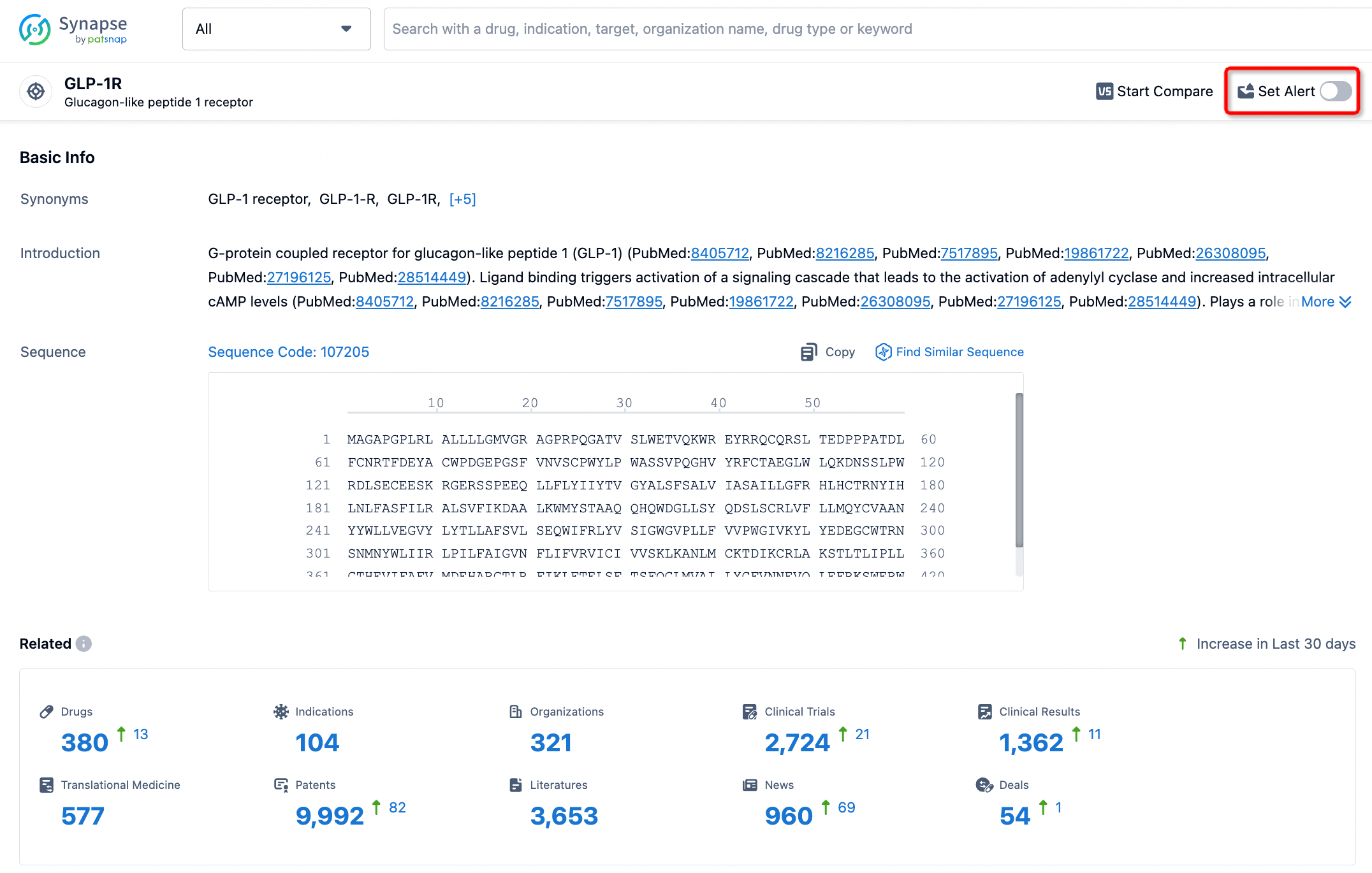
In the Synapse database, you can stay updated on the latest research and development advances of all targets. This service is accessible anytime and anywhere, with updates available daily or weekly. Use the "Set Alert" function to stay informed. Click on the image below to embark on a brand new journey of drug discovery!


Hiro LS Researcher
The AI Search Engine Built to Accelerate Biopharma Decisions
Search across billion-scale life sciences data to uncover signals, validate evidence, and act with confidence.
Ask any biopharma research question→
Get started for free today!
Accelerate Strategic R&D decision making with Synapse, Patsnap’s AI-powered Connected Innovation Intelligence Platform Built for Life Sciences Professionals.
Discover Synapse Data Servers
Synapse data is now integrated into the PatSnap LS Model Context Protocol (MCP) service. Customize your LLM agent now using our MCP server!