Request Demo
What are Aurora A inhibitors and how do they work?
21 June 2024
Aurora A inhibitors are a class of drugs that target the Aurora A kinase, a crucial enzyme involved in the regulation of cell division (mitosis). The Aurora kinases, including Aurora A, B, and C, play significant roles in various stages of mitosis, ensuring proper chromosome alignment, segregation, and cytokinesis. Aurora A, in particular, is essential for the formation and function of the mitotic spindle, a structure that segregates chromosomes during cell division. Given its pivotal role, Aurora A has become an attractive target for cancer therapy, as its overexpression or aberrant activity is often linked to tumorigenesis and poor prognosis in several cancers.
Aurora A inhibitors function by selectively binding to the Aurora A kinase, thereby inhibiting its activity. These inhibitors typically work by occupying the ATP-binding site of the enzyme, which is necessary for its activation and function. By doing so, they prevent the phosphorylation of downstream substrates that are crucial for mitotic progression. This disruption leads to several outcomes at the cellular level:
1. **Mitotic Arrest**: Without functional Aurora A, cells experience defects in spindle assembly and chromosome alignment. This can cause a prolonged mitotic arrest, where cells are unable to progress past a certain point in mitosis.
2. **Apoptosis**: Prolonged mitotic arrest often triggers programmed cell death or apoptosis. Cells that are unable to complete mitosis activate intrinsic apoptotic pathways as a fail-safe mechanism.
3. **Aneuploidy and Genomic Instability**: In some cases, inhibition of Aurora A can lead to errors in chromosome segregation, resulting in aneuploidy (an abnormal number of chromosomes). This genomic instability can either be detrimental to cancer cells or, paradoxically, may contribute to further tumor evolution if not fatal.
Given their ability to disrupt critical processes in dividing cells, Aurora A inhibitors have shown promise in the treatment of various cancers. Their use is primarily focused on malignancies where Aurora A is overexpressed or its pathway is hyperactive. Some of the key applications of Aurora A inhibitors include:
1. **Solid Tumors**: Several types of solid tumors, including breast, ovarian, and colorectal cancers, have been found to exhibit elevated levels of Aurora A. Clinical trials are ongoing to explore the efficacy of Aurora A inhibitors in these cancer types, either as monotherapies or in combination with other treatments such as chemotherapy and radiation.
2. **Hematologic Malignancies**: Aurora A inhibitors are also being investigated for their potential in treating blood cancers like acute myeloid leukemia (AML) and multiple myeloma. These cancers are characterized by rapid, uncontrolled cell division, making them suitable targets for mitotic inhibitors.
3. **Combination Therapies**: Research has shown that Aurora A inhibitors may synergize with other therapeutic agents. For example, combining Aurora A inhibitors with traditional chemotherapeutics or targeted therapies (like those inhibiting the PI3K/AKT pathway) can enhance anti-tumor efficacy and overcome resistance mechanisms.
While the potential of Aurora A inhibitors is significant, there are challenges and considerations that need to be addressed. One major concern is the selectivity and toxicity of these inhibitors. Since Aurora A is also expressed in normal dividing cells, there is a risk of adverse effects such as myelosuppression (suppression of bone marrow activity) and gastrointestinal toxicity. Therefore, ongoing research is focused on developing next-generation inhibitors that are more selective for cancer cells or have an improved therapeutic index.
In conclusion, Aurora A inhibitors represent a promising avenue in cancer therapy by targeting a critical regulator of cell division. Their ability to induce mitotic arrest and apoptosis in rapidly dividing cells makes them particularly effective against various malignancies. However, further research and clinical trials are essential to fully understand their potential, optimize their use, and mitigate associated risks. As our knowledge of Aurora A biology and its role in cancer deepens, so too will the therapeutic strategies that leverage its inhibition for better patient outcomes.
Aurora A inhibitors function by selectively binding to the Aurora A kinase, thereby inhibiting its activity. These inhibitors typically work by occupying the ATP-binding site of the enzyme, which is necessary for its activation and function. By doing so, they prevent the phosphorylation of downstream substrates that are crucial for mitotic progression. This disruption leads to several outcomes at the cellular level:
1. **Mitotic Arrest**: Without functional Aurora A, cells experience defects in spindle assembly and chromosome alignment. This can cause a prolonged mitotic arrest, where cells are unable to progress past a certain point in mitosis.
2. **Apoptosis**: Prolonged mitotic arrest often triggers programmed cell death or apoptosis. Cells that are unable to complete mitosis activate intrinsic apoptotic pathways as a fail-safe mechanism.
3. **Aneuploidy and Genomic Instability**: In some cases, inhibition of Aurora A can lead to errors in chromosome segregation, resulting in aneuploidy (an abnormal number of chromosomes). This genomic instability can either be detrimental to cancer cells or, paradoxically, may contribute to further tumor evolution if not fatal.
Given their ability to disrupt critical processes in dividing cells, Aurora A inhibitors have shown promise in the treatment of various cancers. Their use is primarily focused on malignancies where Aurora A is overexpressed or its pathway is hyperactive. Some of the key applications of Aurora A inhibitors include:
1. **Solid Tumors**: Several types of solid tumors, including breast, ovarian, and colorectal cancers, have been found to exhibit elevated levels of Aurora A. Clinical trials are ongoing to explore the efficacy of Aurora A inhibitors in these cancer types, either as monotherapies or in combination with other treatments such as chemotherapy and radiation.
2. **Hematologic Malignancies**: Aurora A inhibitors are also being investigated for their potential in treating blood cancers like acute myeloid leukemia (AML) and multiple myeloma. These cancers are characterized by rapid, uncontrolled cell division, making them suitable targets for mitotic inhibitors.
3. **Combination Therapies**: Research has shown that Aurora A inhibitors may synergize with other therapeutic agents. For example, combining Aurora A inhibitors with traditional chemotherapeutics or targeted therapies (like those inhibiting the PI3K/AKT pathway) can enhance anti-tumor efficacy and overcome resistance mechanisms.
While the potential of Aurora A inhibitors is significant, there are challenges and considerations that need to be addressed. One major concern is the selectivity and toxicity of these inhibitors. Since Aurora A is also expressed in normal dividing cells, there is a risk of adverse effects such as myelosuppression (suppression of bone marrow activity) and gastrointestinal toxicity. Therefore, ongoing research is focused on developing next-generation inhibitors that are more selective for cancer cells or have an improved therapeutic index.
In conclusion, Aurora A inhibitors represent a promising avenue in cancer therapy by targeting a critical regulator of cell division. Their ability to induce mitotic arrest and apoptosis in rapidly dividing cells makes them particularly effective against various malignancies. However, further research and clinical trials are essential to fully understand their potential, optimize their use, and mitigate associated risks. As our knowledge of Aurora A biology and its role in cancer deepens, so too will the therapeutic strategies that leverage its inhibition for better patient outcomes.
How to obtain the latest development progress of all targets?
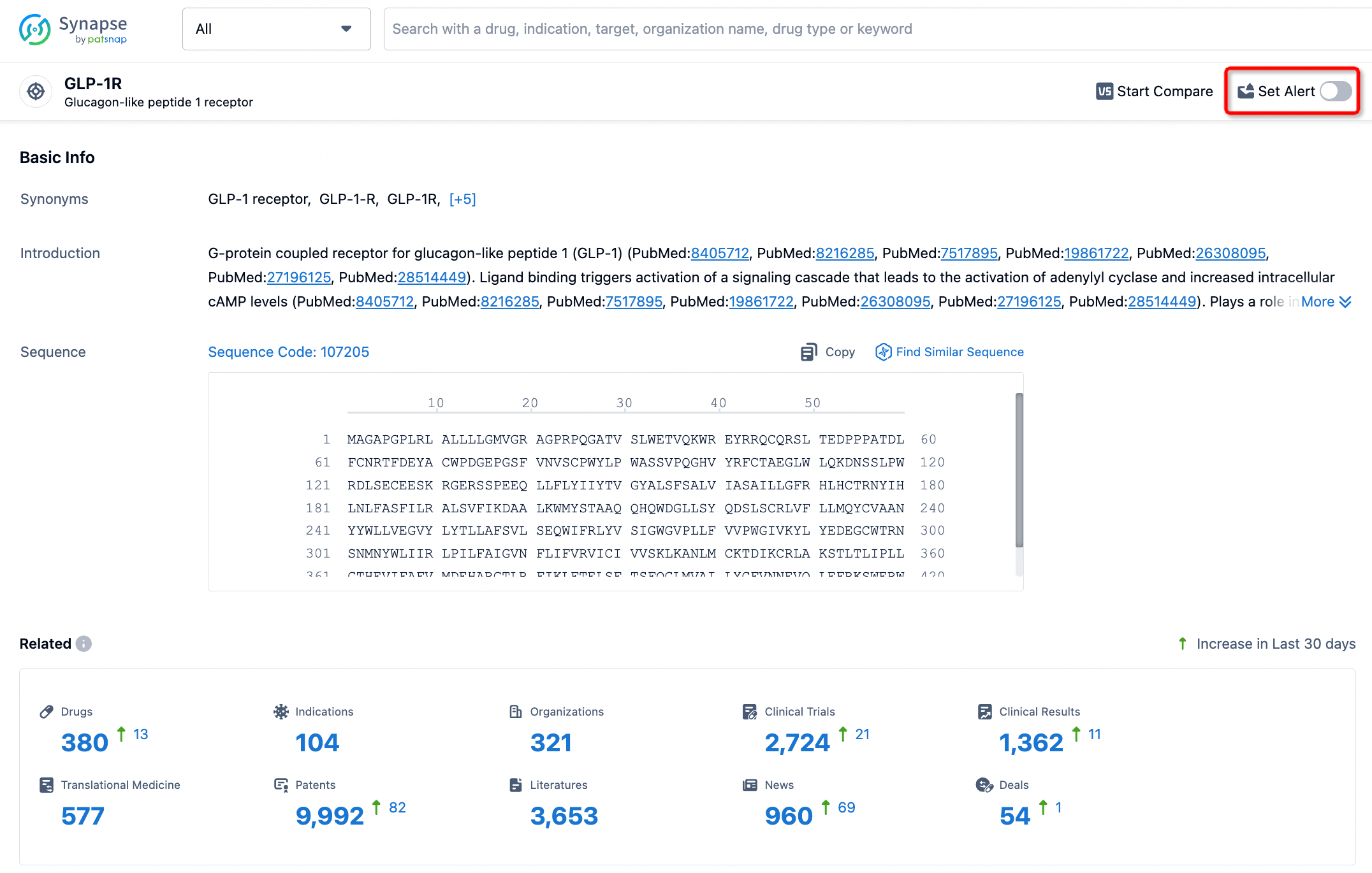
In the Synapse database, you can stay updated on the latest research and development advances of all targets. This service is accessible anytime and anywhere, with updates available daily or weekly. Use the "Set Alert" function to stay informed. Click on the image below to embark on a brand new journey of drug discovery!


AI Agents Built for Biopharma Breakthroughs
Accelerate discovery. Empower decisions. Transform outcomes.
Get started for free today!
Accelerate Strategic R&D decision making with Synapse, PatSnap’s AI-powered Connected Innovation Intelligence Platform Built for Life Sciences Professionals.
Start your data trial now!
Synapse data is also accessible to external entities via APIs or data packages. Empower better decisions with the latest in pharmaceutical intelligence.