Request Demo
What are CTSA stimulators and how do they work?
25 June 2024
Introduction to CTSA Stimulators
In the rapidly evolving world of medical technology, CTSA stimulators have emerged as a significant innovation, promising to revolutionize patient care in numerous ways. CTSA, which stands for Central Transcranial Stimulation Apparatus, refers to a class of devices designed to stimulate specific areas of the brain through non-invasive means. These stimulators have gained attention for their potential to treat a variety of neurological and psychiatric conditions, offering new hope to patients and healthcare providers alike. In this blog post, we will explore the fundamentals of CTSA stimulators, their working mechanisms, and their diverse applications in modern medicine.
How Do CTSA Stimulators Work?
At their core, CTSA stimulators operate by delivering precise electrical impulses to targeted regions of the brain. This is achieved through a non-invasive interface, typically involving electrodes placed on the scalp. The basic principle behind these devices is to modulate neural activity, either by enhancing or inhibiting specific brain circuits. This modulation is achieved through carefully controlled parameters like frequency, intensity, and duration of the electrical stimuli.
The process begins with the mapping of the patient's brain to identify the regions responsible for the symptoms or conditions being treated. Advanced imaging techniques such as MRI or CT scans are often employed to obtain a detailed understanding of the brain's structure and functional areas. Once the target regions are identified, the CTSA stimulator is programmed to deliver electrical impulses in a manner that can alter neural activity in those specific areas.
The electrical impulses generated by the CTSA stimulator can influence neural activity in several ways. They can increase or decrease the firing rates of neurons, promote synaptic plasticity, and even encourage the release of neurotransmitters, depending on the parameters set by the medical professional. This ability to precisely influence brain function has opened up new avenues for treating conditions that were previously challenging to manage.
What Are CTSA Stimulators Used For?
CTSA stimulators have shown promise in treating a broad spectrum of neurological and psychiatric conditions. One of the most well-known applications is in the treatment of depression. Many patients with treatment-resistant depression have found significant relief through the use of CTSA stimulators, which can target and modulate brain regions associated with mood regulation.
Another important application is in the management of chronic pain. Patients suffering from conditions like fibromyalgia, neuropathic pain, and migraines have benefited from CTSA stimulation, as it can disrupt pain signals and reduce their perception. This offers a non-pharmacological alternative for pain management, which is particularly valuable given the growing concerns about opioid addiction and the side effects of pain medications.
CTSA stimulators are also being explored as a treatment for neurological disorders such as epilepsy, Parkinson's disease, and multiple sclerosis. In epilepsy, for instance, these devices can be used to reduce the frequency and severity of seizures by modulating the neural circuits involved in seizure generation. In Parkinson's disease, CTSA stimulation can help alleviate motor symptoms by targeting the basal ganglia, a group of nuclei in the brain associated with movement regulation.
Beyond these applications, CTSA stimulators are being investigated for their potential in cognitive enhancement and rehabilitation. For patients with stroke or traumatic brain injury, these devices can aid in neurorehabilitation by promoting neural plasticity and recovery. There is also growing interest in using CTSA stimulation to enhance cognitive functions such as memory, attention, and learning in both clinical and non-clinical populations.
In conclusion, CTSA stimulators represent a cutting-edge advancement in medical technology, offering new possibilities for the treatment of a wide range of conditions. By harnessing the power of electrical stimulation to modulate brain activity, these devices provide a non-invasive, targeted approach to managing neurological and psychiatric disorders, alleviating chronic pain, and enhancing cognitive functions. As research continues and our understanding of the brain deepens, the potential applications of CTSA stimulators will likely expand, bringing new hope and improved quality of life to countless individuals.
In the rapidly evolving world of medical technology, CTSA stimulators have emerged as a significant innovation, promising to revolutionize patient care in numerous ways. CTSA, which stands for Central Transcranial Stimulation Apparatus, refers to a class of devices designed to stimulate specific areas of the brain through non-invasive means. These stimulators have gained attention for their potential to treat a variety of neurological and psychiatric conditions, offering new hope to patients and healthcare providers alike. In this blog post, we will explore the fundamentals of CTSA stimulators, their working mechanisms, and their diverse applications in modern medicine.
How Do CTSA Stimulators Work?
At their core, CTSA stimulators operate by delivering precise electrical impulses to targeted regions of the brain. This is achieved through a non-invasive interface, typically involving electrodes placed on the scalp. The basic principle behind these devices is to modulate neural activity, either by enhancing or inhibiting specific brain circuits. This modulation is achieved through carefully controlled parameters like frequency, intensity, and duration of the electrical stimuli.
The process begins with the mapping of the patient's brain to identify the regions responsible for the symptoms or conditions being treated. Advanced imaging techniques such as MRI or CT scans are often employed to obtain a detailed understanding of the brain's structure and functional areas. Once the target regions are identified, the CTSA stimulator is programmed to deliver electrical impulses in a manner that can alter neural activity in those specific areas.
The electrical impulses generated by the CTSA stimulator can influence neural activity in several ways. They can increase or decrease the firing rates of neurons, promote synaptic plasticity, and even encourage the release of neurotransmitters, depending on the parameters set by the medical professional. This ability to precisely influence brain function has opened up new avenues for treating conditions that were previously challenging to manage.
What Are CTSA Stimulators Used For?
CTSA stimulators have shown promise in treating a broad spectrum of neurological and psychiatric conditions. One of the most well-known applications is in the treatment of depression. Many patients with treatment-resistant depression have found significant relief through the use of CTSA stimulators, which can target and modulate brain regions associated with mood regulation.
Another important application is in the management of chronic pain. Patients suffering from conditions like fibromyalgia, neuropathic pain, and migraines have benefited from CTSA stimulation, as it can disrupt pain signals and reduce their perception. This offers a non-pharmacological alternative for pain management, which is particularly valuable given the growing concerns about opioid addiction and the side effects of pain medications.
CTSA stimulators are also being explored as a treatment for neurological disorders such as epilepsy, Parkinson's disease, and multiple sclerosis. In epilepsy, for instance, these devices can be used to reduce the frequency and severity of seizures by modulating the neural circuits involved in seizure generation. In Parkinson's disease, CTSA stimulation can help alleviate motor symptoms by targeting the basal ganglia, a group of nuclei in the brain associated with movement regulation.
Beyond these applications, CTSA stimulators are being investigated for their potential in cognitive enhancement and rehabilitation. For patients with stroke or traumatic brain injury, these devices can aid in neurorehabilitation by promoting neural plasticity and recovery. There is also growing interest in using CTSA stimulation to enhance cognitive functions such as memory, attention, and learning in both clinical and non-clinical populations.
In conclusion, CTSA stimulators represent a cutting-edge advancement in medical technology, offering new possibilities for the treatment of a wide range of conditions. By harnessing the power of electrical stimulation to modulate brain activity, these devices provide a non-invasive, targeted approach to managing neurological and psychiatric disorders, alleviating chronic pain, and enhancing cognitive functions. As research continues and our understanding of the brain deepens, the potential applications of CTSA stimulators will likely expand, bringing new hope and improved quality of life to countless individuals.
How to obtain the latest development progress of all targets?
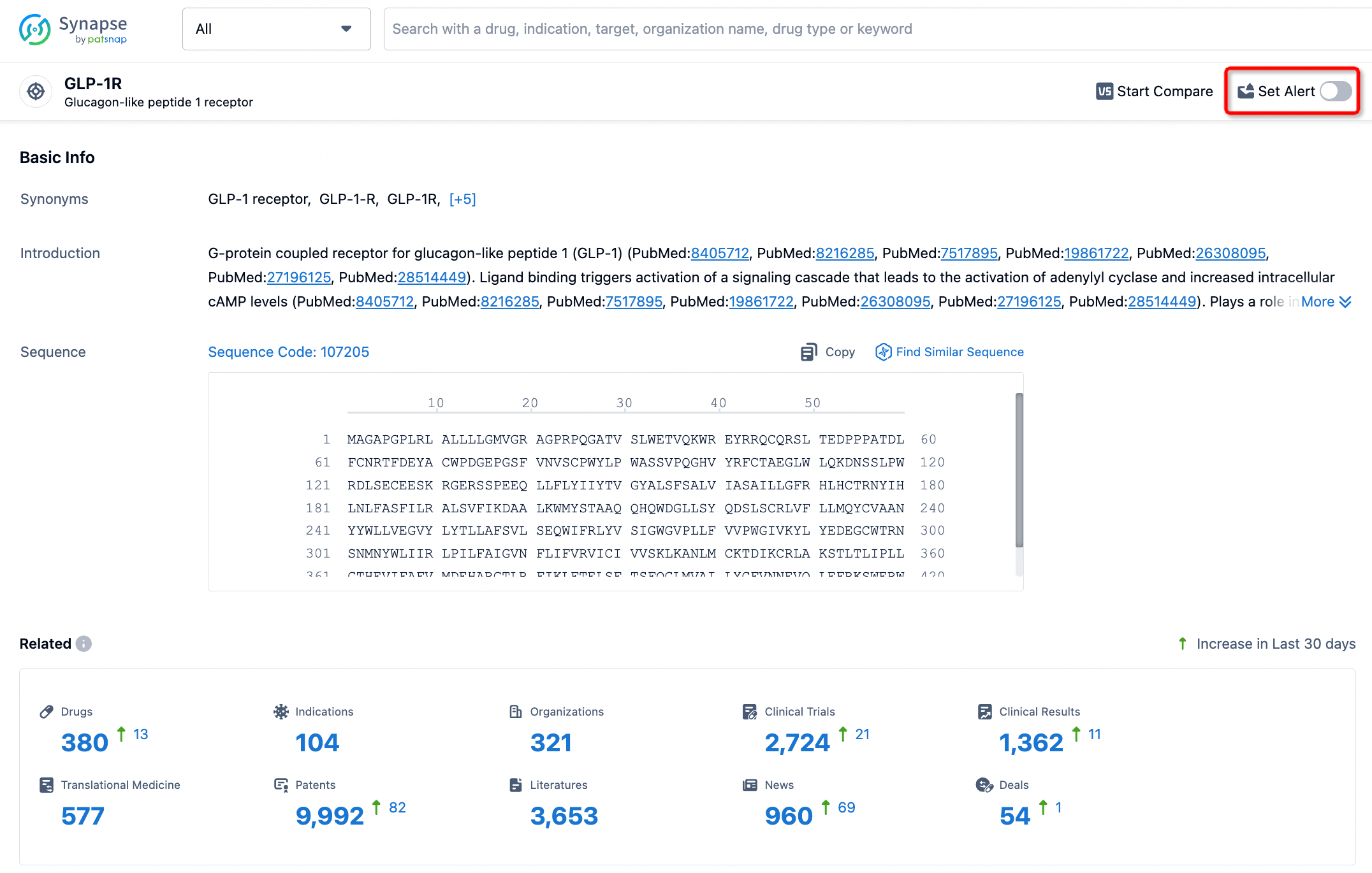
In the Synapse database, you can stay updated on the latest research and development advances of all targets. This service is accessible anytime and anywhere, with updates available daily or weekly. Use the "Set Alert" function to stay informed. Click on the image below to embark on a brand new journey of drug discovery!


AI Agents Built for Biopharma Breakthroughs
Accelerate discovery. Empower decisions. Transform outcomes.
Get started for free today!
Accelerate Strategic R&D decision making with Synapse, PatSnap’s AI-powered Connected Innovation Intelligence Platform Built for Life Sciences Professionals.
Start your data trial now!
Synapse data is also accessible to external entities via APIs or data packages. Empower better decisions with the latest in pharmaceutical intelligence.