Request Demo
What are GPR38 agonists and how do they work?
21 June 2024
GPR38 agonists represent a fascinating and rapidly evolving area of pharmacology with the potential to unlock new therapeutic avenues for various conditions. GPR38, also known as G protein-coupled receptor 38, is a member of the vast GPCR family, which plays a critical role in transmitting signals from outside the cell to the interior, thereby influencing a multitude of physiological processes. This blog post will delve into the mechanisms of GPR38 agonists, their potential therapeutic applications, and the promise they hold for future medical advancements.
GPR38 is a receptor that, like other GPCRs, is embedded in the cell membrane. When a ligand—such as a hormone, neurotransmitter, or drug—binds to it, a conformational change occurs that activates G proteins inside the cell. These G proteins then initiate a cascade of intracellular events, ultimately leading to a specific cellular response. Agonists are compounds that bind to receptors and mimic the action of the natural ligand, thereby activating the receptor. In the case of GPR38 agonists, these molecules bind specifically to the GPR38 receptor and induce its activity.
GPR38 agonists work by binding to the GPR38 receptor, which triggers a series of intracellular signaling pathways. One of the primary pathways activated by GPR38 agonists involves the increase of cyclic AMP (cAMP) levels. cAMP is a secondary messenger that plays a pivotal role in cellular responses, including the regulation of metabolism, gene transcription, and cell growth. By increasing cAMP levels, GPR38 agonists can modulate various physiological processes.
Additionally, GPR38 agonists can influence intracellular calcium levels. Calcium ions act as another secondary messenger involved in numerous cellular functions, such as muscle contraction, neurotransmitter release, and gene expression. By modulating calcium signaling, GPR38 agonists can potentially impact processes like smooth muscle relaxation and neuronal activity.
Moreover, like other GPCRs, GPR38 may also activate the mitogen-activated protein kinase (MAPK) pathway. This signaling cascade is involved in cell proliferation, differentiation, and stress responses. By engaging this pathway, GPR38 agonists could potentially influence cell survival and repair mechanisms.
The potential applications of GPR38 agonists are broad and still under investigation, but early research has indicated several promising areas. One of the most exciting areas of research involves gastrointestinal (GI) disorders. Given the role of GPCRs in the regulation of gut motility and secretion, GPR38 agonists may offer new therapeutic strategies for conditions like irritable bowel syndrome (IBS) and inflammatory bowel disease (IBD). By modulating the activity of GPR38, these agonists could help to normalize bowel function and reduce inflammation.
Another potential application is in the field of metabolic disorders. Since cAMP plays a crucial role in regulating metabolic pathways, GPR38 agonists might be useful in treating conditions such as obesity and type 2 diabetes. By influencing the signaling pathways that control glucose and lipid metabolism, these compounds could help to improve insulin sensitivity and promote weight loss.
Neurological disorders are another promising area for GPR38 agonists. GPCRs are well-known for their role in neurotransmission, and modulating GPR38 activity may have potential benefits for conditions like depression, anxiety, and neurodegenerative diseases. By influencing calcium signaling and other intracellular pathways, GPR38 agonists could help to restore normal brain function and protect against neuronal damage.
Finally, GPR38 agonists may have potential applications in cardiovascular diseases. GPCRs are involved in the regulation of heart rate and blood pressure, and by modulating GPR38 activity, these agonists could help manage conditions such as hypertension and heart failure. The ability of GPR38 agonists to influence smooth muscle relaxation and calcium signaling may be particularly beneficial in these contexts.
In summary, GPR38 agonists represent a promising area of research with potential applications in a variety of medical fields. By understanding how these compounds work and their potential uses, scientists and clinicians can continue to explore their therapeutic potential and develop new treatments for a range of conditions. As research progresses, GPR38 agonists may prove to be valuable tools in the quest to improve human health.
GPR38 is a receptor that, like other GPCRs, is embedded in the cell membrane. When a ligand—such as a hormone, neurotransmitter, or drug—binds to it, a conformational change occurs that activates G proteins inside the cell. These G proteins then initiate a cascade of intracellular events, ultimately leading to a specific cellular response. Agonists are compounds that bind to receptors and mimic the action of the natural ligand, thereby activating the receptor. In the case of GPR38 agonists, these molecules bind specifically to the GPR38 receptor and induce its activity.
GPR38 agonists work by binding to the GPR38 receptor, which triggers a series of intracellular signaling pathways. One of the primary pathways activated by GPR38 agonists involves the increase of cyclic AMP (cAMP) levels. cAMP is a secondary messenger that plays a pivotal role in cellular responses, including the regulation of metabolism, gene transcription, and cell growth. By increasing cAMP levels, GPR38 agonists can modulate various physiological processes.
Additionally, GPR38 agonists can influence intracellular calcium levels. Calcium ions act as another secondary messenger involved in numerous cellular functions, such as muscle contraction, neurotransmitter release, and gene expression. By modulating calcium signaling, GPR38 agonists can potentially impact processes like smooth muscle relaxation and neuronal activity.
Moreover, like other GPCRs, GPR38 may also activate the mitogen-activated protein kinase (MAPK) pathway. This signaling cascade is involved in cell proliferation, differentiation, and stress responses. By engaging this pathway, GPR38 agonists could potentially influence cell survival and repair mechanisms.
The potential applications of GPR38 agonists are broad and still under investigation, but early research has indicated several promising areas. One of the most exciting areas of research involves gastrointestinal (GI) disorders. Given the role of GPCRs in the regulation of gut motility and secretion, GPR38 agonists may offer new therapeutic strategies for conditions like irritable bowel syndrome (IBS) and inflammatory bowel disease (IBD). By modulating the activity of GPR38, these agonists could help to normalize bowel function and reduce inflammation.
Another potential application is in the field of metabolic disorders. Since cAMP plays a crucial role in regulating metabolic pathways, GPR38 agonists might be useful in treating conditions such as obesity and type 2 diabetes. By influencing the signaling pathways that control glucose and lipid metabolism, these compounds could help to improve insulin sensitivity and promote weight loss.
Neurological disorders are another promising area for GPR38 agonists. GPCRs are well-known for their role in neurotransmission, and modulating GPR38 activity may have potential benefits for conditions like depression, anxiety, and neurodegenerative diseases. By influencing calcium signaling and other intracellular pathways, GPR38 agonists could help to restore normal brain function and protect against neuronal damage.
Finally, GPR38 agonists may have potential applications in cardiovascular diseases. GPCRs are involved in the regulation of heart rate and blood pressure, and by modulating GPR38 activity, these agonists could help manage conditions such as hypertension and heart failure. The ability of GPR38 agonists to influence smooth muscle relaxation and calcium signaling may be particularly beneficial in these contexts.
In summary, GPR38 agonists represent a promising area of research with potential applications in a variety of medical fields. By understanding how these compounds work and their potential uses, scientists and clinicians can continue to explore their therapeutic potential and develop new treatments for a range of conditions. As research progresses, GPR38 agonists may prove to be valuable tools in the quest to improve human health.
How to obtain the latest development progress of all targets?
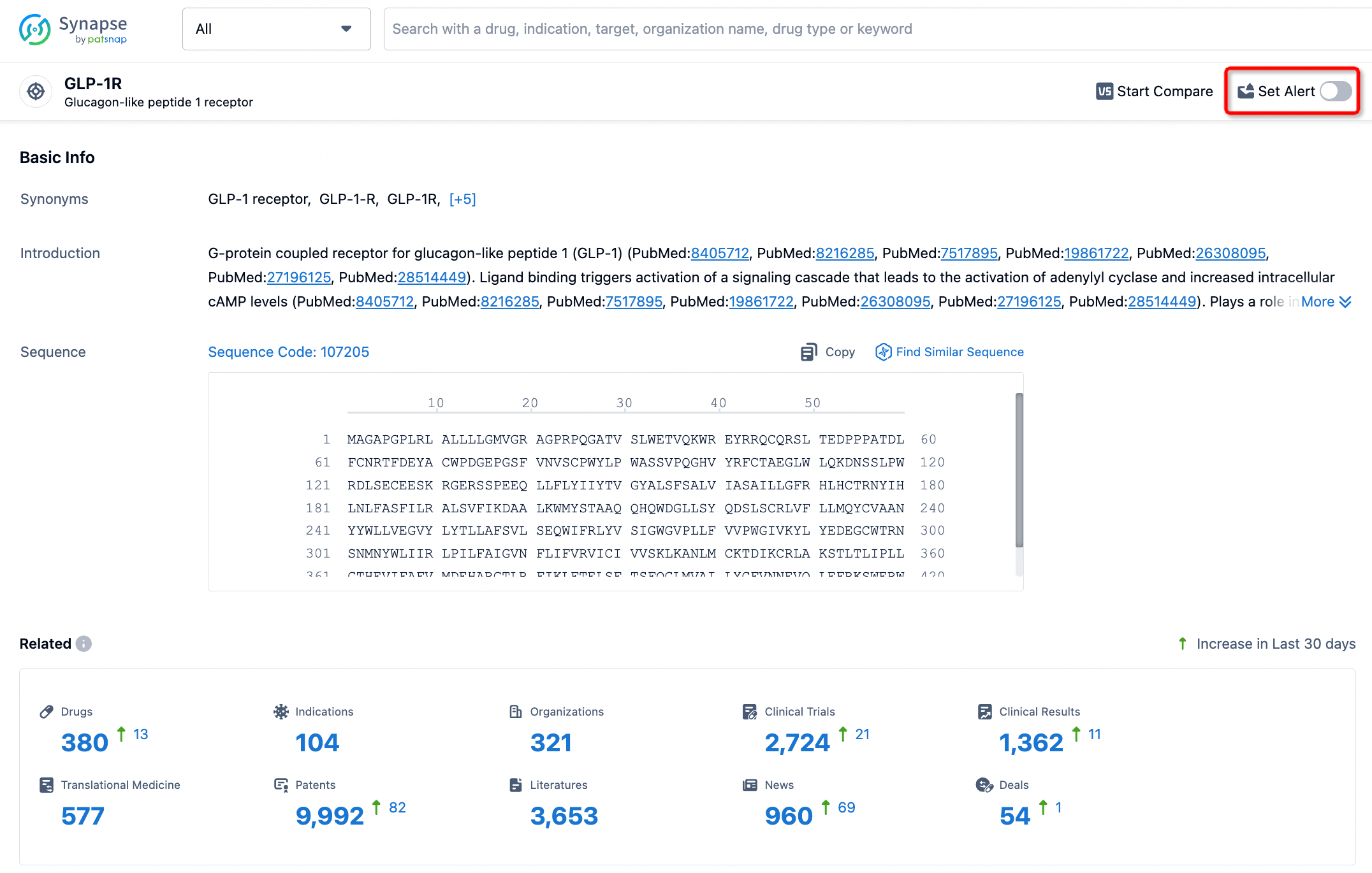
In the Synapse database, you can stay updated on the latest research and development advances of all targets. This service is accessible anytime and anywhere, with updates available daily or weekly. Use the "Set Alert" function to stay informed. Click on the image below to embark on a brand new journey of drug discovery!


AI Agents Built for Biopharma Breakthroughs
Accelerate discovery. Empower decisions. Transform outcomes.
Get started for free today!
Accelerate Strategic R&D decision making with Synapse, PatSnap’s AI-powered Connected Innovation Intelligence Platform Built for Life Sciences Professionals.
Start your data trial now!
Synapse data is also accessible to external entities via APIs or data packages. Empower better decisions with the latest in pharmaceutical intelligence.