Request Demo
What are KIR2DL2 antagonists and how do they work?
25 June 2024
Killer-cell Immunoglobulin-like Receptors (KIRs) are a group of receptors found on the surface of natural killer (NK) cells and some T cells. These receptors play a crucial role in regulating the immune system's response to infected or malignant cells. Among these, KIR2DL2 is an inhibitory receptor that binds to specific HLA-C molecules on target cells, sending inhibitory signals to NK cells and preventing them from destroying the target cells. KIR2DL2 antagonists are a novel class of therapeutic agents that aim to neutralize this inhibitory signal, thus enhancing the immune system's ability to fight cancer and other diseases.
KIR2DL2 antagonists work by blocking the interaction between the KIR2DL2 receptor and its corresponding ligand on target cells. Under normal circumstances, the binding of HLA-C molecules to KIR2DL2 transmits an inhibitory signal to NK cells, reducing their cytotoxic activity. By antagonizing KIR2DL2, these agents prevent this inhibitory interaction, thereby "releasing the brakes" on NK cells. This enables NK cells to maintain their cytotoxic activity against cancer cells or infected cells, leading to their destruction.
One of the fundamental mechanisms by which KIR2DL2 antagonists operate involves the disruption of the KIR2DL2-HLA-C binding. This disruption can be achieved through the use of monoclonal antibodies designed to specifically bind to the KIR2DL2 receptor. When these antibodies attach to KIR2DL2, they prevent HLA-C molecules from engaging with the receptor, thus blocking the inhibitory signal. Without this signal, NK cells remain active and capable of attacking tumor cells or cells infected with viruses.
KIR2DL2 antagonists can also enhance the activity of other immune cells. For example, by blocking the inhibitory signals on NK cells, these antagonists can promote the production of cytokines and chemokines, which are crucial for the recruitment and activation of other immune cells, such as T cells and macrophages. This cascade of immune activation can result in a more robust and coordinated immune response against cancer or infections.
The most prominent use of KIR2DL2 antagonists is in the realm of cancer immunotherapy. Cancer cells often exploit the inhibitory pathways of the immune system to evade detection and destruction. By expressing specific HLA-C molecules, they can engage with KIR2DL2 on NK cells and inhibit their cytotoxic activity. KIR2DL2 antagonists can counteract this immune evasion strategy, allowing NK cells to target and kill cancer cells more effectively.
Several clinical trials are currently underway to evaluate the efficacy and safety of KIR2DL2 antagonists in various types of cancer, including leukemia, lymphoma, and solid tumors. Preliminary data from these trials are promising, showing enhanced NK cell activity and improved tumor control in patients treated with KIR2DL2 antagonists. These findings underscore the potential of KIR2DL2 antagonists as a valuable addition to the arsenal of cancer immunotherapies.
Beyond cancer, KIR2DL2 antagonists may also have applications in infectious diseases. Certain viruses, such as cytomegalovirus (CMV) and Epstein-Barr virus (EBV), can manipulate the expression of HLA molecules to evade immune detection. By blocking the inhibitory signals from KIR2DL2, antagonists can enhance the immune system's ability to detect and eliminate virus-infected cells. This approach holds promise for the treatment of chronic viral infections and may provide an alternative strategy to conventional antiviral therapies.
In addition to their potential in cancer and infectious diseases, KIR2DL2 antagonists are being explored for their role in transplantation. The mismatch of HLA molecules between donors and recipients can lead to transplant rejection or graft-versus-host disease. By modulating the activity of NK cells through KIR2DL2 antagonists, it may be possible to improve transplant outcomes and reduce the incidence of immune-related complications.
In conclusion, KIR2DL2 antagonists represent a promising new class of therapeutic agents with the potential to enhance immune responses against cancer, infectious diseases, and complications arising from transplantation. By blocking the inhibitory signals that dampen NK cell activity, these antagonists offer a novel approach to boosting the body's natural defenses. As research and clinical trials continue to advance, KIR2DL2 antagonists may soon become an integral part of the therapeutic landscape, providing new hope for patients with challenging medical conditions.
KIR2DL2 antagonists work by blocking the interaction between the KIR2DL2 receptor and its corresponding ligand on target cells. Under normal circumstances, the binding of HLA-C molecules to KIR2DL2 transmits an inhibitory signal to NK cells, reducing their cytotoxic activity. By antagonizing KIR2DL2, these agents prevent this inhibitory interaction, thereby "releasing the brakes" on NK cells. This enables NK cells to maintain their cytotoxic activity against cancer cells or infected cells, leading to their destruction.
One of the fundamental mechanisms by which KIR2DL2 antagonists operate involves the disruption of the KIR2DL2-HLA-C binding. This disruption can be achieved through the use of monoclonal antibodies designed to specifically bind to the KIR2DL2 receptor. When these antibodies attach to KIR2DL2, they prevent HLA-C molecules from engaging with the receptor, thus blocking the inhibitory signal. Without this signal, NK cells remain active and capable of attacking tumor cells or cells infected with viruses.
KIR2DL2 antagonists can also enhance the activity of other immune cells. For example, by blocking the inhibitory signals on NK cells, these antagonists can promote the production of cytokines and chemokines, which are crucial for the recruitment and activation of other immune cells, such as T cells and macrophages. This cascade of immune activation can result in a more robust and coordinated immune response against cancer or infections.
The most prominent use of KIR2DL2 antagonists is in the realm of cancer immunotherapy. Cancer cells often exploit the inhibitory pathways of the immune system to evade detection and destruction. By expressing specific HLA-C molecules, they can engage with KIR2DL2 on NK cells and inhibit their cytotoxic activity. KIR2DL2 antagonists can counteract this immune evasion strategy, allowing NK cells to target and kill cancer cells more effectively.
Several clinical trials are currently underway to evaluate the efficacy and safety of KIR2DL2 antagonists in various types of cancer, including leukemia, lymphoma, and solid tumors. Preliminary data from these trials are promising, showing enhanced NK cell activity and improved tumor control in patients treated with KIR2DL2 antagonists. These findings underscore the potential of KIR2DL2 antagonists as a valuable addition to the arsenal of cancer immunotherapies.
Beyond cancer, KIR2DL2 antagonists may also have applications in infectious diseases. Certain viruses, such as cytomegalovirus (CMV) and Epstein-Barr virus (EBV), can manipulate the expression of HLA molecules to evade immune detection. By blocking the inhibitory signals from KIR2DL2, antagonists can enhance the immune system's ability to detect and eliminate virus-infected cells. This approach holds promise for the treatment of chronic viral infections and may provide an alternative strategy to conventional antiviral therapies.
In addition to their potential in cancer and infectious diseases, KIR2DL2 antagonists are being explored for their role in transplantation. The mismatch of HLA molecules between donors and recipients can lead to transplant rejection or graft-versus-host disease. By modulating the activity of NK cells through KIR2DL2 antagonists, it may be possible to improve transplant outcomes and reduce the incidence of immune-related complications.
In conclusion, KIR2DL2 antagonists represent a promising new class of therapeutic agents with the potential to enhance immune responses against cancer, infectious diseases, and complications arising from transplantation. By blocking the inhibitory signals that dampen NK cell activity, these antagonists offer a novel approach to boosting the body's natural defenses. As research and clinical trials continue to advance, KIR2DL2 antagonists may soon become an integral part of the therapeutic landscape, providing new hope for patients with challenging medical conditions.
How to obtain the latest development progress of all targets?
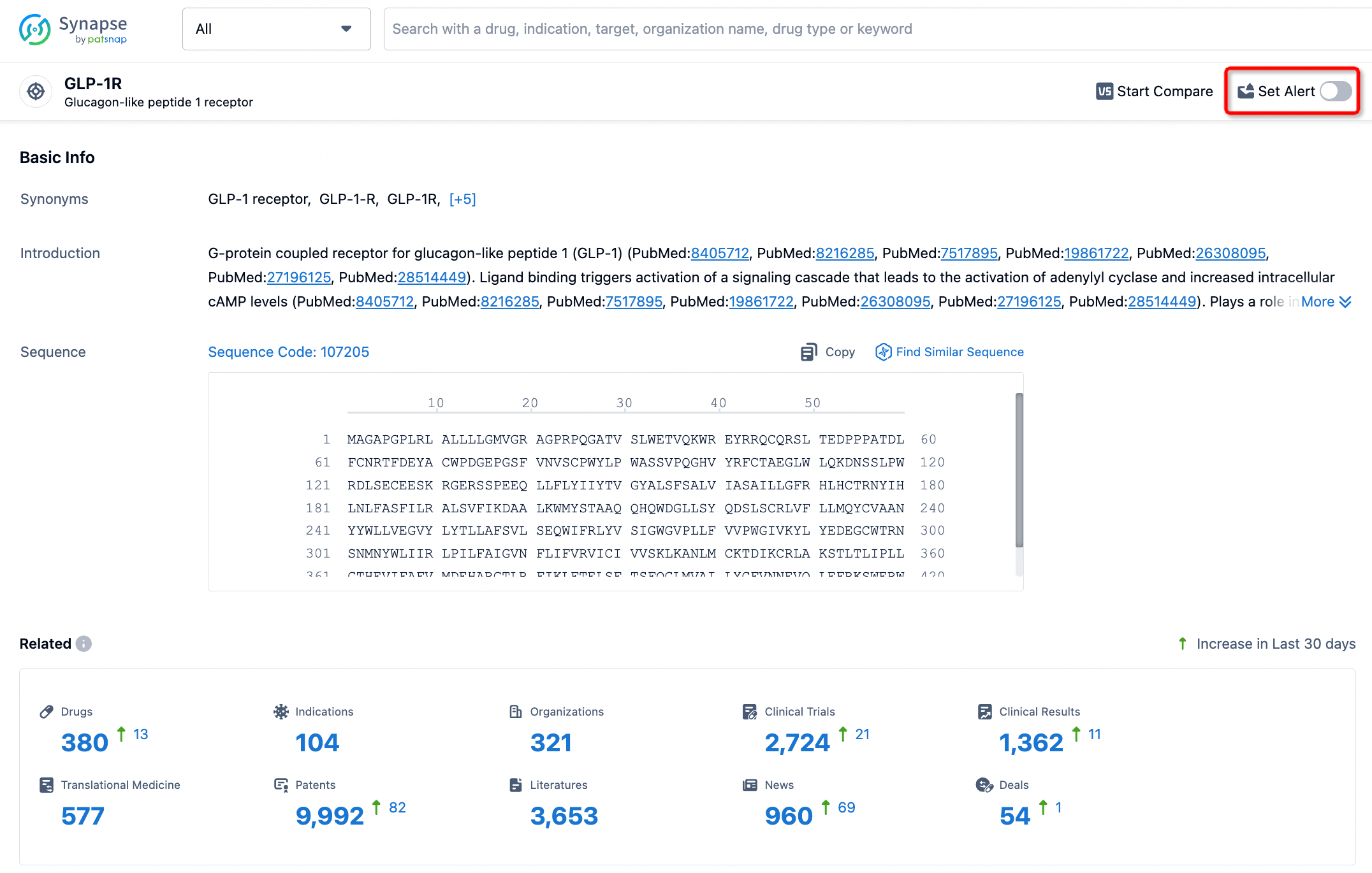
In the Synapse database, you can stay updated on the latest research and development advances of all targets. This service is accessible anytime and anywhere, with updates available daily or weekly. Use the "Set Alert" function to stay informed. Click on the image below to embark on a brand new journey of drug discovery!


AI Agents Built for Biopharma Breakthroughs
Accelerate discovery. Empower decisions. Transform outcomes.
Get started for free today!
Accelerate Strategic R&D decision making with Synapse, PatSnap’s AI-powered Connected Innovation Intelligence Platform Built for Life Sciences Professionals.
Start your data trial now!
Synapse data is also accessible to external entities via APIs or data packages. Empower better decisions with the latest in pharmaceutical intelligence.