Request Demo
What are MYC stimulants and how do they work?
25 June 2024
MYC stimulants have become a focal point in both scientific research and clinical applications due to their profound impact on cellular functions. Understanding MYC stimulants is crucial for grasping their potential in various medical and research settings. This article delves into what MYC stimulants are, how they work, and their diverse applications in modern medicine and research.
MYC stimulants are compounds that enhance the activity of the MYC gene, a well-known regulator of gene expression, cellular growth, and differentiation. The MYC gene, a member of the family of oncogenes, plays a pivotal role in controlling numerous biological processes. When activated, MYC proteins bind to DNA and regulate the transcription of various genes involved in cell proliferation, metabolism, and apoptosis. MYC stimulants thus hold significant promise for influencing these critical pathways, making them valuable tools in both research and therapeutic contexts.
The mechanism by which MYC stimulants work is deeply rooted in their ability to modulate the activity of the MYC protein. Typically, MYC proteins are tightly regulated within cells to ensure proper cellular function. However, when MYC stimulants are introduced, they enhance the transcriptional activity of MYC by either increasing its expression or stabilizing the protein, thereby prolonging its activity. This boost in MYC activity can lead to a substantial increase in the expression of downstream target genes, which are responsible for various cellular functions.
MYC stimulants operate through several pathways. One primary mechanism is the stabilization of the MYC protein, which normally has a very short half-life. Certain stimulants inhibit the degradation pathways of MYC, thus preserving the protein and extending its activity period. Others may increase the transcription of the MYC gene itself, thereby producing more MYC protein to carry out its functions. Yet another method involves enhancing the binding affinity of MYC to its target DNA sequences, amplifying its effect on gene expression.
The applications of MYC stimulants are broad and varied, reflecting their central role in regulating critical cellular processes. In the realm of cancer research, MYC stimulants are of particular interest due to the MYC gene's well-documented involvement in numerous forms of cancer. Many cancers exhibit dysregulated MYC activity, leading to uncontrolled cell growth and proliferation. By understanding how MYC stimulants affect these pathways, researchers can develop targeted therapies aimed at modulating MYC activity to inhibit cancer progression.
Beyond cancer, MYC stimulants are also being explored for their potential in regenerative medicine. The ability of MYC to promote cell proliferation and differentiation makes these stimulants attractive candidates for tissue engineering and wound healing applications. For instance, in stem cell research, MYC stimulants can potentially enhance the proliferation of stem cells, thereby accelerating tissue regeneration and repair.
Moreover, MYC stimulants are useful tools in basic scientific research, particularly in studies investigating gene regulation and cellular metabolism. By manipulating MYC activity, scientists can gain insights into the intricate networks of gene expression and cellular function. This knowledge can then be translated into a better understanding of various diseases and the development of novel therapeutic strategies.
In conclusion, MYC stimulants represent a powerful class of compounds with significant implications for both research and clinical practice. By enhancing the activity of the MYC gene, these stimulants can influence a range of cellular processes, from proliferation and differentiation to metabolism and apoptosis. Their applications are vast, spanning cancer therapy, regenerative medicine, and basic scientific research. As our understanding of MYC and its stimulants continues to grow, so too does the potential for groundbreaking advancements in health and medicine.
MYC stimulants are compounds that enhance the activity of the MYC gene, a well-known regulator of gene expression, cellular growth, and differentiation. The MYC gene, a member of the family of oncogenes, plays a pivotal role in controlling numerous biological processes. When activated, MYC proteins bind to DNA and regulate the transcription of various genes involved in cell proliferation, metabolism, and apoptosis. MYC stimulants thus hold significant promise for influencing these critical pathways, making them valuable tools in both research and therapeutic contexts.
The mechanism by which MYC stimulants work is deeply rooted in their ability to modulate the activity of the MYC protein. Typically, MYC proteins are tightly regulated within cells to ensure proper cellular function. However, when MYC stimulants are introduced, they enhance the transcriptional activity of MYC by either increasing its expression or stabilizing the protein, thereby prolonging its activity. This boost in MYC activity can lead to a substantial increase in the expression of downstream target genes, which are responsible for various cellular functions.
MYC stimulants operate through several pathways. One primary mechanism is the stabilization of the MYC protein, which normally has a very short half-life. Certain stimulants inhibit the degradation pathways of MYC, thus preserving the protein and extending its activity period. Others may increase the transcription of the MYC gene itself, thereby producing more MYC protein to carry out its functions. Yet another method involves enhancing the binding affinity of MYC to its target DNA sequences, amplifying its effect on gene expression.
The applications of MYC stimulants are broad and varied, reflecting their central role in regulating critical cellular processes. In the realm of cancer research, MYC stimulants are of particular interest due to the MYC gene's well-documented involvement in numerous forms of cancer. Many cancers exhibit dysregulated MYC activity, leading to uncontrolled cell growth and proliferation. By understanding how MYC stimulants affect these pathways, researchers can develop targeted therapies aimed at modulating MYC activity to inhibit cancer progression.
Beyond cancer, MYC stimulants are also being explored for their potential in regenerative medicine. The ability of MYC to promote cell proliferation and differentiation makes these stimulants attractive candidates for tissue engineering and wound healing applications. For instance, in stem cell research, MYC stimulants can potentially enhance the proliferation of stem cells, thereby accelerating tissue regeneration and repair.
Moreover, MYC stimulants are useful tools in basic scientific research, particularly in studies investigating gene regulation and cellular metabolism. By manipulating MYC activity, scientists can gain insights into the intricate networks of gene expression and cellular function. This knowledge can then be translated into a better understanding of various diseases and the development of novel therapeutic strategies.
In conclusion, MYC stimulants represent a powerful class of compounds with significant implications for both research and clinical practice. By enhancing the activity of the MYC gene, these stimulants can influence a range of cellular processes, from proliferation and differentiation to metabolism and apoptosis. Their applications are vast, spanning cancer therapy, regenerative medicine, and basic scientific research. As our understanding of MYC and its stimulants continues to grow, so too does the potential for groundbreaking advancements in health and medicine.
How to obtain the latest development progress of all targets?
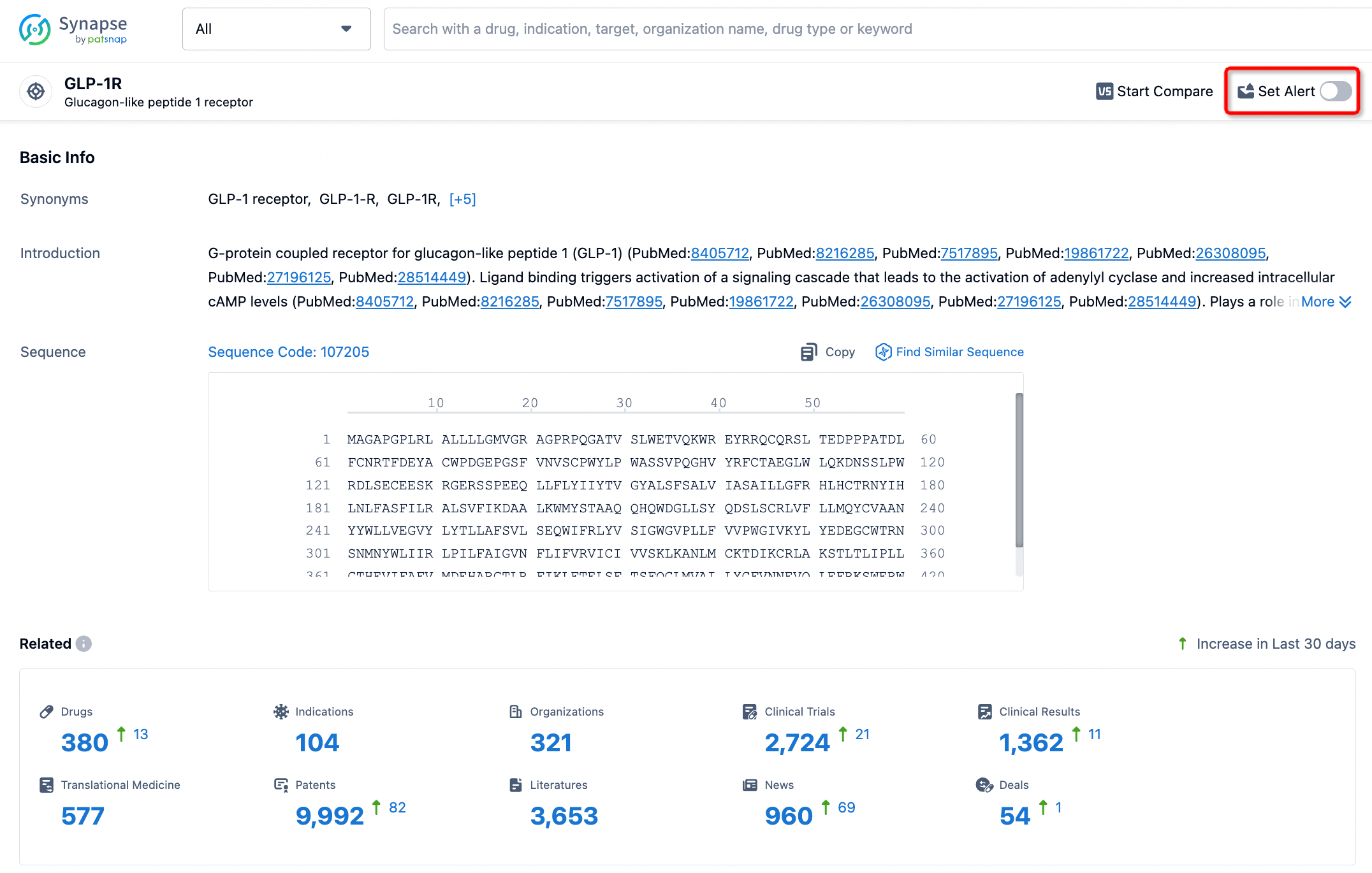
In the Synapse database, you can stay updated on the latest research and development advances of all targets. This service is accessible anytime and anywhere, with updates available daily or weekly. Use the "Set Alert" function to stay informed. Click on the image below to embark on a brand new journey of drug discovery!


AI Agents Built for Biopharma Breakthroughs
Accelerate discovery. Empower decisions. Transform outcomes.
Get started for free today!
Accelerate Strategic R&D decision making with Synapse, PatSnap’s AI-powered Connected Innovation Intelligence Platform Built for Life Sciences Professionals.
Start your data trial now!
Synapse data is also accessible to external entities via APIs or data packages. Empower better decisions with the latest in pharmaceutical intelligence.