Request Demo
What are PRG4 modulators and how do they work?
21 June 2024
In recent years, the spotlight has increasingly shone on PRG4 modulators, a promising class of therapeutic agents with potential applications in various medical fields. PRG4, or proteoglycan 4, is a glycoprotein primarily known for its role in lubricating and protecting joint surfaces. This article delves into the nature of PRG4 modulators, how they work, and their potential uses.
PRG4, also known as lubricin, is pivotal for maintaining joint health. It is primarily secreted by synovial lining cells and chondrocytes in articular cartilage, where it forms a critical part of the synovial fluid. This fluid ensures smooth joint movement and reduces friction between articulating surfaces. Given its essential role in joint mechanics, any imbalance in the production or function of PRG4 can lead to degenerative joint diseases, such as osteoarthritis. This has led scientists to explore ways to modulate PRG4 levels and activity as a therapeutic strategy.
PRG4 modulators work by either enhancing or inhibiting the production or function of PRG4, depending on the desired therapeutic outcome. These modulators can be small molecules, peptides, or even gene therapy approaches aimed at regulating the expression of the PRG4 gene. The primary mechanism through which these agents function involves upregulating the synthesis of PRG4 in cells that naturally produce it or mimicking its action in the synovial fluid.
Some PRG4 modulators may work by directly binding to the PRG4 protein, stabilizing its structure and function. Others might interact with cellular pathways that control PRG4 secretion, thereby increasing its levels in the joint space. Recent advances in biotechnology have also enabled the development of gene therapies that can deliver a functional copy of the PRG4 gene to cells, thereby correcting any underlying genetic deficiencies.
The versatility of PRG4 modulators makes them suitable for a range of applications. One of the most promising avenues is in the treatment of osteoarthritis. This degenerative joint disease is characterized by the breakdown of cartilage and synovial fluid, leading to pain, stiffness, and reduced mobility. By boosting PRG4 levels, these modulators can help restore the natural lubrication of the joints, alleviating symptoms and potentially slowing disease progression.
Beyond osteoarthritis, PRG4 modulators hold promise in treating other joint disorders such as rheumatoid arthritis, a condition marked by chronic inflammation and joint damage. In this context, PRG4 modulators may not only act as lubricants but also possess anti-inflammatory properties, offering a dual benefit. Furthermore, these modulators could be beneficial in sports medicine, providing relief and promoting recovery in athletes suffering from joint injuries.
Another exciting application of PRG4 modulators is in ophthalmology. The ocular surface is another area where lubrication is crucial, and PRG4 is present in tears, contributing to eye comfort and health. PRG4 modulators could be developed into eye drops or other formulations to treat dry eye syndrome, a common condition that can cause significant discomfort and visual disturbances.
Moreover, emerging research suggests that PRG4 modulators could have applications in managing conditions beyond joints and eyes. For instance, the anti-adhesive properties of PRG4 may be harnessed to prevent post-surgical adhesions, where tissues stick together abnormally after surgery, leading to complications. There is also potential for PRG4 modulators to play a role in cancer treatment, particularly in preventing the spread of cancer cells by inhibiting their adhesion to other tissues.
In conclusion, PRG4 modulators represent a versatile and promising class of therapeutic agents with applications spanning from joint and eye health to potentially broader medical conditions. By enhancing or mimicking the action of this vital glycoprotein, these modulators offer new hope for patients suffering from a range of debilitating conditions. As research progresses, we can expect to see more innovative applications and formulations of PRG4 modulators, paving the way for improved therapeutic outcomes in various fields of medicine.
PRG4, also known as lubricin, is pivotal for maintaining joint health. It is primarily secreted by synovial lining cells and chondrocytes in articular cartilage, where it forms a critical part of the synovial fluid. This fluid ensures smooth joint movement and reduces friction between articulating surfaces. Given its essential role in joint mechanics, any imbalance in the production or function of PRG4 can lead to degenerative joint diseases, such as osteoarthritis. This has led scientists to explore ways to modulate PRG4 levels and activity as a therapeutic strategy.
PRG4 modulators work by either enhancing or inhibiting the production or function of PRG4, depending on the desired therapeutic outcome. These modulators can be small molecules, peptides, or even gene therapy approaches aimed at regulating the expression of the PRG4 gene. The primary mechanism through which these agents function involves upregulating the synthesis of PRG4 in cells that naturally produce it or mimicking its action in the synovial fluid.
Some PRG4 modulators may work by directly binding to the PRG4 protein, stabilizing its structure and function. Others might interact with cellular pathways that control PRG4 secretion, thereby increasing its levels in the joint space. Recent advances in biotechnology have also enabled the development of gene therapies that can deliver a functional copy of the PRG4 gene to cells, thereby correcting any underlying genetic deficiencies.
The versatility of PRG4 modulators makes them suitable for a range of applications. One of the most promising avenues is in the treatment of osteoarthritis. This degenerative joint disease is characterized by the breakdown of cartilage and synovial fluid, leading to pain, stiffness, and reduced mobility. By boosting PRG4 levels, these modulators can help restore the natural lubrication of the joints, alleviating symptoms and potentially slowing disease progression.
Beyond osteoarthritis, PRG4 modulators hold promise in treating other joint disorders such as rheumatoid arthritis, a condition marked by chronic inflammation and joint damage. In this context, PRG4 modulators may not only act as lubricants but also possess anti-inflammatory properties, offering a dual benefit. Furthermore, these modulators could be beneficial in sports medicine, providing relief and promoting recovery in athletes suffering from joint injuries.
Another exciting application of PRG4 modulators is in ophthalmology. The ocular surface is another area where lubrication is crucial, and PRG4 is present in tears, contributing to eye comfort and health. PRG4 modulators could be developed into eye drops or other formulations to treat dry eye syndrome, a common condition that can cause significant discomfort and visual disturbances.
Moreover, emerging research suggests that PRG4 modulators could have applications in managing conditions beyond joints and eyes. For instance, the anti-adhesive properties of PRG4 may be harnessed to prevent post-surgical adhesions, where tissues stick together abnormally after surgery, leading to complications. There is also potential for PRG4 modulators to play a role in cancer treatment, particularly in preventing the spread of cancer cells by inhibiting their adhesion to other tissues.
In conclusion, PRG4 modulators represent a versatile and promising class of therapeutic agents with applications spanning from joint and eye health to potentially broader medical conditions. By enhancing or mimicking the action of this vital glycoprotein, these modulators offer new hope for patients suffering from a range of debilitating conditions. As research progresses, we can expect to see more innovative applications and formulations of PRG4 modulators, paving the way for improved therapeutic outcomes in various fields of medicine.
How to obtain the latest development progress of all targets?
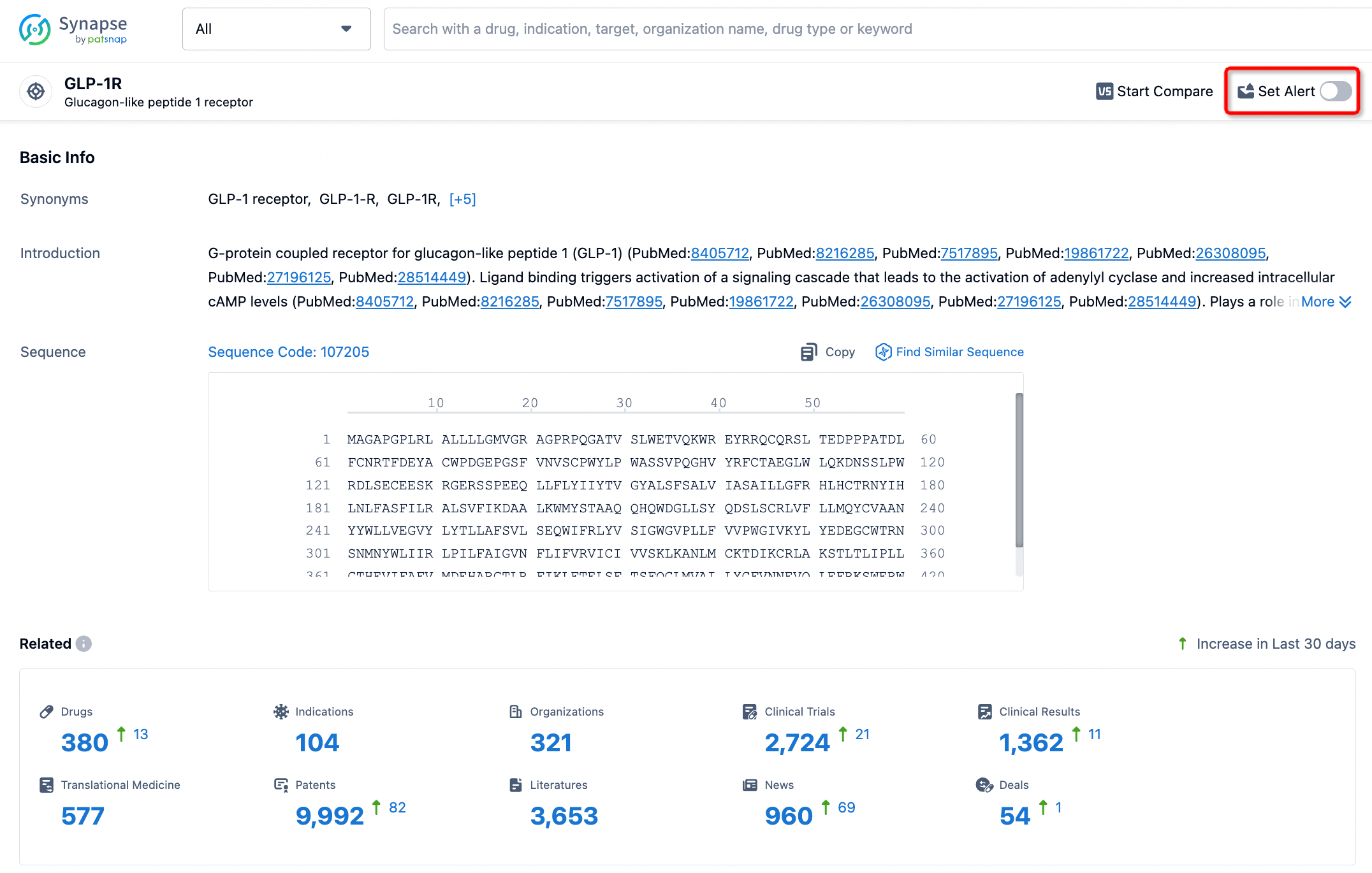
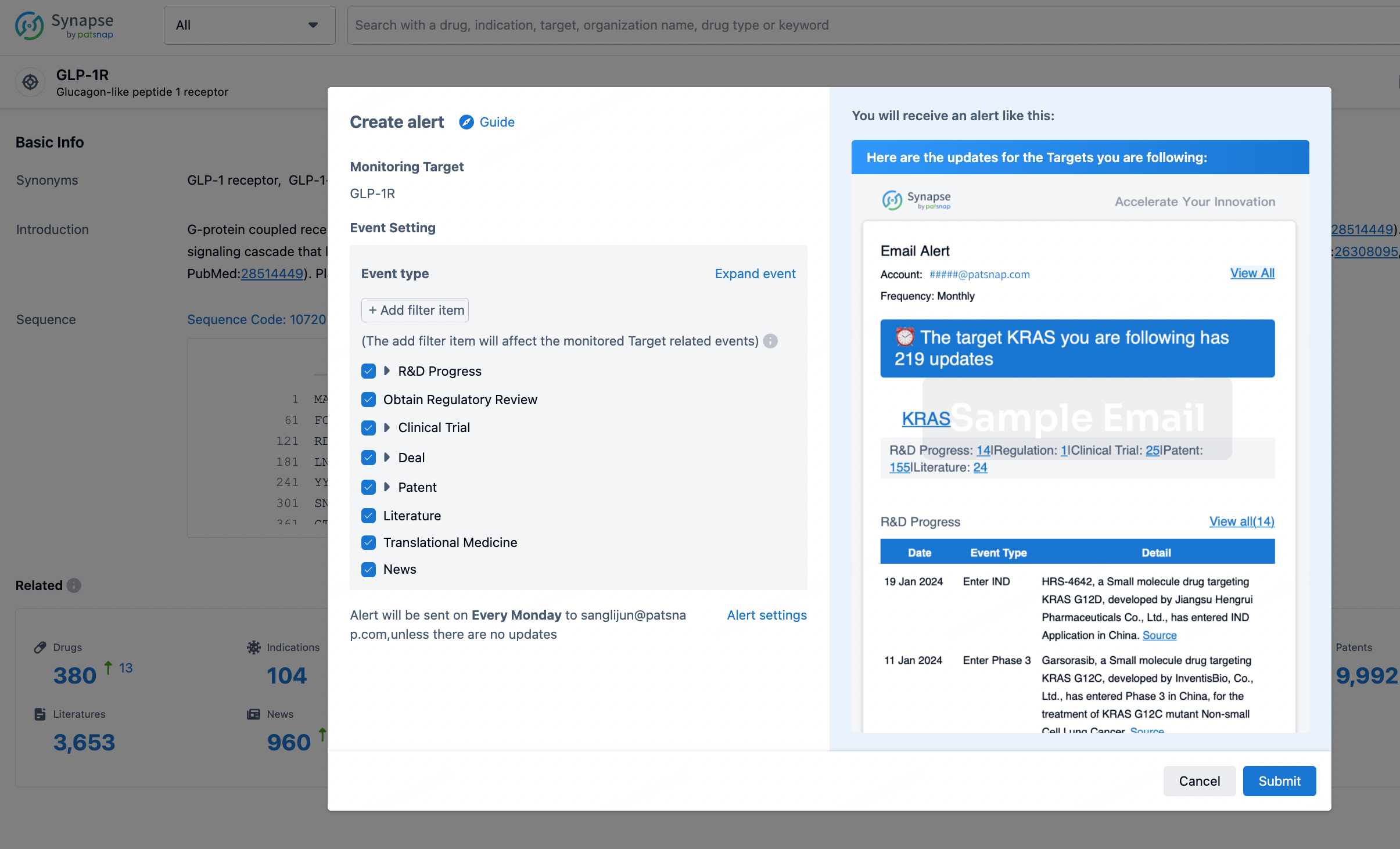
In the Synapse database, you can stay updated on the latest research and development advances of all targets. This service is accessible anytime and anywhere, with updates available daily or weekly. Use the "Set Alert" function to stay informed. Click on the image below to embark on a brand new journey of drug discovery!

AI Agents Built for Biopharma Breakthroughs
Accelerate discovery. Empower decisions. Transform outcomes.
Get started for free today!
Accelerate Strategic R&D decision making with Synapse, PatSnap’s AI-powered Connected Innovation Intelligence Platform Built for Life Sciences Professionals.
Start your data trial now!
Synapse data is also accessible to external entities via APIs or data packages. Empower better decisions with the latest in pharmaceutical intelligence.