Request Demo
What are THR-α antagonists and how do they work?
25 June 2024
Thyroid hormone receptor alpha (THR-α) antagonists have recently emerged as promising agents in the realm of medical research and pharmacology. These compounds offer the potential to modulate thyroid hormone activity in specific tissues, potentially leading to new treatments for a variety of conditions. To fully appreciate the value of THR-α antagonists, it is essential to understand their mechanisms of action and their potential therapeutic applications.
Thyroid hormones, such as thyroxine (T4) and triiodothyronine (T3), play crucial roles in regulating metabolism, growth, and development. They exert their effects primarily by binding to thyroid hormone receptors (THRs), which are nuclear receptors that act as transcription factors to regulate the expression of specific genes. THRs exist in two main isoforms: THR-α and THR-β. While both isoforms are widely expressed throughout the body, they have different tissue distributions and physiological roles. THR-α is predominantly found in cardiac and skeletal muscle, the gastrointestinal tract, and the central nervous system, while THR-β is more prevalent in the liver, kidneys, and other tissues.
THR-α antagonists work by selectively binding to the THR-α isoform, thereby preventing thyroid hormones from interacting with this receptor. This inhibition effectively blocks the downstream signaling pathways that would normally be activated by thyroid hormones, leading to a reduction in the expression of genes regulated by THR-α. By specifically targeting THR-α, these antagonists can modulate thyroid hormone activity in a tissue-specific manner, potentially reducing the risk of side effects associated with non-selective thyroid hormone modulation.
The development of THR-α antagonists represents a significant advancement in the field of thyroid hormone research. Traditional treatments for thyroid-related disorders, such as hypothyroidism and hyperthyroidism, often involve the systemic administration of thyroid hormones or antithyroid drugs, which can have widespread effects on multiple tissues. In contrast, THR-α antagonists offer the potential for more targeted therapies, minimizing off-target effects and improving patient outcomes.
One of the most promising applications of THR-α antagonists is in the treatment of cardiovascular diseases. Thyroid hormones are known to have significant effects on the cardiovascular system, influencing heart rate, cardiac contractility, and vascular tone. Dysregulation of thyroid hormone signaling can contribute to various cardiovascular conditions, such as heart failure, arrhythmias, and hypertension. By selectively inhibiting THR-α, these antagonists may help to normalize thyroid hormone activity in cardiac tissue, potentially improving cardiac function and reducing the risk of adverse cardiovascular events.
Another potential application of THR-α antagonists is in the treatment of metabolic disorders. Thyroid hormones play a critical role in regulating metabolism, influencing processes such as lipid and glucose metabolism, thermogenesis, and energy expenditure. Dysregulation of thyroid hormone signaling can contribute to metabolic conditions such as obesity, diabetes, and dyslipidemia. By selectively targeting THR-α, these antagonists may help to restore metabolic balance, potentially leading to improved metabolic health and reduced risk of associated complications.
THR-α antagonists may also have applications in the treatment of gastrointestinal disorders. Thyroid hormones are involved in regulating gastrointestinal motility, absorption, and secretion. Dysregulation of thyroid hormone signaling can contribute to gastrointestinal conditions such as irritable bowel syndrome, inflammatory bowel disease, and gastrointestinal dysmotility. By selectively inhibiting THR-α, these antagonists may help to normalize gastrointestinal function, potentially improving symptoms and quality of life for affected individuals.
In addition to their potential therapeutic applications, THR-α antagonists also hold promise as research tools. By selectively modulating thyroid hormone activity in specific tissues, these compounds can help researchers to better understand the physiological roles of THR-α and the mechanisms underlying thyroid hormone-related diseases. This knowledge may ultimately lead to the development of more effective and targeted therapies for a wide range of conditions.
In conclusion, THR-α antagonists represent a novel and promising approach to the modulation of thyroid hormone activity. By selectively targeting the THR-α isoform, these compounds offer the potential for tissue-specific therapies with reduced side effects. As research into THR-α antagonists continues to advance, it is likely that these compounds will play an increasingly important role in the treatment of cardiovascular, metabolic, and gastrointestinal disorders, as well as in the broader field of thyroid hormone research.
Thyroid hormones, such as thyroxine (T4) and triiodothyronine (T3), play crucial roles in regulating metabolism, growth, and development. They exert their effects primarily by binding to thyroid hormone receptors (THRs), which are nuclear receptors that act as transcription factors to regulate the expression of specific genes. THRs exist in two main isoforms: THR-α and THR-β. While both isoforms are widely expressed throughout the body, they have different tissue distributions and physiological roles. THR-α is predominantly found in cardiac and skeletal muscle, the gastrointestinal tract, and the central nervous system, while THR-β is more prevalent in the liver, kidneys, and other tissues.
THR-α antagonists work by selectively binding to the THR-α isoform, thereby preventing thyroid hormones from interacting with this receptor. This inhibition effectively blocks the downstream signaling pathways that would normally be activated by thyroid hormones, leading to a reduction in the expression of genes regulated by THR-α. By specifically targeting THR-α, these antagonists can modulate thyroid hormone activity in a tissue-specific manner, potentially reducing the risk of side effects associated with non-selective thyroid hormone modulation.
The development of THR-α antagonists represents a significant advancement in the field of thyroid hormone research. Traditional treatments for thyroid-related disorders, such as hypothyroidism and hyperthyroidism, often involve the systemic administration of thyroid hormones or antithyroid drugs, which can have widespread effects on multiple tissues. In contrast, THR-α antagonists offer the potential for more targeted therapies, minimizing off-target effects and improving patient outcomes.
One of the most promising applications of THR-α antagonists is in the treatment of cardiovascular diseases. Thyroid hormones are known to have significant effects on the cardiovascular system, influencing heart rate, cardiac contractility, and vascular tone. Dysregulation of thyroid hormone signaling can contribute to various cardiovascular conditions, such as heart failure, arrhythmias, and hypertension. By selectively inhibiting THR-α, these antagonists may help to normalize thyroid hormone activity in cardiac tissue, potentially improving cardiac function and reducing the risk of adverse cardiovascular events.
Another potential application of THR-α antagonists is in the treatment of metabolic disorders. Thyroid hormones play a critical role in regulating metabolism, influencing processes such as lipid and glucose metabolism, thermogenesis, and energy expenditure. Dysregulation of thyroid hormone signaling can contribute to metabolic conditions such as obesity, diabetes, and dyslipidemia. By selectively targeting THR-α, these antagonists may help to restore metabolic balance, potentially leading to improved metabolic health and reduced risk of associated complications.
THR-α antagonists may also have applications in the treatment of gastrointestinal disorders. Thyroid hormones are involved in regulating gastrointestinal motility, absorption, and secretion. Dysregulation of thyroid hormone signaling can contribute to gastrointestinal conditions such as irritable bowel syndrome, inflammatory bowel disease, and gastrointestinal dysmotility. By selectively inhibiting THR-α, these antagonists may help to normalize gastrointestinal function, potentially improving symptoms and quality of life for affected individuals.
In addition to their potential therapeutic applications, THR-α antagonists also hold promise as research tools. By selectively modulating thyroid hormone activity in specific tissues, these compounds can help researchers to better understand the physiological roles of THR-α and the mechanisms underlying thyroid hormone-related diseases. This knowledge may ultimately lead to the development of more effective and targeted therapies for a wide range of conditions.
In conclusion, THR-α antagonists represent a novel and promising approach to the modulation of thyroid hormone activity. By selectively targeting the THR-α isoform, these compounds offer the potential for tissue-specific therapies with reduced side effects. As research into THR-α antagonists continues to advance, it is likely that these compounds will play an increasingly important role in the treatment of cardiovascular, metabolic, and gastrointestinal disorders, as well as in the broader field of thyroid hormone research.
How to obtain the latest development progress of all targets?
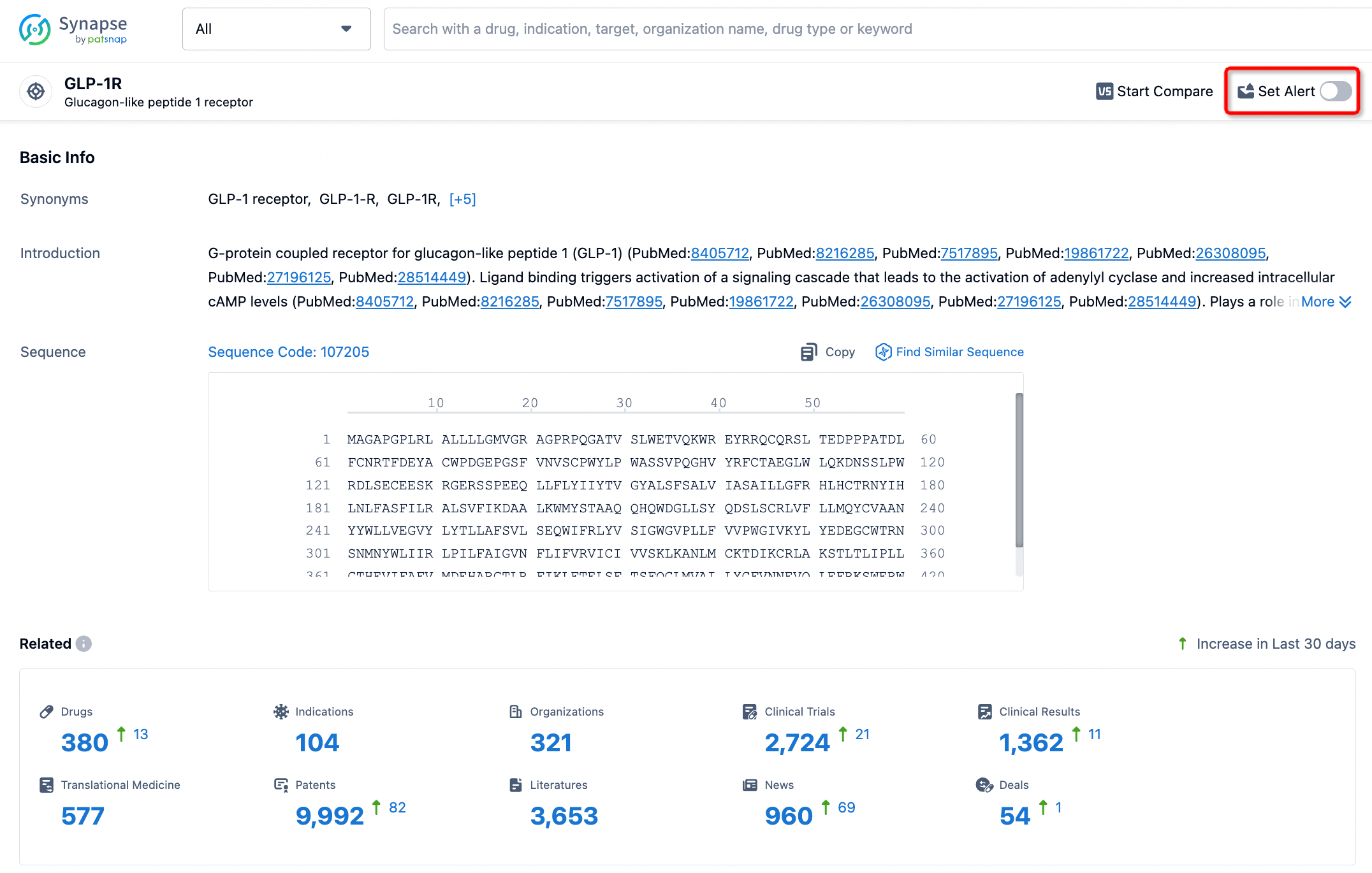
In the Synapse database, you can stay updated on the latest research and development advances of all targets. This service is accessible anytime and anywhere, with updates available daily or weekly. Use the "Set Alert" function to stay informed. Click on the image below to embark on a brand new journey of drug discovery!

AI Agents Built for Biopharma Breakthroughs
Accelerate discovery. Empower decisions. Transform outcomes.
Get started for free today!
Accelerate Strategic R&D decision making with Synapse, PatSnap’s AI-powered Connected Innovation Intelligence Platform Built for Life Sciences Professionals.
Start your data trial now!
Synapse data is also accessible to external entities via APIs or data packages. Empower better decisions with the latest in pharmaceutical intelligence.