Request Demo
Last update 08 Jul 2026
SSGJ-706
Last update 08 Jul 2026
Overview
Basic Info
Drug Type Bispecific antibody |
Synonyms 706, SSGJ 706, SSGJ-706 + [1] |
Target |
Action inhibitors |
Mechanism PD-1 inhibitors(Programmed cell death protein 1 inhibitors), PDL1 inhibitors(Programmed death-ligand 1 inhibitors) |
Therapeutic Areas |
Active Indication |
Inactive Indication |
Originator Organization |
Inactive Organization- |
Drug Highest PhasePhase 2 |
First Approval Date- |
Regulation- |


Login to view timeline
Related
3
Clinical Trials associated with SSGJ-706NCT07233850
A Phase II Clinical Study Evaluating SSGJ-706 in Combination Therapy for Advanced Gastrointestinal Cancers
NCT07171606
A Phase II Study of SSGJ-706 Monotherapy and Combination Therapy in Advanced Non-Small Cell Lung Cancer(NSCLC) Patients
NCT06533605
Phase I Clinical Study to Evaluate the Safety, Tolerability, and Initial Efficacy of SSGJ-706 Monotherapy for Patients With Advanced Solid Tumors
100 Clinical Results associated with SSGJ-706
Login to view more data
100 Translational Medicine associated with SSGJ-706
Login to view more data
100 Patents (Medical) associated with SSGJ-706
Login to view more data
1
Literatures (Medical) associated with SSGJ-706Intranasal Delivery of HIV/SIV Antigens with NE/AS01B Adjuvants Enhances Cellular Immunity and Reduces Viral Loads in SHIV-Challenged Macaques
Article
Author: Pandey, Kabita ; Gao, Hongmei ; Byrareddy, Siddappa N. ; Kathamuthu, Gokul Raj ; Olwenyi, Omalla A ; Johnson, Samuel D. ; Thurman, Michellie ; Hong, Kai Ying ; Adeniji, Samson ; Villinger, Francois ; Abdel-Mohsen, Mohamed ; Johnston, Morgan ; Baker, James R ; Wong, Pamela T. ; Chokkavelu, Viswanathan ; Bose, Deepanwita ; Shen, Xiaoying ; Montefiori, David ; Yu, Jianshi ; Kane, Maureen
Abstract:
The primary route of HIV transmission is across mucosal tissues; therefore, developing a protective mucosal vaccine is a top priority. In a pilot study, using a macaque model, we delivered HIV gp140 envelope glycoprotein and SIVmac239 P55 Gag and Nef antigens using heterologous prime/boost via the intranasal route with a soybean oil-based nanoemulsion (NE) adjuvant and through the intramuscular route with the AS01B adjuvant system to generate enhanced cell-mediated immunity. We used a NE adjuvant to promote gut-homing cell-mediated immunity and the AS01B system to enhance humoral immune responses. Following intrarectal challenge with SHIV 4MTF.tHy, vaccinated macaques acquired the virus but experienced lower viral loads in plasma (P=0.003) and CSF (P=0.001), and potent polyfunctional gag-specific (CD107a+, IFNγ, TNFα+) responses across diverse lymph nodes. Significant antibody-dependent complement deposition (ADCD) and antibody-dependent cellular phagocytosis (ADCP) responses were induced, and gut-microbiome crosstalk could be modulated and showing reduced SHIV-dysbiosis. Notably, vaccination preserved mucosal all-trans retinoic acid levels (atRA) (p<0.05). However, no significant differences were observed for antibody responses between vaccinated and unvaccinated macaques. In summary, the induced gut-homing properties by the NE adjuvant are effective at generating cell-mediated immunity and reducing viral set points and warrant further investigations as a mucosal adjuvant in HIV vaccine design.
Importance:
Three major non-mucosal vaccine trials (RV144, HVTN702, and 706) failed to reduce HIV infection rates. Therefore, new approaches in developing a mucosal vaccine remain an effective strategy to attempt to control HIV infection. Coherent vaccine approaches against HIV were focused on immune correlates related to viral loads, persistent reservoirs, and antibody responses. As a proof-of-principle, we developed a vaccine regimen consisting of AS01B and an adjuvanted oil-in-water NE cleaved HIV clade C gp140 protein and non-cleaved Gag, and nef particles administered through intranasal, subcutaneous, and intramuscular routes, followed by intrarectal challenge with clade C SHIV. This vaccine elicited strong ADCD and ADCP responses, modulated immune-microbiome crosstalk, and reduced susceptibility to SHIV-infection-associated dysbiosis. Additionally, it preserved mucosal all trans retinoic acid (atRA) levels, suggesting a potential role for this approach in HIV vaccine development.
100 Deals associated with SSGJ-706
Login to view more data
R&D Status
10 top R&D records. to view more data
Login
| Indication | Highest Phase | Country/Location | Organization | Date |
|---|---|---|---|---|
| Metastatic Colorectal Carcinoma | Phase 2 | China | 01 Nov 2025 | |
| Adenocarcinoma of large intestine | Phase 2 | China | 27 Oct 2025 | |
| Adenoma | Phase 2 | China | 27 Oct 2025 | |
| Adenosquamous Carcinoma | Phase 2 | China | 27 Oct 2025 | |
| Esophageal Squamous Cell Carcinoma | Phase 2 | China | 27 Oct 2025 | |
| Gastroesophageal junction adenocarcinoma | Phase 2 | China | 27 Oct 2025 | |
| Pancreatic Ductal Adenocarcinoma | Phase 2 | China | 27 Oct 2025 | |
| stomach adenocarcinoma | Phase 2 | China | 27 Oct 2025 | |
| Advanced Lung Non-Small Cell Carcinoma | Phase 2 | China | 29 Aug 2025 | |
| Neoplasms | Phase 2 | United States | 14 Oct 2021 |
Login to view more data
Clinical Result
Clinical Result
Indication
Phase
Evaluation
View All Results
Login to view more data
Translational Medicine
Boost your research with our translational medicine data.
login
or

Deal
Boost your decision using our deal data.
login
or

Core Patent
Boost your research with our Core Patent data.
login
or

Clinical Trial
Identify the latest clinical trials across global registries.
login
or

Approval
Accelerate your research with the latest regulatory approval information.
login
or
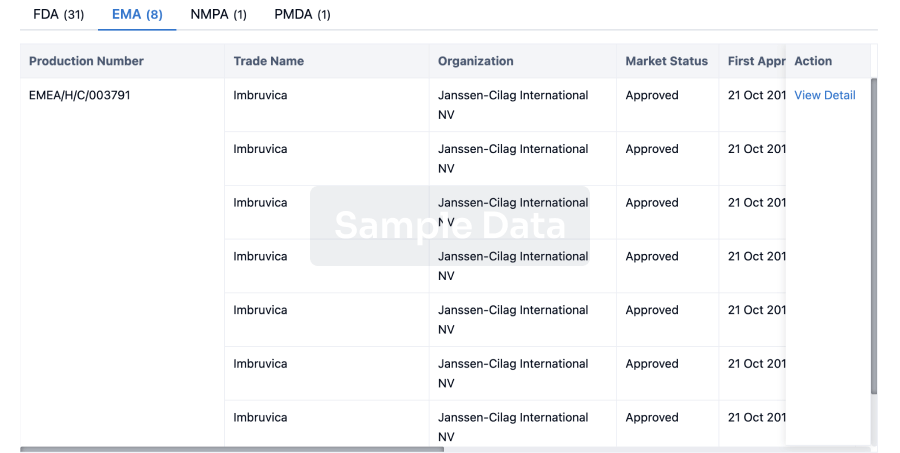
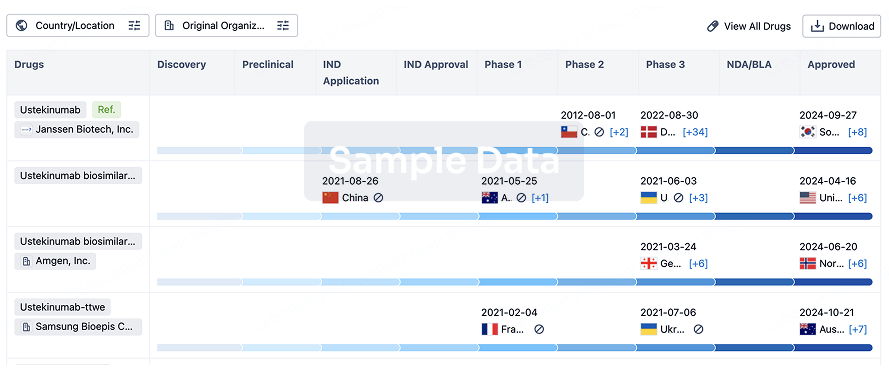
Biosimilar
Competitive landscape of biosimilars in different countries/locations. Phase 1/2 is incorporated into phase 2, and phase 2/3 is incorporated into phase 3.
login
or
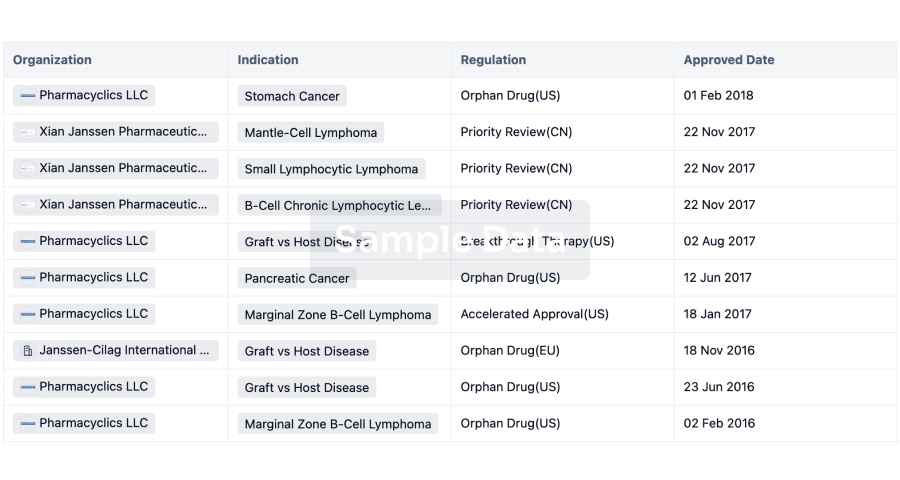
Regulation
Understand key drug designations in just a few clicks with Synapse.
login
or
Hiro LS Researcher
The AI Search Engine Built to Accelerate Biopharma Decisions
Search across billion-scale life sciences data to uncover signals, validate evidence, and act with confidence.
Ask any biopharma research question→
Get started for free today!
Accelerate Strategic R&D decision making with Synapse, Patsnap’s AI-powered Connected Innovation Intelligence Platform Built for Life Sciences Professionals.
Discover Synapse Data Servers
Synapse data is now integrated into the PatSnap LS Model Context Protocol (MCP) service. Customize your LLM agent now using our MCP server!
Bio
Bio Sequences Search & Analysis
Sign up for free
Chemical
Chemical Structures Search & Analysis
Sign up for free