Request Demo
Last update 28 Nov 2025
Natalizumab Biosimilar (Polpharma Biologics)
Last update 28 Nov 2025
Overview
Basic Info
Drug Type Biosimilar, Monoclonal antibody |
Synonyms Natalizumab biosimilar, natalizumab-sztn, DST-356A1 + [2] |
Target |
Action antagonists |
Mechanism CD49d antagonists(Integrin alpha-4 antagonists) |
Therapeutic Areas |
Inactive Indication- |
Originator Organization |
Active Organization |
Inactive Organization- |
License Organization |
Drug Highest PhaseApproved |
First Approval Date United States (24 Aug 2023), |
Regulation- |

Login to view timeline
Structure/Sequence
Sequence Code 62983H
The sequence is quoted from: *****
Sequence Code 143812L
The sequence is quoted from: *****
Related
3
Clinical Trials associated with Natalizumab Biosimilar (Polpharma Biologics)NCT04115488
Efficacy and Safety of the Biosimilar Natalizumab PB006 in Comparison to Tysabri® in Patients With Relapsing-Remitting Multiple Sclerosis (RRMS)
NL-OMON48246
An open label study to assess the safety and tolerability of PB006 administered as a single intravenous infusion - PB006 single dose safety study
NCT02325440
A 32-week, Monocentric, Exploratory, Single Arm Study to Assess Immune Function and MRI Disease Activity in Patients With RRMS Transferred From Previous Treatment With Natalizumab to Gilenya® (Fingolimod)

100 Clinical Results associated with Natalizumab Biosimilar (Polpharma Biologics)
Login to view more data
100 Translational Medicine associated with Natalizumab Biosimilar (Polpharma Biologics)
Login to view more data
100 Patents (Medical) associated with Natalizumab Biosimilar (Polpharma Biologics)
Login to view more data
2
Literatures (Medical) associated with Natalizumab Biosimilar (Polpharma Biologics)01 Nov 2024BIODRUGS
Introducing the Biosimilar Paradigm to Neurology: The Totality of Evidence for the First Biosimilar Natalizumab
Review
Author: Derlacz, Rafał ; Vitzithum, Klaus ; Hornuss, Cyrill ; Roth, Karsten ; Singer, Barry ; Jacobs, Laura ; von Richter, Oliver ; Selmaj, Krzysztof ; Höfler, Josef ; Poetzl, Johann
A biosimilar medicine is a successor to a reference ('originator'/'original-brand') biologic medicine brought to market once the patent and exclusive marketing rights for the reference have expired. Biosimilar natalizumab (PB006 [biosim-NTZ]; developed by Polpharma Biologics S.A. and marketed globally as Tyruko®; Sandoz) has been developed as a successor to reference natalizumab (Tysabri® [ref-NTZ]; Biogen) and is the first US Food and Drug Administration (FDA)-approved and European Medicines Agency (EMA)-approved biosimilar in neurology. As per the FDA and EMA indications for ref-NTZ, biosim-NTZ is approved to treat relapsing forms of multiple sclerosis (USA, EU) and Crohn's disease (USA only). Approval of biosim-NTZ was based on the 'totality of evidence', a comprehensive body of data collected during the development process, demonstrating similarity to its reference medicine. The foundational step of demonstrating structural and functional similarity between biosim-NTZ and ref-NTZ confirmed identical primary and indistinguishable higher order structures, as well as matching binding affinity to α4β1/α4β7 integrins. Following the confirmation of matching structure and function, pharmacokinetic/pharmacodynamic similarity of biosim-NTZ to ref-NTZ in healthy subjects was demonstrated, with no clinically meaningful differences identified in safety and immunogenicity. A comparative, double-blind, randomized study (Antelope) was also conducted in patients with relapsing-remitting multiple sclerosis and demonstrated matching efficacy, safety, and immunogenicity with no clinically meaningful differences between biosim-NTZ and ref-NTZ. This review presents the totality of evidence that confirmed the biosimilarity of biosimilar natalizumab to its reference medicine, which supported its approval by the FDA and the EMA. [Graphical plain language summary available].
01 May 2024Clinical Drug Investigation
PB006: A Natalizumab Biosimilar
Review
Author: Shirley, Matt
PB006 (Tyruko®) is the first biosimilar of the reference monoclonal anti-α4-integrin antibody natalizumab. It is approved for use in the same indications for which reference natalizumab is approved, as a single disease-modifying therapy in adults with highly active relapsing-remitting multiple sclerosis (RRMS). PB006 has similar physicochemical and pharmacodynamic properties to those of reference natalizumab, and the pharmacokinetic similarity of the agents has been demonstrated in a study in healthy subjects. PB006 demonstrated clinical efficacy similar to that of reference natalizumab in patients with RRMS, and was generally well tolerated in this population. The tolerability, safety and immunogenicity profiles of PB006 were similar to those of reference natalizumab, and switching from reference natalizumab to PB006 appeared to have no impact on tolerability or immunogenicity. The role of reference natalizumab in the management of RRMS is well established and PB006 provides an effective biosimilar alternative for patients requiring natalizumab therapy.
37
News (Medical) associated with Natalizumab Biosimilar (Polpharma Biologics)27 Nov 2025

17 Nov 2025
Drug ApprovalLicense out/inPatent Infringement
17 Nov 2025
100 Deals associated with Natalizumab Biosimilar (Polpharma Biologics)
Login to view more data
R&D Status
10 top approved records. to view more data
Login
| Indication | Country/Location | Organization | Date |
|---|---|---|---|
| Multiple Sclerosis, Relapsing-Remitting | European Union | 22 Sep 2023 | |
| Multiple Sclerosis, Relapsing-Remitting | Iceland | 22 Sep 2023 | |
| Multiple Sclerosis, Relapsing-Remitting | Liechtenstein | 22 Sep 2023 | |
| Multiple Sclerosis, Relapsing-Remitting | Norway | 22 Sep 2023 | |
| Crohn Disease | United States | 24 Aug 2023 | |
| Multiple Sclerosis | United States | 24 Aug 2023 |
Login to view more data
Clinical Result
Clinical Result
Indication
Phase
Evaluation
View All Results
Login to view more data
Translational Medicine
Boost your research with our translational medicine data.
login
or
Deal
Boost your decision using our deal data.
login
or
Core Patent
Boost your research with our Core Patent data.
login
or
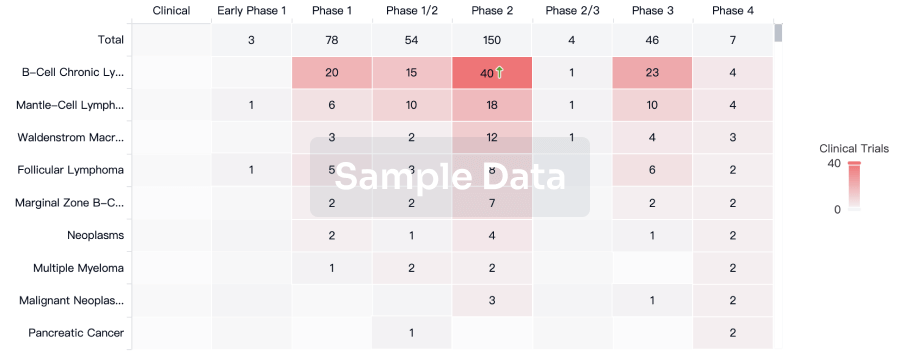
Clinical Trial
Identify the latest clinical trials across global registries.
login
or
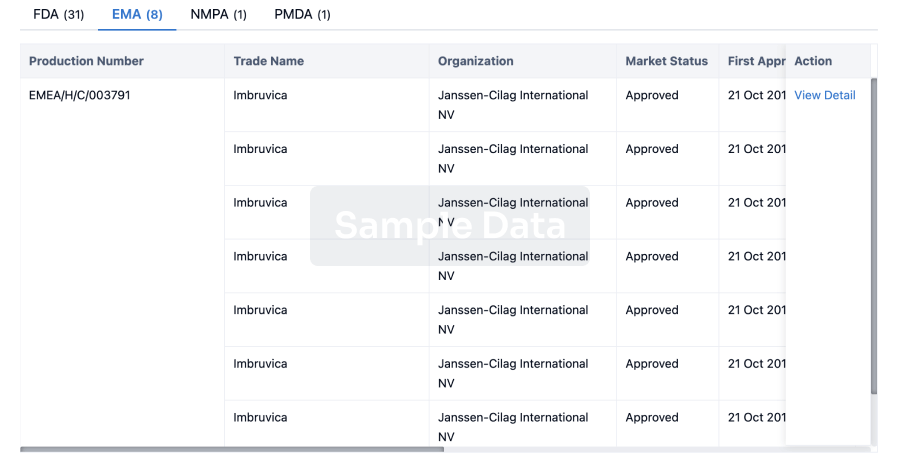
Approval
Accelerate your research with the latest regulatory approval information.
login
or
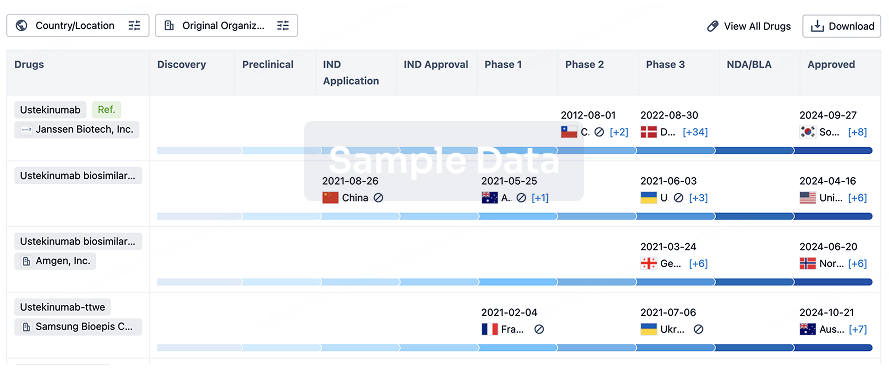
Biosimilar
Competitive landscape of biosimilars in different countries/locations. Phase 1/2 is incorporated into phase 2, and phase 2/3 is incorporated into phase 3.
login
or
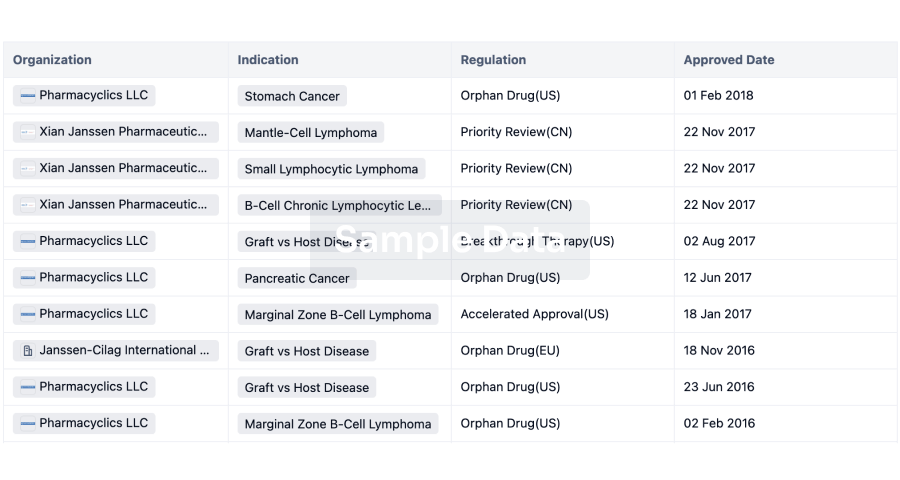
Regulation
Understand key drug designations in just a few clicks with Synapse.
login
or
AI Agents Built for Biopharma Breakthroughs
Accelerate discovery. Empower decisions. Transform outcomes.
Get started for free today!
Accelerate Strategic R&D decision making with Synapse, PatSnap’s AI-powered Connected Innovation Intelligence Platform Built for Life Sciences Professionals.
Start your data trial now!
Synapse data is also accessible to external entities via APIs or data packages. Empower better decisions with the latest in pharmaceutical intelligence.
Bio
Bio Sequences Search & Analysis
Sign up for free
Chemical
Chemical Structures Search & Analysis
Sign up for free