Request Demo
What are DMD exon 50 modulators and how do they work?
21 June 2024
Duchenne Muscular Dystrophy (DMD) is a devastating genetic disorder primarily affecting boys, characterized by progressive muscle degeneration and weakness. The root cause of DMD is mutations in the dystrophin gene, which is vital for maintaining muscle fiber integrity. Among the many complex mutations that can occur in the dystrophin gene, exon 50 deletions are particularly challenging. This is where DMD exon 50 modulators come into play, offering hope to patients and families affected by this condition.
DMD exon 50 modulators are a novel class of therapeutic agents designed to target specific genetic mutations within the dystrophin gene. They aim to address the underlying genetic defect and restore some level of dystrophin production, which can significantly improve muscle function and quality of life for patients with DMD. To grasp the true potential of these modulators, it is crucial to understand their mechanisms of action and their applications in clinical settings.
DMD exon 50 modulators work through a process known as exon skipping. The dystrophin gene is composed of 79 exons, and mutations that disrupt the reading frame can prevent the production of functional dystrophin protein. In the case of exon 50 deletions, the reading frame downstream is disrupted, leading to a premature stop codon and the production of a truncated, non-functional protein.
Exon skipping employs synthetic molecules called antisense oligonucleotides (AONs) to bind to specific sequences in the pre-mRNA transcripts of the dystrophin gene. By binding to the target sites, these AONs mask the exon from the cellular machinery responsible for splicing RNA, causing the machinery to "skip" over the faulty exon during the RNA splicing process. In the context of exon 50, modulators aim to skip the surrounding exons, such as exon 51, to restore the reading frame, enabling the production of a shorter but still functional dystrophin protein.
Although this restored dystrophin is not identical to the full-length version, it is sufficiently functional to stabilize muscle cell membranes and improve muscle strength and endurance. Research and clinical trials have shown that patients treated with exon skipping therapies exhibit increased dystrophin levels and experience slower disease progression, highlighting the potential of these modulators.
DMD exon 50 modulators are specifically used to treat individuals with deletions or mutations around exon 50 of the dystrophin gene. This subgroup of patients represents a significant portion of those affected by DMD, making this targeted therapy highly relevant. The primary goal of using these modulators is to slow down the progression of muscle degeneration, thereby extending the patient's ability to walk, breathe independently, and maintain overall mobility for a longer period.
One of the most well-known exon 50 modulators under investigation is Eteplirsen, which targets exon 51 skipping to treat patients with exon 50 deletions. Clinical trials have demonstrated that Eteplirsen can increase dystrophin levels in muscle tissues, leading to improved clinical outcomes compared to untreated patients. The treatment is generally well-tolerated, with manageable side effects primarily consisting of mild to moderate reactions at the injection site.
In addition to improving muscle function, DMD exon 50 modulators have the potential to extend life expectancy. Respiratory and cardiac muscles are also affected by DMD, and by preserving overall muscle function, these therapies can help maintain vital respiratory and cardiac functions. Moreover, the psychological and emotional benefits of slowing disease progression are substantial, offering patients and their families hope and improved quality of life.
In conclusion, DMD exon 50 modulators represent a groundbreaking approach to treating Duchenne Muscular Dystrophy, particularly for those with exon 50 deletions. By harnessing the power of exon skipping, these therapies can restore dystrophin production, improve muscle function, and slow disease progression. While challenges remain in optimizing these treatments and expanding their accessibility, the progress made thus far is promising and paves the way for future advancements in the fight against this debilitating disorder.
DMD exon 50 modulators are a novel class of therapeutic agents designed to target specific genetic mutations within the dystrophin gene. They aim to address the underlying genetic defect and restore some level of dystrophin production, which can significantly improve muscle function and quality of life for patients with DMD. To grasp the true potential of these modulators, it is crucial to understand their mechanisms of action and their applications in clinical settings.
DMD exon 50 modulators work through a process known as exon skipping. The dystrophin gene is composed of 79 exons, and mutations that disrupt the reading frame can prevent the production of functional dystrophin protein. In the case of exon 50 deletions, the reading frame downstream is disrupted, leading to a premature stop codon and the production of a truncated, non-functional protein.
Exon skipping employs synthetic molecules called antisense oligonucleotides (AONs) to bind to specific sequences in the pre-mRNA transcripts of the dystrophin gene. By binding to the target sites, these AONs mask the exon from the cellular machinery responsible for splicing RNA, causing the machinery to "skip" over the faulty exon during the RNA splicing process. In the context of exon 50, modulators aim to skip the surrounding exons, such as exon 51, to restore the reading frame, enabling the production of a shorter but still functional dystrophin protein.
Although this restored dystrophin is not identical to the full-length version, it is sufficiently functional to stabilize muscle cell membranes and improve muscle strength and endurance. Research and clinical trials have shown that patients treated with exon skipping therapies exhibit increased dystrophin levels and experience slower disease progression, highlighting the potential of these modulators.
DMD exon 50 modulators are specifically used to treat individuals with deletions or mutations around exon 50 of the dystrophin gene. This subgroup of patients represents a significant portion of those affected by DMD, making this targeted therapy highly relevant. The primary goal of using these modulators is to slow down the progression of muscle degeneration, thereby extending the patient's ability to walk, breathe independently, and maintain overall mobility for a longer period.
One of the most well-known exon 50 modulators under investigation is Eteplirsen, which targets exon 51 skipping to treat patients with exon 50 deletions. Clinical trials have demonstrated that Eteplirsen can increase dystrophin levels in muscle tissues, leading to improved clinical outcomes compared to untreated patients. The treatment is generally well-tolerated, with manageable side effects primarily consisting of mild to moderate reactions at the injection site.
In addition to improving muscle function, DMD exon 50 modulators have the potential to extend life expectancy. Respiratory and cardiac muscles are also affected by DMD, and by preserving overall muscle function, these therapies can help maintain vital respiratory and cardiac functions. Moreover, the psychological and emotional benefits of slowing disease progression are substantial, offering patients and their families hope and improved quality of life.
In conclusion, DMD exon 50 modulators represent a groundbreaking approach to treating Duchenne Muscular Dystrophy, particularly for those with exon 50 deletions. By harnessing the power of exon skipping, these therapies can restore dystrophin production, improve muscle function, and slow disease progression. While challenges remain in optimizing these treatments and expanding their accessibility, the progress made thus far is promising and paves the way for future advancements in the fight against this debilitating disorder.
How to obtain the latest development progress of all targets?
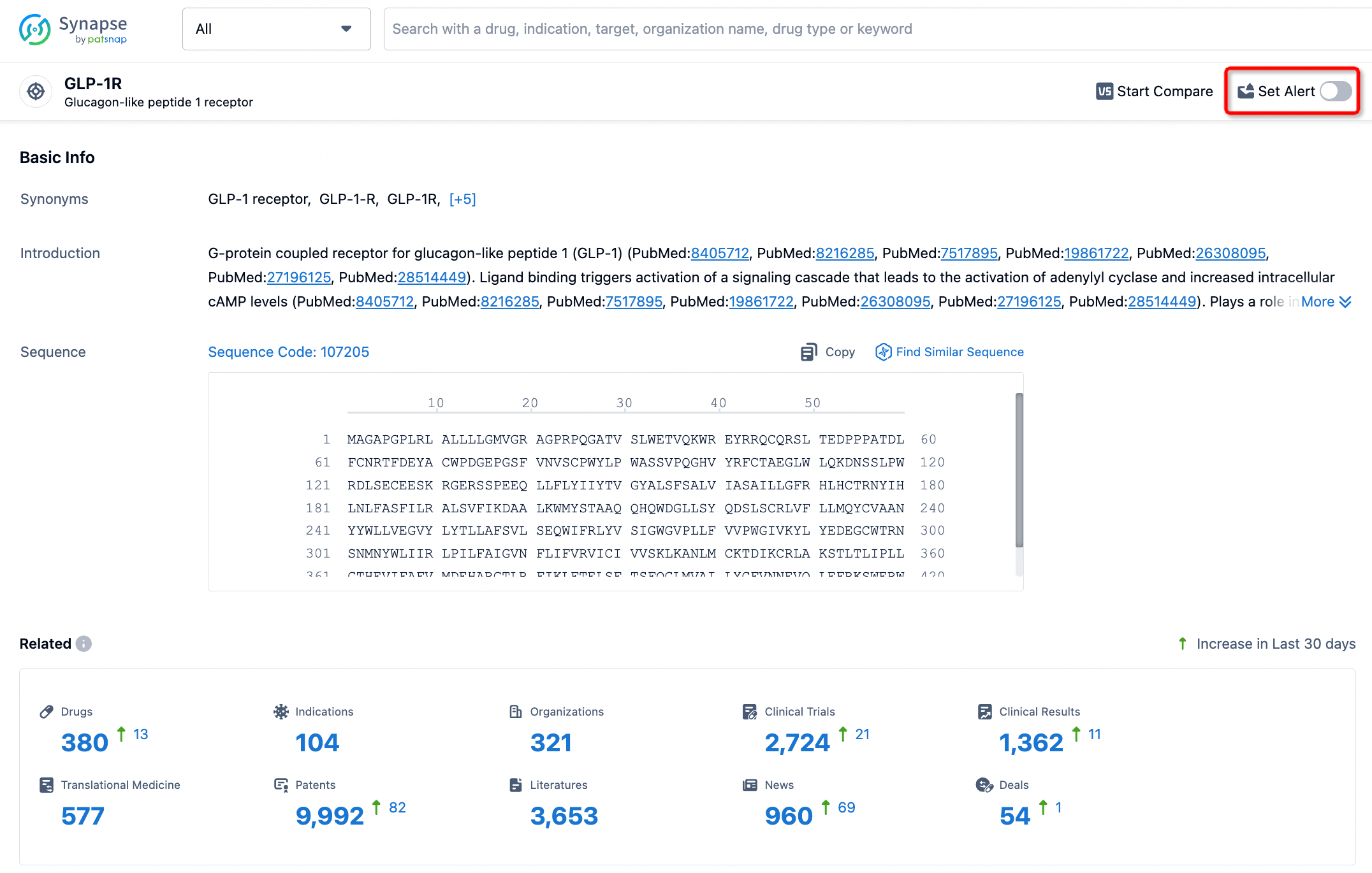
In the Synapse database, you can stay updated on the latest research and development advances of all targets. This service is accessible anytime and anywhere, with updates available daily or weekly. Use the "Set Alert" function to stay informed. Click on the image below to embark on a brand new journey of drug discovery!


AI Agents Built for Biopharma Breakthroughs
Accelerate discovery. Empower decisions. Transform outcomes.
Get started for free today!
Accelerate Strategic R&D decision making with Synapse, PatSnap’s AI-powered Connected Innovation Intelligence Platform Built for Life Sciences Professionals.
Start your data trial now!
Synapse data is also accessible to external entities via APIs or data packages. Empower better decisions with the latest in pharmaceutical intelligence.