Request Demo
What are PDGFRα modulators and how do they work?
21 June 2024
Platelet-Derived Growth Factor Receptor Alpha (PDGFRα) modulators represent a promising frontier in the field of targeted cancer therapy and other diseases characterized by abnormal cell growth. PDGFRα is a type of cell surface receptor that plays a crucial role in cell proliferation, differentiation, and survival. By understanding how PDGFRα modulators work, researchers and clinicians can develop more effective treatments for a range of diseases, including cancer, fibrosis, and certain cardiovascular conditions.
PDGFRα is a receptor tyrosine kinase that binds to its ligand, the platelet-derived growth factor (PDGF). Upon ligand binding, PDGFRα undergoes dimerization and autophosphorylation, initiating a cascade of downstream signaling pathways such as the PI3K/AKT, RAS/MAPK, and JAK/STAT pathways. These pathways ultimately lead to cellular responses like proliferation, survival, and migration. However, aberrant activation of PDGFRα due to mutations, overexpression, or other genetic alterations can lead to uncontrolled cell growth and contribute to the development of various cancers and fibrotic diseases.
PDGFRα modulators are designed to interfere with the receptor's activity at various points in its signaling pathway. These modulators can be classified into several categories, including monoclonal antibodies, small molecule inhibitors, and ligand traps. Monoclonal antibodies target the extracellular domain of PDGFRα, preventing PDGF from binding to the receptor and thereby inhibiting receptor activation. Small molecule inhibitors, on the other hand, target the intracellular tyrosine kinase domain of PDGFRα, blocking its kinase activity and subsequent downstream signaling. Ligand traps are fusion proteins that sequester PDGF ligands, preventing them from interacting with PDGFRα and other PDGF receptors.
One of the most well-known PDGFRα modulators is imatinib, a small molecule inhibitor that targets the tyrosine kinase domains of both PDGFRα and BCR-ABL, another tyrosine kinase involved in chronic myeloid leukemia (CML). Imatinib has been successfully used to treat gastrointestinal stromal tumors (GISTs) that harbor activating mutations in PDGFRα. Another small molecule inhibitor, crenolanib, has shown promise in preclinical studies and early-phase clinical trials for the treatment of cancers with PDGFRα alterations, such as glioblastoma and certain types of sarcoma.
In addition to cancer, PDGFRα modulators have potential applications in treating fibrotic diseases, where excessive deposition of extracellular matrix components leads to tissue scarring and organ dysfunction. For instance, nintedanib, a small molecule inhibitor of PDGFRα, VEGFR, and FGFR, is approved for the treatment of idiopathic pulmonary fibrosis (IPF), a chronic and progressive lung disease. By inhibiting PDGFRα signaling, nintedanib can reduce fibroblast proliferation and collagen production, thereby slowing disease progression.
Cardiovascular diseases, such as atherosclerosis and restenosis, are also potential targets for PDGFRα modulation. In these conditions, PDGFRα signaling contributes to the proliferation and migration of vascular smooth muscle cells (VSMCs), leading to the formation of neointimal lesions and vascular occlusion. PDGFRα inhibitors have shown efficacy in preclinical models of these diseases by reducing VSMC proliferation and neointimal hyperplasia.
In conclusion, PDGFRα modulators represent a valuable tool in the fight against diseases characterized by abnormal cell growth and proliferation. By targeting the PDGFRα signaling pathway, these modulators can effectively inhibit tumor growth, reduce fibrosis, and improve outcomes in cardiovascular diseases. As our understanding of PDGFRα biology continues to evolve, we can expect the development of more selective and potent modulators, ultimately leading to improved therapeutic options for patients with PDGFRα-driven diseases.
PDGFRα is a receptor tyrosine kinase that binds to its ligand, the platelet-derived growth factor (PDGF). Upon ligand binding, PDGFRα undergoes dimerization and autophosphorylation, initiating a cascade of downstream signaling pathways such as the PI3K/AKT, RAS/MAPK, and JAK/STAT pathways. These pathways ultimately lead to cellular responses like proliferation, survival, and migration. However, aberrant activation of PDGFRα due to mutations, overexpression, or other genetic alterations can lead to uncontrolled cell growth and contribute to the development of various cancers and fibrotic diseases.
PDGFRα modulators are designed to interfere with the receptor's activity at various points in its signaling pathway. These modulators can be classified into several categories, including monoclonal antibodies, small molecule inhibitors, and ligand traps. Monoclonal antibodies target the extracellular domain of PDGFRα, preventing PDGF from binding to the receptor and thereby inhibiting receptor activation. Small molecule inhibitors, on the other hand, target the intracellular tyrosine kinase domain of PDGFRα, blocking its kinase activity and subsequent downstream signaling. Ligand traps are fusion proteins that sequester PDGF ligands, preventing them from interacting with PDGFRα and other PDGF receptors.
One of the most well-known PDGFRα modulators is imatinib, a small molecule inhibitor that targets the tyrosine kinase domains of both PDGFRα and BCR-ABL, another tyrosine kinase involved in chronic myeloid leukemia (CML). Imatinib has been successfully used to treat gastrointestinal stromal tumors (GISTs) that harbor activating mutations in PDGFRα. Another small molecule inhibitor, crenolanib, has shown promise in preclinical studies and early-phase clinical trials for the treatment of cancers with PDGFRα alterations, such as glioblastoma and certain types of sarcoma.
In addition to cancer, PDGFRα modulators have potential applications in treating fibrotic diseases, where excessive deposition of extracellular matrix components leads to tissue scarring and organ dysfunction. For instance, nintedanib, a small molecule inhibitor of PDGFRα, VEGFR, and FGFR, is approved for the treatment of idiopathic pulmonary fibrosis (IPF), a chronic and progressive lung disease. By inhibiting PDGFRα signaling, nintedanib can reduce fibroblast proliferation and collagen production, thereby slowing disease progression.
Cardiovascular diseases, such as atherosclerosis and restenosis, are also potential targets for PDGFRα modulation. In these conditions, PDGFRα signaling contributes to the proliferation and migration of vascular smooth muscle cells (VSMCs), leading to the formation of neointimal lesions and vascular occlusion. PDGFRα inhibitors have shown efficacy in preclinical models of these diseases by reducing VSMC proliferation and neointimal hyperplasia.
In conclusion, PDGFRα modulators represent a valuable tool in the fight against diseases characterized by abnormal cell growth and proliferation. By targeting the PDGFRα signaling pathway, these modulators can effectively inhibit tumor growth, reduce fibrosis, and improve outcomes in cardiovascular diseases. As our understanding of PDGFRα biology continues to evolve, we can expect the development of more selective and potent modulators, ultimately leading to improved therapeutic options for patients with PDGFRα-driven diseases.
How to obtain the latest development progress of all targets?
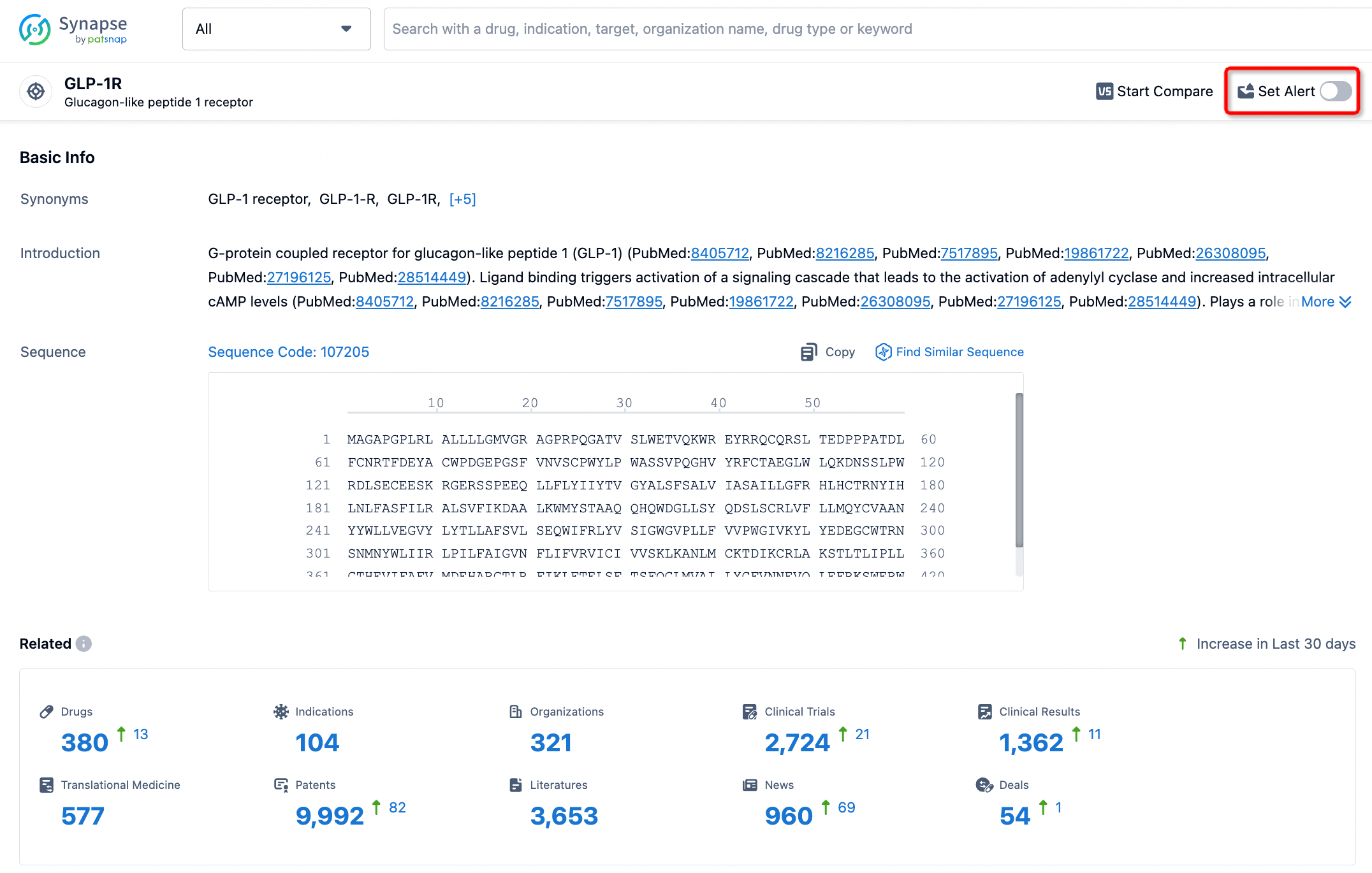
In the Synapse database, you can stay updated on the latest research and development advances of all targets. This service is accessible anytime and anywhere, with updates available daily or weekly. Use the "Set Alert" function to stay informed. Click on the image below to embark on a brand new journey of drug discovery!


Hiro LS Researcher
The AI Search Engine Built to Accelerate Biopharma Decisions
Search across billion-scale life sciences data to uncover signals, validate evidence, and act with confidence.
Ask any biopharma research question→
Get started for free today!
Accelerate Strategic R&D decision making with Synapse, Patsnap’s AI-powered Connected Innovation Intelligence Platform Built for Life Sciences Professionals.
Discover Synapse Data Servers
Synapse data is now integrated into the PatSnap LS Model Context Protocol (MCP) service. Customize your LLM agent now using our MCP server!