Request Demo
What are RARγ inverse agonists and how do they work?
21 June 2024
Retinoic acid receptors (RARs) play a pivotal role in various biological processes, including cellular growth, differentiation, and apoptosis. Among the three subtypes—RARα, RARβ, and RARγ—the RARγ subtype has garnered significant attention due to its unique involvement in these processes. This blog post delves into the realm of RARγ inverse agonists, exploring their mechanisms of action and potential therapeutic applications.
RARγ inverse agonists are a class of compounds that specifically target the RARγ receptor. Unlike agonists, which activate receptors to provoke a cellular response, inverse agonists bind to the same receptors but induce a diametrically opposite effect, effectively reducing the receptor's basal activity. In the case of RARγ, these inverse agonists work by stabilizing a specific conformational state of the receptor, which in turn represses its activity. This repression can modulate gene expression profiles governed by RARγ, thereby influencing various downstream biological processes.
The molecular mechanics of RARγ inverse agonists involve a finely tuned interplay between ligand and receptor. At a cellular level, RARγ is typically bound to DNA in complexes with retinoid X receptors (RXRs). Upon binding to their respective ligands, these receptor complexes undergo conformational changes that either initiate or inhibit transcription of specific target genes. In the context of inverse agonists, these compounds bind to the ligand-binding domain of RARγ, forcing a conformational shift that recruits co-repressors while displacing co-activators. This recruitment of co-repressors inhibits the transcription of genes activated by RARγ, thereby diminishing the receptor's overall activity.
RARγ inverse agonists can fine-tune the transcriptional landscape of cells in a tissue-specific manner. This specificity is particularly valuable in therapeutic contexts, as it allows for targeted modulation of gene expression in diseased tissues without broadly affecting healthy ones.
RARγ inverse agonists have shown promise across a variety of medical conditions, thanks to their ability to modulate cellular differentiation and proliferation. One of the most compelling areas of research involves their application in cancer therapy. Certain cancers, such as acute promyelocytic leukemia (APL), are driven by aberrant retinoic acid signaling. By dampening the activity of RARγ, inverse agonists can disrupt the pathological signaling pathways that contribute to tumor progression. Clinical studies have indicated that these compounds can induce differentiation and apoptosis in cancer cells, offering a potential therapeutic avenue for malignancies resistant to traditional treatments.
Apart from oncology, RARγ inverse agonists are also being explored for their potential in treating autoimmune and inflammatory diseases. Conditions like psoriasis and rheumatoid arthritis are characterized by dysregulated immune responses and abnormal cell proliferation. By targeting RARγ, inverse agonists can modulate immune cell differentiation and attenuate inflammatory signaling, thus ameliorating disease symptoms. Preclinical models have demonstrated the efficacy of these compounds in reducing inflammation and promoting tissue repair, paving the way for future clinical trials.
In dermatology, RARγ inverse agonists hold potential as therapeutic agents for skin disorders. Given that RARγ plays a crucial role in skin homeostasis and keratinocyte differentiation, inverse agonists can be harnessed to treat conditions like acne, psoriasis, and certain forms of dermatitis. By mitigating hyperproliferation and promoting normal differentiation of skin cells, these compounds can help restore healthy skin architecture.
The realm of regenerative medicine also stands to benefit from advancements in RARγ inverse agonist research. Tissue engineering and regenerative therapies often require precise control over cellular differentiation and proliferation. By fine-tuning RARγ activity, these inverse agonists could facilitate the development of bioengineered tissues and organs, potentially revolutionizing the field of regenerative medicine.
In conclusion, RARγ inverse agonists represent a promising frontier in medical research, offering innovative solutions for a spectrum of diseases. By effectively modulating the activity of RARγ, these compounds hold the potential to transform therapeutic paradigms in oncology, immunology, dermatology, and beyond. Continued research and clinical exploration will undoubtedly unveil new applications, solidifying the role of RARγ inverse agonists in modern medicine.
RARγ inverse agonists are a class of compounds that specifically target the RARγ receptor. Unlike agonists, which activate receptors to provoke a cellular response, inverse agonists bind to the same receptors but induce a diametrically opposite effect, effectively reducing the receptor's basal activity. In the case of RARγ, these inverse agonists work by stabilizing a specific conformational state of the receptor, which in turn represses its activity. This repression can modulate gene expression profiles governed by RARγ, thereby influencing various downstream biological processes.
The molecular mechanics of RARγ inverse agonists involve a finely tuned interplay between ligand and receptor. At a cellular level, RARγ is typically bound to DNA in complexes with retinoid X receptors (RXRs). Upon binding to their respective ligands, these receptor complexes undergo conformational changes that either initiate or inhibit transcription of specific target genes. In the context of inverse agonists, these compounds bind to the ligand-binding domain of RARγ, forcing a conformational shift that recruits co-repressors while displacing co-activators. This recruitment of co-repressors inhibits the transcription of genes activated by RARγ, thereby diminishing the receptor's overall activity.
RARγ inverse agonists can fine-tune the transcriptional landscape of cells in a tissue-specific manner. This specificity is particularly valuable in therapeutic contexts, as it allows for targeted modulation of gene expression in diseased tissues without broadly affecting healthy ones.
RARγ inverse agonists have shown promise across a variety of medical conditions, thanks to their ability to modulate cellular differentiation and proliferation. One of the most compelling areas of research involves their application in cancer therapy. Certain cancers, such as acute promyelocytic leukemia (APL), are driven by aberrant retinoic acid signaling. By dampening the activity of RARγ, inverse agonists can disrupt the pathological signaling pathways that contribute to tumor progression. Clinical studies have indicated that these compounds can induce differentiation and apoptosis in cancer cells, offering a potential therapeutic avenue for malignancies resistant to traditional treatments.
Apart from oncology, RARγ inverse agonists are also being explored for their potential in treating autoimmune and inflammatory diseases. Conditions like psoriasis and rheumatoid arthritis are characterized by dysregulated immune responses and abnormal cell proliferation. By targeting RARγ, inverse agonists can modulate immune cell differentiation and attenuate inflammatory signaling, thus ameliorating disease symptoms. Preclinical models have demonstrated the efficacy of these compounds in reducing inflammation and promoting tissue repair, paving the way for future clinical trials.
In dermatology, RARγ inverse agonists hold potential as therapeutic agents for skin disorders. Given that RARγ plays a crucial role in skin homeostasis and keratinocyte differentiation, inverse agonists can be harnessed to treat conditions like acne, psoriasis, and certain forms of dermatitis. By mitigating hyperproliferation and promoting normal differentiation of skin cells, these compounds can help restore healthy skin architecture.
The realm of regenerative medicine also stands to benefit from advancements in RARγ inverse agonist research. Tissue engineering and regenerative therapies often require precise control over cellular differentiation and proliferation. By fine-tuning RARγ activity, these inverse agonists could facilitate the development of bioengineered tissues and organs, potentially revolutionizing the field of regenerative medicine.
In conclusion, RARγ inverse agonists represent a promising frontier in medical research, offering innovative solutions for a spectrum of diseases. By effectively modulating the activity of RARγ, these compounds hold the potential to transform therapeutic paradigms in oncology, immunology, dermatology, and beyond. Continued research and clinical exploration will undoubtedly unveil new applications, solidifying the role of RARγ inverse agonists in modern medicine.
How to obtain the latest development progress of all targets?
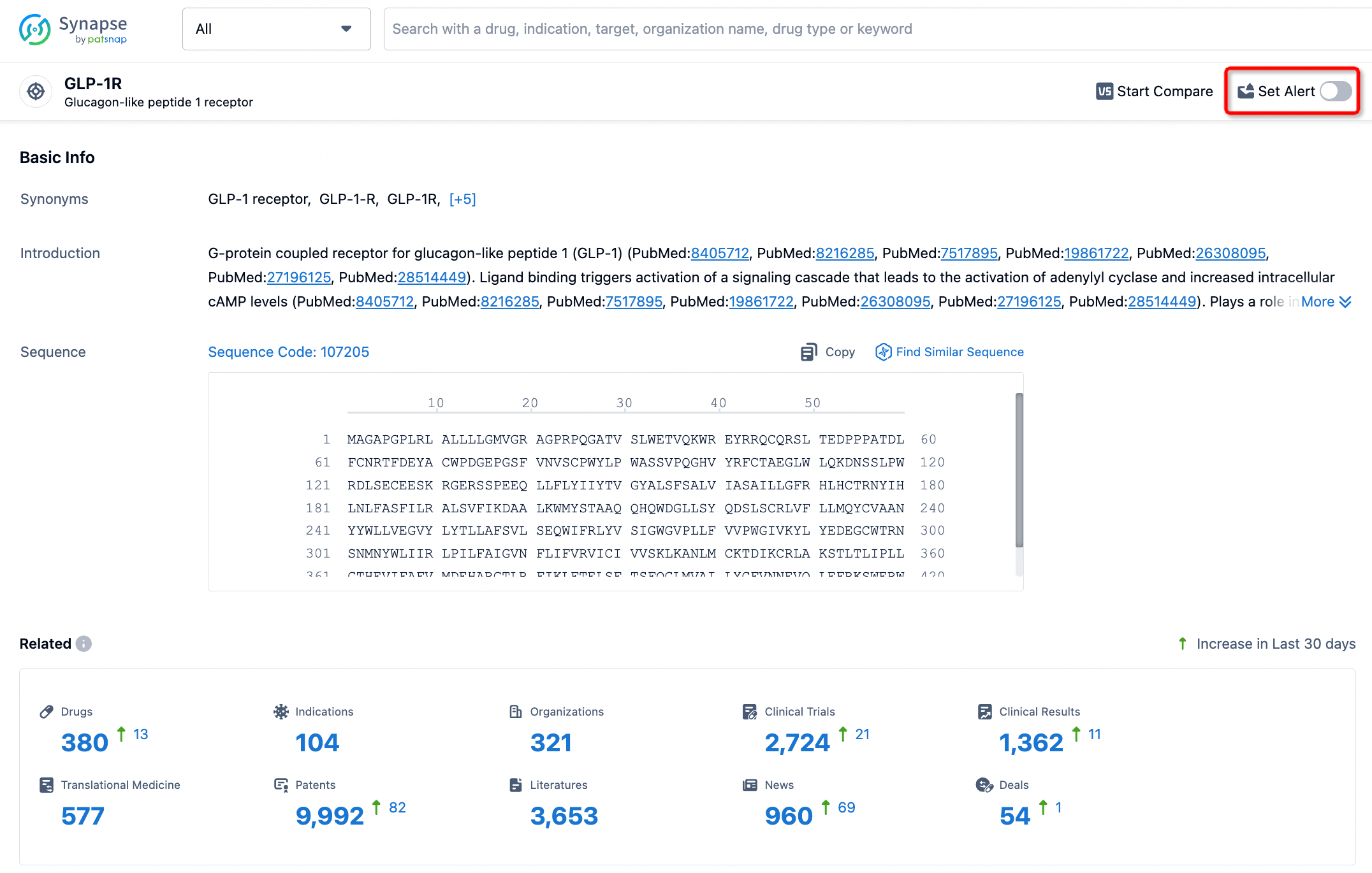
In the Synapse database, you can stay updated on the latest research and development advances of all targets. This service is accessible anytime and anywhere, with updates available daily or weekly. Use the "Set Alert" function to stay informed. Click on the image below to embark on a brand new journey of drug discovery!


AI Agents Built for Biopharma Breakthroughs
Accelerate discovery. Empower decisions. Transform outcomes.
Get started for free today!
Accelerate Strategic R&D decision making with Synapse, PatSnap’s AI-powered Connected Innovation Intelligence Platform Built for Life Sciences Professionals.
Start your data trial now!
Synapse data is also accessible to external entities via APIs or data packages. Empower better decisions with the latest in pharmaceutical intelligence.