Request Demo
What are TMED9 modulators and how do they work?
25 June 2024
In recent years, the field of cellular and molecular biology has made substantial strides, unveiling new proteins and pathways that hold the potential to revolutionize treatments for various diseases. One such intriguing protein is TMED9, a member of the transmembrane emp24 domain-containing (TMED) family. TMED9 modulators are emerging as a promising area of research with potential applications in several biomedical fields. In this blog post, we will delve into an introduction to TMED9 modulators, explore how they work, and examine what they are used for.
Introduction to TMED9 modulators
TMED9 is a protein that plays a pivotal role in the trafficking and sorting of proteins within the secretory pathway of cells. This pathway is critical for the processing and transport of proteins from the endoplasmic reticulum (ER) to the Golgi apparatus and ultimately to their final destinations, whether it be the cell membrane, lysosomes, or extracellular space. TMED9, like other members of the TMED family, is characterized by a conserved GOLD (Golgi dynamics) domain, a coiled-coil domain, and a transmembrane domain, which enable it to interact with other proteins and lipids within the cell.
Modulating the activity of TMED9 can have significant implications for cellular function and homeostasis. TMED9 modulators are compounds or molecules that can either enhance or inhibit the activity of TMED9. These modulators hold great potential for therapeutic interventions, especially in diseases where protein trafficking and sorting are disrupted or where aberrant protein accumulation occurs.
How do TMED9 modulators work?
To understand how TMED9 modulators work, it is essential to grasp the normal function of TMED9 in the cell. TMED9 is involved in the formation of vesicles that bud off from the ER and transport proteins to the Golgi apparatus. It also plays a role in the selection of cargo proteins that are packaged into these vesicles. By influencing the activity of TMED9, modulators can affect the efficiency and specificity of protein trafficking within the cell.
TMED9 modulators can work through various mechanisms. Some modulators may bind directly to TMED9, altering its conformation and thereby enhancing or inhibiting its activity. Others may affect the protein-protein interactions that TMED9 engages in, either stabilizing or disrupting these interactions. Additionally, modulators could influence the post-translational modifications of TMED9, such as phosphorylation or ubiquitination, which can impact its function and stability.
The precise mechanism of action for TMED9 modulators can vary depending on the specific compound or molecule being used. Researchers often employ high-throughput screening methods to identify potential modulators and then use a combination of biochemical, cellular, and structural biology techniques to elucidate their mechanisms of action.
What are TMED9 modulators used for?
The potential applications of TMED9 modulators are vast and varied, owing to the central role of TMED9 in protein trafficking and sorting. One of the most promising areas of research is in the context of neurodegenerative diseases, such as Alzheimer's and Parkinson's disease. These conditions are often characterized by the accumulation of misfolded or aberrant proteins. By modulating TMED9 activity, it may be possible to enhance the clearance of these proteins and alleviate the associated cellular stress and damage.
Cancer is another area where TMED9 modulators could have significant impact. Tumor cells often exhibit abnormal protein trafficking and secretion, contributing to their growth and invasiveness. TMED9 modulators could potentially be used to correct these trafficking defects, thereby inhibiting tumor progression and metastasis.
In addition to neurodegenerative diseases and cancer, TMED9 modulators may also have applications in metabolic disorders, infectious diseases, and immune system regulation. For example, certain viral infections rely on the host cell's secretory pathway for the production and release of viral particles. Modulating TMED9 activity could interfere with this process and inhibit viral replication.
Moreover, TMED9 modulators could be used as research tools to better understand the fundamental biology of protein trafficking and sorting. By selectively modulating TMED9 activity, researchers can dissect its specific functions and interactions within the cell, providing deeper insights into this critical cellular process.
In conclusion, TMED9 modulators represent a burgeoning area of research with significant therapeutic potential. By influencing the activity of TMED9, these modulators can impact protein trafficking and sorting, offering new avenues for the treatment of a range of diseases. As our understanding of TMED9 and its modulators continues to grow, we can look forward to exciting developments in both basic research and clinical applications.
Introduction to TMED9 modulators
TMED9 is a protein that plays a pivotal role in the trafficking and sorting of proteins within the secretory pathway of cells. This pathway is critical for the processing and transport of proteins from the endoplasmic reticulum (ER) to the Golgi apparatus and ultimately to their final destinations, whether it be the cell membrane, lysosomes, or extracellular space. TMED9, like other members of the TMED family, is characterized by a conserved GOLD (Golgi dynamics) domain, a coiled-coil domain, and a transmembrane domain, which enable it to interact with other proteins and lipids within the cell.
Modulating the activity of TMED9 can have significant implications for cellular function and homeostasis. TMED9 modulators are compounds or molecules that can either enhance or inhibit the activity of TMED9. These modulators hold great potential for therapeutic interventions, especially in diseases where protein trafficking and sorting are disrupted or where aberrant protein accumulation occurs.
How do TMED9 modulators work?
To understand how TMED9 modulators work, it is essential to grasp the normal function of TMED9 in the cell. TMED9 is involved in the formation of vesicles that bud off from the ER and transport proteins to the Golgi apparatus. It also plays a role in the selection of cargo proteins that are packaged into these vesicles. By influencing the activity of TMED9, modulators can affect the efficiency and specificity of protein trafficking within the cell.
TMED9 modulators can work through various mechanisms. Some modulators may bind directly to TMED9, altering its conformation and thereby enhancing or inhibiting its activity. Others may affect the protein-protein interactions that TMED9 engages in, either stabilizing or disrupting these interactions. Additionally, modulators could influence the post-translational modifications of TMED9, such as phosphorylation or ubiquitination, which can impact its function and stability.
The precise mechanism of action for TMED9 modulators can vary depending on the specific compound or molecule being used. Researchers often employ high-throughput screening methods to identify potential modulators and then use a combination of biochemical, cellular, and structural biology techniques to elucidate their mechanisms of action.
What are TMED9 modulators used for?
The potential applications of TMED9 modulators are vast and varied, owing to the central role of TMED9 in protein trafficking and sorting. One of the most promising areas of research is in the context of neurodegenerative diseases, such as Alzheimer's and Parkinson's disease. These conditions are often characterized by the accumulation of misfolded or aberrant proteins. By modulating TMED9 activity, it may be possible to enhance the clearance of these proteins and alleviate the associated cellular stress and damage.
Cancer is another area where TMED9 modulators could have significant impact. Tumor cells often exhibit abnormal protein trafficking and secretion, contributing to their growth and invasiveness. TMED9 modulators could potentially be used to correct these trafficking defects, thereby inhibiting tumor progression and metastasis.
In addition to neurodegenerative diseases and cancer, TMED9 modulators may also have applications in metabolic disorders, infectious diseases, and immune system regulation. For example, certain viral infections rely on the host cell's secretory pathway for the production and release of viral particles. Modulating TMED9 activity could interfere with this process and inhibit viral replication.
Moreover, TMED9 modulators could be used as research tools to better understand the fundamental biology of protein trafficking and sorting. By selectively modulating TMED9 activity, researchers can dissect its specific functions and interactions within the cell, providing deeper insights into this critical cellular process.
In conclusion, TMED9 modulators represent a burgeoning area of research with significant therapeutic potential. By influencing the activity of TMED9, these modulators can impact protein trafficking and sorting, offering new avenues for the treatment of a range of diseases. As our understanding of TMED9 and its modulators continues to grow, we can look forward to exciting developments in both basic research and clinical applications.
How to obtain the latest development progress of all targets?
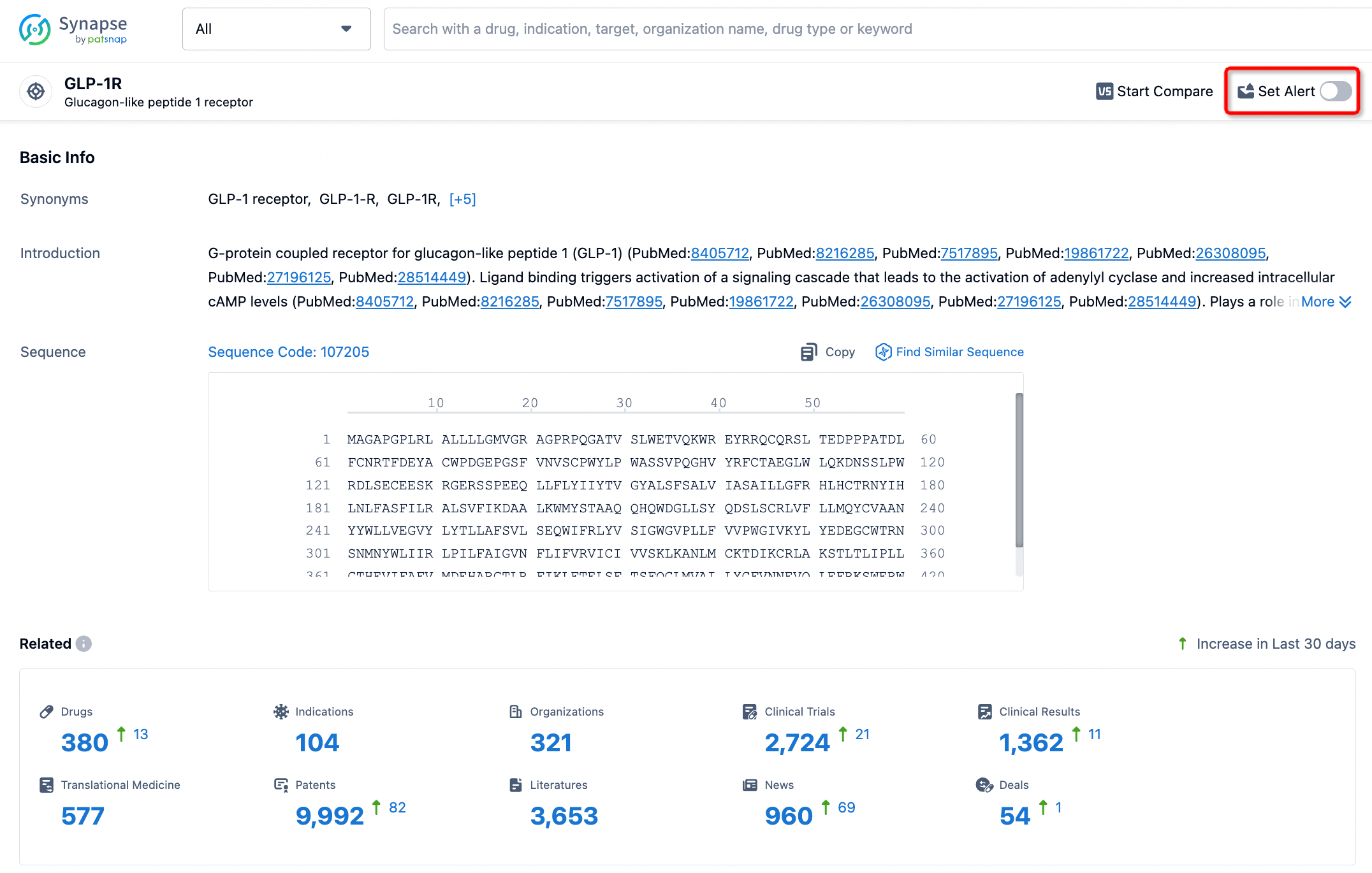
In the Synapse database, you can stay updated on the latest research and development advances of all targets. This service is accessible anytime and anywhere, with updates available daily or weekly. Use the "Set Alert" function to stay informed. Click on the image below to embark on a brand new journey of drug discovery!


AI Agents Built for Biopharma Breakthroughs
Accelerate discovery. Empower decisions. Transform outcomes.
Get started for free today!
Accelerate Strategic R&D decision making with Synapse, PatSnap’s AI-powered Connected Innovation Intelligence Platform Built for Life Sciences Professionals.
Start your data trial now!
Synapse data is also accessible to external entities via APIs or data packages. Empower better decisions with the latest in pharmaceutical intelligence.