Request Demo
What is Eflimrufusp alfa used for?
28 June 2024
Eflimrufusp alfa is an emerging biologic drug that has garnered significant attention in the pharmaceutical and medical research communities. Developed through a collaborative effort involving several prominent research institutions, including the National Institutes of Health (NIH) and a consortium of leading academic medical centers, Eflimrufusp alfa represents a new frontier in targeted therapeutics. This drug is classified as a monoclonal antibody, a type of biologic that can precisely target specific proteins involved in disease processes. Currently, Eflimrufusp alfa is under investigation for its potential to treat autoimmune diseases, with a particular focus on rheumatoid arthritis (RA) and systemic lupus erythematosus (SLE). While still in the research phase, early clinical trials have shown promising results, propelling it to the forefront of potential new treatments for these chronic conditions.
The mechanism of action for Eflimrufusp alfa is both innovative and highly specific, setting it apart from existing therapies. Unlike traditional disease-modifying antirheumatic drugs (DMARDs) that broadly suppress the immune system, Eflimrufusp alfa works by targeting and neutralizing a particular cytokine known as interleukin-17A (IL-17A). IL-17A is a pro-inflammatory molecule that plays a pivotal role in the pathogenesis of several autoimmune diseases. By binding to IL-17A, Eflimrufusp alfa prevents this cytokine from interacting with its receptors on the surface of various immune cells. This inhibition leads to a reduction in the inflammatory cascade that typically results in the tissue damage and chronic pain seen in autoimmune conditions. Importantly, this targeted approach aims to minimize the broader immunosuppressive effects, potentially reducing the risk of infections and other adverse effects commonly associated with current treatments.
Rheumatoid arthritis and systemic lupus erythematosus are the primary indications for Eflimrufusp alfa. Both of these conditions are characterized by chronic inflammation and autoimmunity, where the body's immune system mistakenly attacks its own tissues. Rheumatoid arthritis primarily affects the joints, leading to painful swelling, stiffness, and eventual joint destruction if left untreated. Systemic lupus erythematosus, on the other hand, can affect multiple organ systems, including the skin, kidneys, brain, and cardiovascular system, causing a wide range of symptoms from mild rashes to severe organ damage. Current treatment options for these diseases often involve a combination of nonsteroidal anti-inflammatory drugs (NSAIDs), corticosteroids, and DMARDs, all of which come with their own sets of risks and limitations.
Eflimrufusp alfa offers a novel approach by specifically targeting IL-17A, a cytokine that has been implicated in the pathogenesis of both RA and SLE. Early clinical trials have demonstrated that patients receiving Eflimrufusp alfa experience significant improvements in symptom severity, physical function, and overall quality of life compared to those receiving placebo or standard treatments. The drug has shown a favorable safety profile, with fewer reported cases of serious infections and adverse events, suggesting that it may offer a safer alternative to broad-spectrum immunosuppressive therapies.
The development of Eflimrufusp alfa is a testament to the advancements in our understanding of the molecular underpinnings of autoimmune diseases. By honing in on specific targets like IL-17A, researchers are paving the way for more personalized and effective treatments. As the drug progresses through the various phases of clinical trials, it holds the promise of becoming a new standard of care for patients suffering from rheumatoid arthritis and systemic lupus erythematosus, offering hope for better disease management and an improved quality of life.
In conclusion, Eflimrufusp alfa represents a significant leap forward in the treatment of autoimmune diseases. Its targeted mechanism of action, promising clinical trial results, and potential for a favorable safety profile make it a noteworthy candidate in the ongoing quest to improve therapeutic options for conditions like rheumatoid arthritis and systemic lupus erythematosus. As research continues, the medical community remains hopeful that Eflimrufusp alfa will soon become an integral part of the therapeutic arsenal against these debilitating diseases.
The mechanism of action for Eflimrufusp alfa is both innovative and highly specific, setting it apart from existing therapies. Unlike traditional disease-modifying antirheumatic drugs (DMARDs) that broadly suppress the immune system, Eflimrufusp alfa works by targeting and neutralizing a particular cytokine known as interleukin-17A (IL-17A). IL-17A is a pro-inflammatory molecule that plays a pivotal role in the pathogenesis of several autoimmune diseases. By binding to IL-17A, Eflimrufusp alfa prevents this cytokine from interacting with its receptors on the surface of various immune cells. This inhibition leads to a reduction in the inflammatory cascade that typically results in the tissue damage and chronic pain seen in autoimmune conditions. Importantly, this targeted approach aims to minimize the broader immunosuppressive effects, potentially reducing the risk of infections and other adverse effects commonly associated with current treatments.
Rheumatoid arthritis and systemic lupus erythematosus are the primary indications for Eflimrufusp alfa. Both of these conditions are characterized by chronic inflammation and autoimmunity, where the body's immune system mistakenly attacks its own tissues. Rheumatoid arthritis primarily affects the joints, leading to painful swelling, stiffness, and eventual joint destruction if left untreated. Systemic lupus erythematosus, on the other hand, can affect multiple organ systems, including the skin, kidneys, brain, and cardiovascular system, causing a wide range of symptoms from mild rashes to severe organ damage. Current treatment options for these diseases often involve a combination of nonsteroidal anti-inflammatory drugs (NSAIDs), corticosteroids, and DMARDs, all of which come with their own sets of risks and limitations.
Eflimrufusp alfa offers a novel approach by specifically targeting IL-17A, a cytokine that has been implicated in the pathogenesis of both RA and SLE. Early clinical trials have demonstrated that patients receiving Eflimrufusp alfa experience significant improvements in symptom severity, physical function, and overall quality of life compared to those receiving placebo or standard treatments. The drug has shown a favorable safety profile, with fewer reported cases of serious infections and adverse events, suggesting that it may offer a safer alternative to broad-spectrum immunosuppressive therapies.
The development of Eflimrufusp alfa is a testament to the advancements in our understanding of the molecular underpinnings of autoimmune diseases. By honing in on specific targets like IL-17A, researchers are paving the way for more personalized and effective treatments. As the drug progresses through the various phases of clinical trials, it holds the promise of becoming a new standard of care for patients suffering from rheumatoid arthritis and systemic lupus erythematosus, offering hope for better disease management and an improved quality of life.
In conclusion, Eflimrufusp alfa represents a significant leap forward in the treatment of autoimmune diseases. Its targeted mechanism of action, promising clinical trial results, and potential for a favorable safety profile make it a noteworthy candidate in the ongoing quest to improve therapeutic options for conditions like rheumatoid arthritis and systemic lupus erythematosus. As research continues, the medical community remains hopeful that Eflimrufusp alfa will soon become an integral part of the therapeutic arsenal against these debilitating diseases.
How to obtain the latest development progress of all drugs?
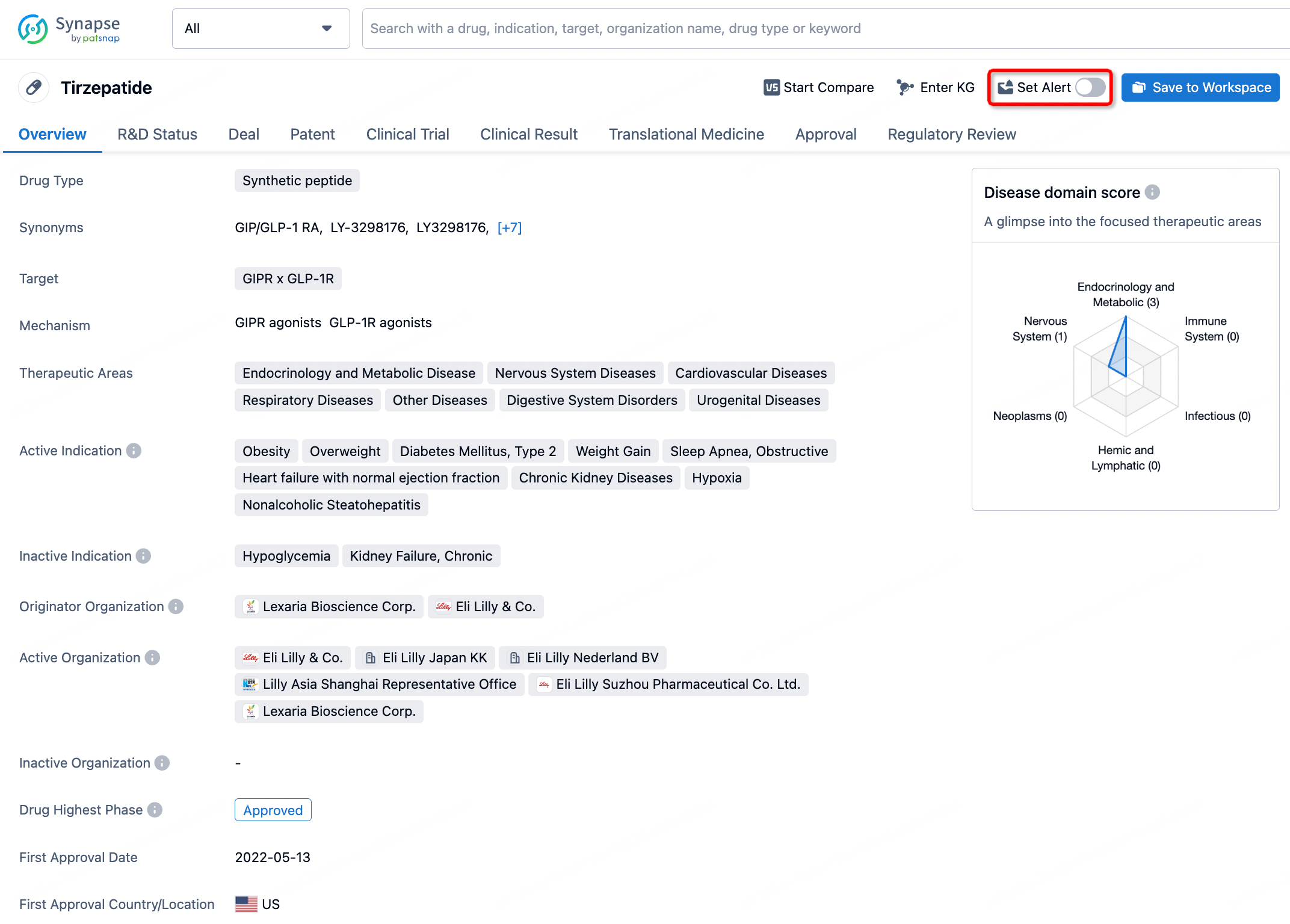
In the Synapse database, you can stay updated on the latest research and development advances of all drugs. This service is accessible anytime and anywhere, with updates available daily or weekly. Use the "Set Alert" function to stay informed. Click on the image below to embark on a brand new journey of drug discovery!

AI Agents Built for Biopharma Breakthroughs
Accelerate discovery. Empower decisions. Transform outcomes.
Get started for free today!
Accelerate Strategic R&D decision making with Synapse, PatSnap’s AI-powered Connected Innovation Intelligence Platform Built for Life Sciences Professionals.
Start your data trial now!
Synapse data is also accessible to external entities via APIs or data packages. Empower better decisions with the latest in pharmaceutical intelligence.