Request Demo
What is OC-02 used for?
28 June 2024
OC-02 is an innovative and promising therapeutic agent currently being researched and developed for its potential benefits in ophthalmic conditions. The drug has garnered significant attention in the medical community due to its unique mechanism of action and the extensive research supporting its efficacy. OC-02 is being developed by Oyster Point Pharma, a biopharmaceutical company dedicated to discovering, developing, and commercializing first-in-class therapies to address significant unmet medical needs in ocular surface diseases.
The drug is classified as a nicotinic acetylcholine receptor (nAChR) agonist, which targets specific receptors in the trigeminal parasympathetic pathway. This pathway is crucial for the regulation of tear production, which is essential for maintaining the health of the corneal surface. The primary indication for OC-02 is dry eye disease (DED), a condition characterized by insufficient tear production or poor tear quality, leading to discomfort, visual disturbance, and potential damage to the ocular surface. Currently, OC-02 is in the late stages of clinical development, with promising results from Phase 2 and Phase 3 clinical trials, indicating its potential efficacy and safety for patients suffering from dry eye disease.
The mechanism of action of OC-02 is particularly noteworthy due to its novel approach to treating dry eye disease. As a nicotinic acetylcholine receptor agonist, OC-02 stimulates the parasympathetic nervous system by activating the trigeminal parasympathetic pathway. This activation results in increased tear production from both the lacrimal glands (which produce the aqueous layer of the tear film) and the meibomian glands (which produce the lipid layer of the tear film). By enhancing the secretion from these glands, OC-02 helps to restore a more stable and healthy tear film, addressing both the quantity and quality of tears.
The unique mechanism of OC-02 differentiates it from other dry eye treatments currently available, such as artificial tears or anti-inflammatory medications, which primarily address the symptoms rather than the underlying cause of the disease. By targeting the neural regulation of tear production, OC-02 offers a more holistic and potentially more effective solution for patients with dry eye disease. This innovative approach also suggests that OC-02 may have broader applications in other ocular surface diseases where tear production is compromised.
Dry eye disease is the primary indication for OC-02, a condition affecting millions of individuals worldwide. It is a multifactorial disease of the ocular surface characterized by a loss of homeostasis of the tear film and is accompanied by ocular symptoms such as discomfort, visual disturbance, and tear film instability. The disease can significantly impact the quality of life, causing chronic pain, blurred vision, difficulty with daily activities such as reading or driving, and even depression due to the persistent and often debilitating nature of the symptoms.
Patients with dry eye disease often suffer from chronic inflammation and damage to the ocular surface, leading to a vicious cycle of worsening symptoms. Traditional treatments, including over-the-counter artificial tears and prescription anti-inflammatory eye drops, provide symptomatic relief but do not address the underlying causes of the disease. OC-02’s ability to enhance natural tear production represents a significant advancement in the treatment landscape, offering a potential long-term solution for managing dry eye disease.
The development of OC-02 has been met with cautious optimism within the medical community, particularly given the robust data emerging from clinical trials. In Phase 2 studies, OC-02 demonstrated statistically significant improvements in both the signs and symptoms of dry eye disease compared to placebo. Patients reported reduced eye dryness, improved ocular comfort, and better overall quality of life. Further, the Phase 3 trials have reinforced these findings, showing that OC-02 is not only effective but also well-tolerated, with a favorable safety profile.
In conclusion, OC-02 represents a promising advance in the treatment of dry eye disease through its novel mechanism of action as a nicotinic acetylcholine receptor agonist. By targeting the neural pathways regulating tear production, OC-02 offers the potential to restore tear film homeostasis and provide significant relief to patients suffering from this chronic and often debilitating condition. As research progresses, OC-02 may well become a cornerstone in the management of dry eye disease and potentially other related ocular surface disorders.
The drug is classified as a nicotinic acetylcholine receptor (nAChR) agonist, which targets specific receptors in the trigeminal parasympathetic pathway. This pathway is crucial for the regulation of tear production, which is essential for maintaining the health of the corneal surface. The primary indication for OC-02 is dry eye disease (DED), a condition characterized by insufficient tear production or poor tear quality, leading to discomfort, visual disturbance, and potential damage to the ocular surface. Currently, OC-02 is in the late stages of clinical development, with promising results from Phase 2 and Phase 3 clinical trials, indicating its potential efficacy and safety for patients suffering from dry eye disease.
The mechanism of action of OC-02 is particularly noteworthy due to its novel approach to treating dry eye disease. As a nicotinic acetylcholine receptor agonist, OC-02 stimulates the parasympathetic nervous system by activating the trigeminal parasympathetic pathway. This activation results in increased tear production from both the lacrimal glands (which produce the aqueous layer of the tear film) and the meibomian glands (which produce the lipid layer of the tear film). By enhancing the secretion from these glands, OC-02 helps to restore a more stable and healthy tear film, addressing both the quantity and quality of tears.
The unique mechanism of OC-02 differentiates it from other dry eye treatments currently available, such as artificial tears or anti-inflammatory medications, which primarily address the symptoms rather than the underlying cause of the disease. By targeting the neural regulation of tear production, OC-02 offers a more holistic and potentially more effective solution for patients with dry eye disease. This innovative approach also suggests that OC-02 may have broader applications in other ocular surface diseases where tear production is compromised.
Dry eye disease is the primary indication for OC-02, a condition affecting millions of individuals worldwide. It is a multifactorial disease of the ocular surface characterized by a loss of homeostasis of the tear film and is accompanied by ocular symptoms such as discomfort, visual disturbance, and tear film instability. The disease can significantly impact the quality of life, causing chronic pain, blurred vision, difficulty with daily activities such as reading or driving, and even depression due to the persistent and often debilitating nature of the symptoms.
Patients with dry eye disease often suffer from chronic inflammation and damage to the ocular surface, leading to a vicious cycle of worsening symptoms. Traditional treatments, including over-the-counter artificial tears and prescription anti-inflammatory eye drops, provide symptomatic relief but do not address the underlying causes of the disease. OC-02’s ability to enhance natural tear production represents a significant advancement in the treatment landscape, offering a potential long-term solution for managing dry eye disease.
The development of OC-02 has been met with cautious optimism within the medical community, particularly given the robust data emerging from clinical trials. In Phase 2 studies, OC-02 demonstrated statistically significant improvements in both the signs and symptoms of dry eye disease compared to placebo. Patients reported reduced eye dryness, improved ocular comfort, and better overall quality of life. Further, the Phase 3 trials have reinforced these findings, showing that OC-02 is not only effective but also well-tolerated, with a favorable safety profile.
In conclusion, OC-02 represents a promising advance in the treatment of dry eye disease through its novel mechanism of action as a nicotinic acetylcholine receptor agonist. By targeting the neural pathways regulating tear production, OC-02 offers the potential to restore tear film homeostasis and provide significant relief to patients suffering from this chronic and often debilitating condition. As research progresses, OC-02 may well become a cornerstone in the management of dry eye disease and potentially other related ocular surface disorders.
How to obtain the latest development progress of all drugs?
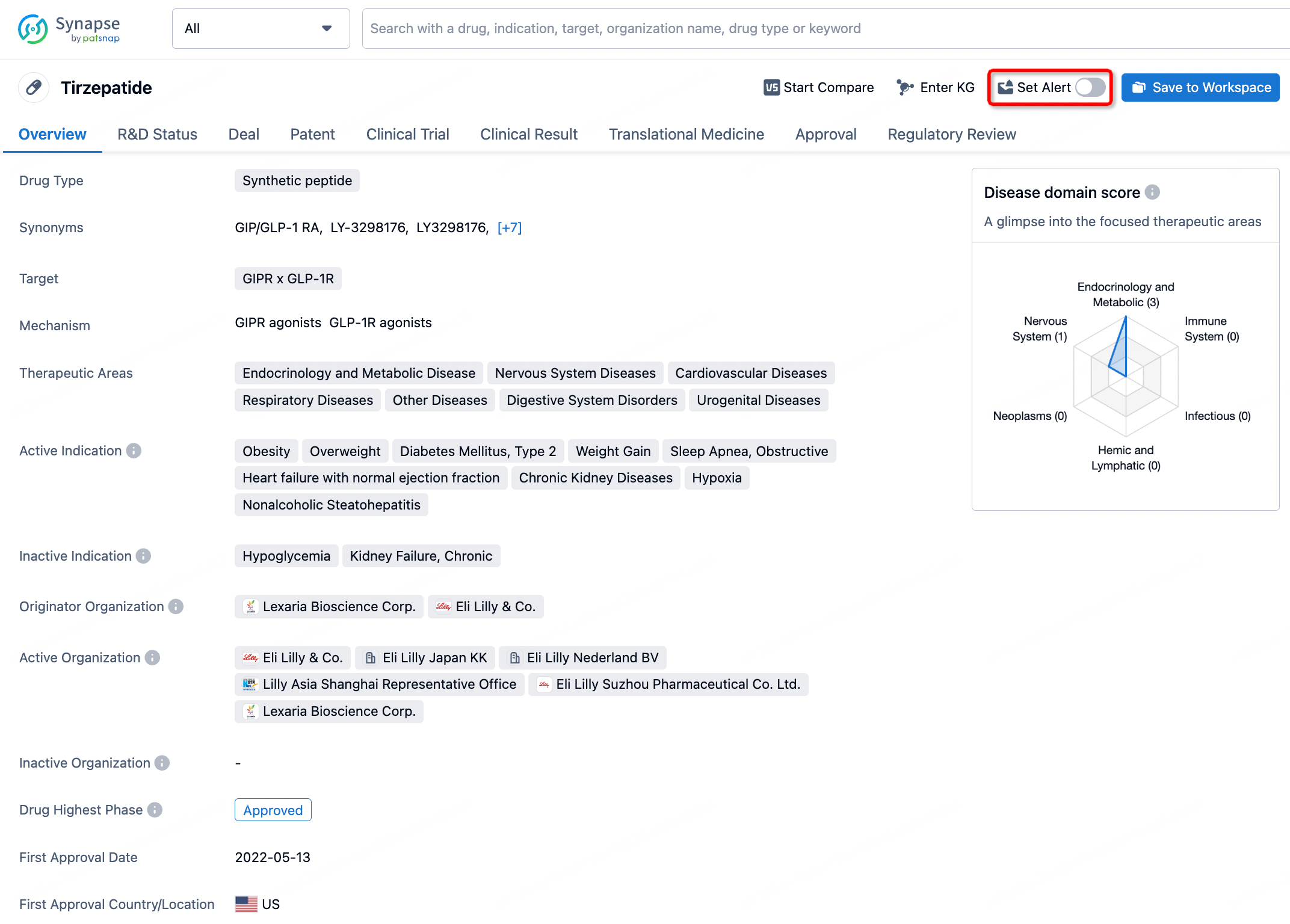
In the Synapse database, you can stay updated on the latest research and development advances of all drugs. This service is accessible anytime and anywhere, with updates available daily or weekly. Use the "Set Alert" function to stay informed. Click on the image below to embark on a brand new journey of drug discovery!


AI Agents Built for Biopharma Breakthroughs
Accelerate discovery. Empower decisions. Transform outcomes.
Get started for free today!
Accelerate Strategic R&D decision making with Synapse, PatSnap’s AI-powered Connected Innovation Intelligence Platform Built for Life Sciences Professionals.
Start your data trial now!
Synapse data is also accessible to external entities via APIs or data packages. Empower better decisions with the latest in pharmaceutical intelligence.