Request Demo
What is the mechanism of Acetohexamide?
18 July 2024
Acetohexamide is a sulfonylurea class drug primarily used in the management of type 2 diabetes mellitus. Being one of the first-generation sulfonylureas, Acetohexamide has a unique mechanism of action that helps regulate blood glucose levels in diabetic patients. To understand its mechanism, it is essential to delve into the pharmacological aspects and the biochemical pathways impacted by this medication.
The primary mechanism of action of Acetohexamide involves stimulating insulin secretion from the pancreatic β-cells. This is achieved through the interaction with specific receptors on the surface of the β-cells. Acetohexamide binds to the sulfonylurea receptor 1 (SUR1), which is a subunit of the ATP-sensitive potassium (K_ATP) channel located in the plasma membrane of the β-cells. Under normal conditions, these K_ATP channels play a critical role in regulating the membrane potential of β-cells.
In the absence of Acetohexamide, the K_ATP channels remain open, allowing potassium ions to exit the cells, thereby maintaining a hyperpolarized state. This hyperpolarization prevents the opening of voltage-gated calcium channels, thus inhibiting calcium influx. Since calcium is a critical secondary messenger for insulin secretion, low intracellular calcium levels result in reduced insulin release.
When Acetohexamide binds to the SUR1 receptor, it induces closure of the K_ATP channels. This closure leads to a decrease in potassium efflux, causing depolarization of the β-cell membrane. The depolarization subsequently triggers the opening of voltage-gated calcium channels, leading to an influx of calcium ions. The increased intracellular calcium concentration acts as a signal to stimulate the exocytosis of insulin-containing granules. Thus, Acetohexamide effectively enhances insulin secretion, which helps lower blood glucose levels.
Additionally, Acetohexamide has some extra-pancreatic effects that contribute to its glucose-lowering action. It has been reported to increase the sensitivity of peripheral tissues, such as muscle and adipose tissue, to insulin. This enhanced sensitivity helps improve glucose uptake and utilization by these tissues, further aiding in the reduction of blood glucose levels.
Moreover, Acetohexamide undergoes hepatic metabolism, primarily via the cytochrome P450 enzyme system. Its active metabolite, hydroxyhexamide, also contributes to its hypoglycemic effect. This metabolite has a longer half-life than the parent compound, which can help in maintaining prolonged glucose control.
In summary, the mechanism of Acetohexamide in managing type 2 diabetes mellitus is primarily through its action on pancreatic β-cells, leading to increased insulin secretion. The drug achieves this by binding to the SUR1 receptor, causing the closure of K_ATP channels, resulting in cell membrane depolarization and subsequent calcium influx. Additionally, Acetohexamide improves insulin sensitivity in peripheral tissues and has a significant active metabolite contributing to its therapeutic efficacy. Understanding these mechanisms helps in appreciating how Acetohexamide functions to control blood glucose levels in diabetic patients.
The primary mechanism of action of Acetohexamide involves stimulating insulin secretion from the pancreatic β-cells. This is achieved through the interaction with specific receptors on the surface of the β-cells. Acetohexamide binds to the sulfonylurea receptor 1 (SUR1), which is a subunit of the ATP-sensitive potassium (K_ATP) channel located in the plasma membrane of the β-cells. Under normal conditions, these K_ATP channels play a critical role in regulating the membrane potential of β-cells.
In the absence of Acetohexamide, the K_ATP channels remain open, allowing potassium ions to exit the cells, thereby maintaining a hyperpolarized state. This hyperpolarization prevents the opening of voltage-gated calcium channels, thus inhibiting calcium influx. Since calcium is a critical secondary messenger for insulin secretion, low intracellular calcium levels result in reduced insulin release.
When Acetohexamide binds to the SUR1 receptor, it induces closure of the K_ATP channels. This closure leads to a decrease in potassium efflux, causing depolarization of the β-cell membrane. The depolarization subsequently triggers the opening of voltage-gated calcium channels, leading to an influx of calcium ions. The increased intracellular calcium concentration acts as a signal to stimulate the exocytosis of insulin-containing granules. Thus, Acetohexamide effectively enhances insulin secretion, which helps lower blood glucose levels.
Additionally, Acetohexamide has some extra-pancreatic effects that contribute to its glucose-lowering action. It has been reported to increase the sensitivity of peripheral tissues, such as muscle and adipose tissue, to insulin. This enhanced sensitivity helps improve glucose uptake and utilization by these tissues, further aiding in the reduction of blood glucose levels.
Moreover, Acetohexamide undergoes hepatic metabolism, primarily via the cytochrome P450 enzyme system. Its active metabolite, hydroxyhexamide, also contributes to its hypoglycemic effect. This metabolite has a longer half-life than the parent compound, which can help in maintaining prolonged glucose control.
In summary, the mechanism of Acetohexamide in managing type 2 diabetes mellitus is primarily through its action on pancreatic β-cells, leading to increased insulin secretion. The drug achieves this by binding to the SUR1 receptor, causing the closure of K_ATP channels, resulting in cell membrane depolarization and subsequent calcium influx. Additionally, Acetohexamide improves insulin sensitivity in peripheral tissues and has a significant active metabolite contributing to its therapeutic efficacy. Understanding these mechanisms helps in appreciating how Acetohexamide functions to control blood glucose levels in diabetic patients.
How to obtain the latest development progress of all drugs?
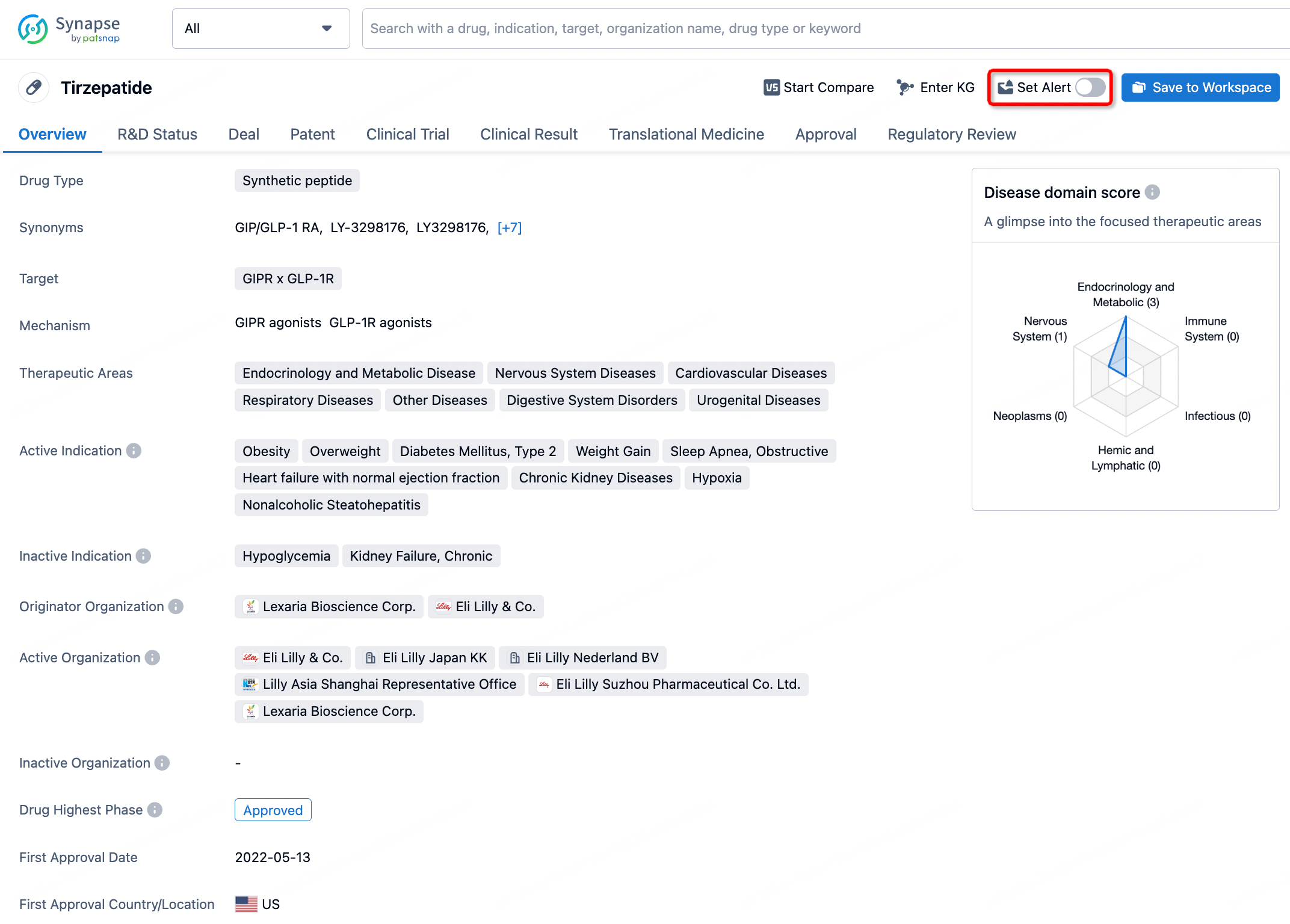
In the Synapse database, you can stay updated on the latest research and development advances of all drugs. This service is accessible anytime and anywhere, with updates available daily or weekly. Use the "Set Alert" function to stay informed. Click on the image below to embark on a brand new journey of drug discovery!

AI Agents Built for Biopharma Breakthroughs
Accelerate discovery. Empower decisions. Transform outcomes.
Get started for free today!
Accelerate Strategic R&D decision making with Synapse, PatSnap’s AI-powered Connected Innovation Intelligence Platform Built for Life Sciences Professionals.
Start your data trial now!
Synapse data is also accessible to external entities via APIs or data packages. Empower better decisions with the latest in pharmaceutical intelligence.