Request Demo
What is the mechanism of BRN-2129747?
17 July 2024
BRN-2129747, a compound garnering increasing attention in the fields of pharmacology and biochemistry, represents a promising candidate in the realm of therapeutic agents. Understanding its mechanism of action requires delving into its biochemical interactions, molecular targets, and the subsequent physiological responses it elicits.
The primary focus of BRN-2129747's mechanism involves its interaction at the cellular level, particularly within specific signaling pathways that are crucial for maintaining cellular homeostasis. This compound has been shown to exhibit high affinity for particular receptor sites, which are often implicated in the pathogenesis of various diseases. By binding to these receptors, BRN-2129747 modulates their activity, thereby altering the downstream signaling cascades.
One of the key pathways influenced by BRN-2129747 is the PI3K/Akt/mTOR pathway, a critical regulator of cell growth, proliferation, and survival. BRN-2129747 appears to exert its effects by inhibiting the activity of PI3K, an enzyme that phosphorylates and activates Akt. The inhibition of PI3K leads to a reduction in Akt phosphorylation, which in turn diminishes mTOR activity. This chain of events ultimately results in the suppression of cellular proliferation and induction of apoptosis, particularly in cancerous cells where this pathway is often dysregulated.
Furthermore, BRN-2129747's role extends to the modulation of the immune response. It has been observed to influence the activity of various cytokines and immune cells. By altering the cytokine milieu, BRN-2129747 can enhance the body's immune response against pathological conditions, including infections and autoimmune diseases. The exact molecular details of this immune modulation are still under investigation, but initial findings suggest that BRN-2129747 can either potentiate or suppress immune activity depending on the context, thereby providing a versatile tool for therapeutic interventions.
Another significant aspect of BRN-2129747's mechanism involves its impact on the oxidative stress response. Oxidative stress, characterized by an imbalance between the production of reactive oxygen species (ROS) and the antioxidant defense system, plays a pivotal role in the progression of numerous diseases, including neurodegenerative disorders and cardiovascular diseases. BRN-2129747 has been shown to enhance the expression of antioxidant enzymes, thus bolstering the cell's defense against oxidative damage. This antioxidative property not only helps in protecting cellular integrity but also in maintaining overall physiological functions.
BRN-2129747 also exhibits neuroprotective effects, which are of particular interest in the context of neurodegenerative diseases such as Alzheimer's and Parkinson's disease. The compound's ability to cross the blood-brain barrier allows it to exert its effects directly within the central nervous system. By modulating neurotransmitter levels, reducing neuroinflammation, and mitigating oxidative stress, BRN-2129747 helps in preserving neuronal function and preventing neurodegeneration.
In conclusion, BRN-2129747 represents a multifaceted compound with diverse mechanisms of action. Its ability to interfere with key signaling pathways, modulate immune responses, enhance antioxidant defenses, and provide neuroprotection underscores its potential as a therapeutic agent. Ongoing research is expected to further elucidate the detailed molecular mechanisms of BRN-2129747, paving the way for its application in treating a wide array of diseases.
The primary focus of BRN-2129747's mechanism involves its interaction at the cellular level, particularly within specific signaling pathways that are crucial for maintaining cellular homeostasis. This compound has been shown to exhibit high affinity for particular receptor sites, which are often implicated in the pathogenesis of various diseases. By binding to these receptors, BRN-2129747 modulates their activity, thereby altering the downstream signaling cascades.
One of the key pathways influenced by BRN-2129747 is the PI3K/Akt/mTOR pathway, a critical regulator of cell growth, proliferation, and survival. BRN-2129747 appears to exert its effects by inhibiting the activity of PI3K, an enzyme that phosphorylates and activates Akt. The inhibition of PI3K leads to a reduction in Akt phosphorylation, which in turn diminishes mTOR activity. This chain of events ultimately results in the suppression of cellular proliferation and induction of apoptosis, particularly in cancerous cells where this pathway is often dysregulated.
Furthermore, BRN-2129747's role extends to the modulation of the immune response. It has been observed to influence the activity of various cytokines and immune cells. By altering the cytokine milieu, BRN-2129747 can enhance the body's immune response against pathological conditions, including infections and autoimmune diseases. The exact molecular details of this immune modulation are still under investigation, but initial findings suggest that BRN-2129747 can either potentiate or suppress immune activity depending on the context, thereby providing a versatile tool for therapeutic interventions.
Another significant aspect of BRN-2129747's mechanism involves its impact on the oxidative stress response. Oxidative stress, characterized by an imbalance between the production of reactive oxygen species (ROS) and the antioxidant defense system, plays a pivotal role in the progression of numerous diseases, including neurodegenerative disorders and cardiovascular diseases. BRN-2129747 has been shown to enhance the expression of antioxidant enzymes, thus bolstering the cell's defense against oxidative damage. This antioxidative property not only helps in protecting cellular integrity but also in maintaining overall physiological functions.
BRN-2129747 also exhibits neuroprotective effects, which are of particular interest in the context of neurodegenerative diseases such as Alzheimer's and Parkinson's disease. The compound's ability to cross the blood-brain barrier allows it to exert its effects directly within the central nervous system. By modulating neurotransmitter levels, reducing neuroinflammation, and mitigating oxidative stress, BRN-2129747 helps in preserving neuronal function and preventing neurodegeneration.
In conclusion, BRN-2129747 represents a multifaceted compound with diverse mechanisms of action. Its ability to interfere with key signaling pathways, modulate immune responses, enhance antioxidant defenses, and provide neuroprotection underscores its potential as a therapeutic agent. Ongoing research is expected to further elucidate the detailed molecular mechanisms of BRN-2129747, paving the way for its application in treating a wide array of diseases.
How to obtain the latest development progress of all drugs?
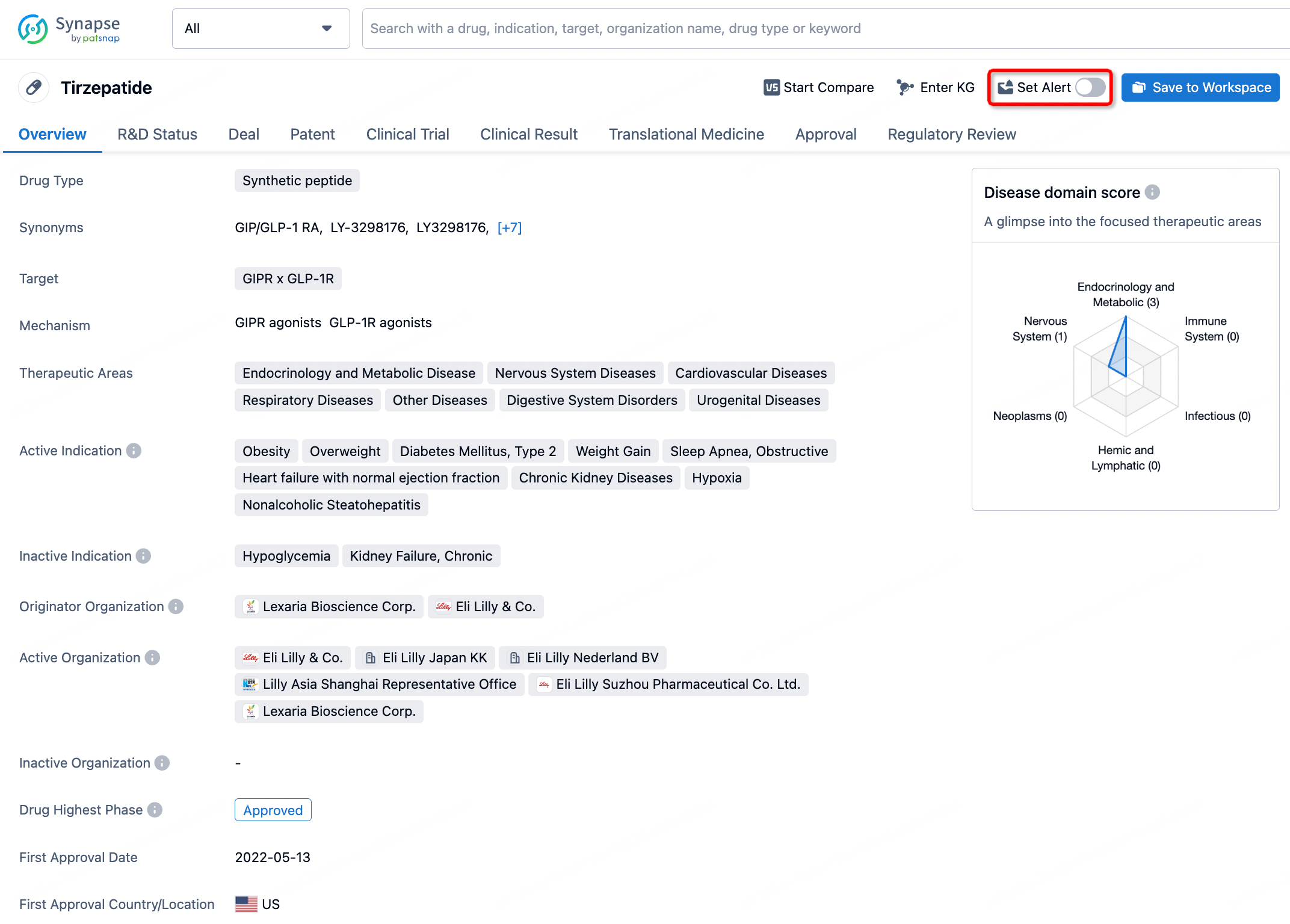
In the Synapse database, you can stay updated on the latest research and development advances of all drugs. This service is accessible anytime and anywhere, with updates available daily or weekly. Use the "Set Alert" function to stay informed. Click on the image below to embark on a brand new journey of drug discovery!


AI Agents Built for Biopharma Breakthroughs
Accelerate discovery. Empower decisions. Transform outcomes.
Get started for free today!
Accelerate Strategic R&D decision making with Synapse, PatSnap’s AI-powered Connected Innovation Intelligence Platform Built for Life Sciences Professionals.
Start your data trial now!
Synapse data is also accessible to external entities via APIs or data packages. Empower better decisions with the latest in pharmaceutical intelligence.