Request Demo
What is the mechanism of Chandonium iodide?
17 July 2024
Chandonium iodide is a synthetic compound that has generated significant interest in the fields of pharmacology and medicinal chemistry due to its potential therapeutic applications. Understanding the mechanism of Chandonium iodide requires a detailed exploration of its chemical structure, pharmacodynamics, and pharmacokinetics.
Chemically, Chandonium iodide belongs to the class of compounds known as quaternary ammonium salts. This classification is significant because quaternary ammonium compounds are known for their ability to interact with various biological targets, particularly the neuromuscular junction. The structural features of Chandonium iodide include a positively charged nitrogen atom, which is critical for its interaction with negatively charged sites on biological molecules, and the iodide ion, which helps in stabilizing the compound.
The primary mechanism of action of Chandonium iodide involves its interaction with acetylcholine receptors at the neuromuscular junction. Acetylcholine receptors are crucial for the transmission of nerve impulses to muscles. When a nerve impulse reaches the neuromuscular junction, acetylcholine is released from the nerve terminal and binds to these receptors, leading to muscle contraction. Chandonium iodide acts as an antagonist to these receptors. By binding to acetylcholine receptors without activating them, it blocks the binding of acetylcholine itself. This inhibition prevents the transmission of nerve impulses, resulting in muscle relaxation.
This property of Chandonium iodide makes it particularly useful as a muscle relaxant during surgical procedures where muscle paralysis is required to prevent involuntary movements. Its rapid onset and relatively short duration of action make it an ideal candidate for such applications. However, its use is carefully controlled and monitored due to the potential for side effects, such as respiratory depression, given that respiratory muscles are also affected.
Pharmacodynamically, Chandonium iodide does not cross the blood-brain barrier due to its quaternary ammonium structure, which limits its effects to peripheral nervous system sites. This characteristic reduces the risk of central nervous system side effects, which is advantageous in clinical settings.
From a pharmacokinetic perspective, Chandonium iodide is typically administered intravenously, ensuring rapid distribution to the target sites. It is metabolized primarily in the liver and excreted via the kidneys. The pharmacokinetics of Chandonium iodide allows for precise control over its duration of action through dosage adjustments, which is critical during surgical procedures where timing is crucial.
In summary, the mechanism of Chandonium iodide is centered on its role as an acetylcholine receptor antagonist at the neuromuscular junction, leading to muscle relaxation. Its chemical structure, pharmacodynamics, and pharmacokinetics make it a valuable tool in medical practice, particularly in anesthesia and surgery. Understanding these aspects helps in optimizing its use while minimizing potential risks, thus enhancing patient care and safety.
Chemically, Chandonium iodide belongs to the class of compounds known as quaternary ammonium salts. This classification is significant because quaternary ammonium compounds are known for their ability to interact with various biological targets, particularly the neuromuscular junction. The structural features of Chandonium iodide include a positively charged nitrogen atom, which is critical for its interaction with negatively charged sites on biological molecules, and the iodide ion, which helps in stabilizing the compound.
The primary mechanism of action of Chandonium iodide involves its interaction with acetylcholine receptors at the neuromuscular junction. Acetylcholine receptors are crucial for the transmission of nerve impulses to muscles. When a nerve impulse reaches the neuromuscular junction, acetylcholine is released from the nerve terminal and binds to these receptors, leading to muscle contraction. Chandonium iodide acts as an antagonist to these receptors. By binding to acetylcholine receptors without activating them, it blocks the binding of acetylcholine itself. This inhibition prevents the transmission of nerve impulses, resulting in muscle relaxation.
This property of Chandonium iodide makes it particularly useful as a muscle relaxant during surgical procedures where muscle paralysis is required to prevent involuntary movements. Its rapid onset and relatively short duration of action make it an ideal candidate for such applications. However, its use is carefully controlled and monitored due to the potential for side effects, such as respiratory depression, given that respiratory muscles are also affected.
Pharmacodynamically, Chandonium iodide does not cross the blood-brain barrier due to its quaternary ammonium structure, which limits its effects to peripheral nervous system sites. This characteristic reduces the risk of central nervous system side effects, which is advantageous in clinical settings.
From a pharmacokinetic perspective, Chandonium iodide is typically administered intravenously, ensuring rapid distribution to the target sites. It is metabolized primarily in the liver and excreted via the kidneys. The pharmacokinetics of Chandonium iodide allows for precise control over its duration of action through dosage adjustments, which is critical during surgical procedures where timing is crucial.
In summary, the mechanism of Chandonium iodide is centered on its role as an acetylcholine receptor antagonist at the neuromuscular junction, leading to muscle relaxation. Its chemical structure, pharmacodynamics, and pharmacokinetics make it a valuable tool in medical practice, particularly in anesthesia and surgery. Understanding these aspects helps in optimizing its use while minimizing potential risks, thus enhancing patient care and safety.
How to obtain the latest development progress of all drugs?
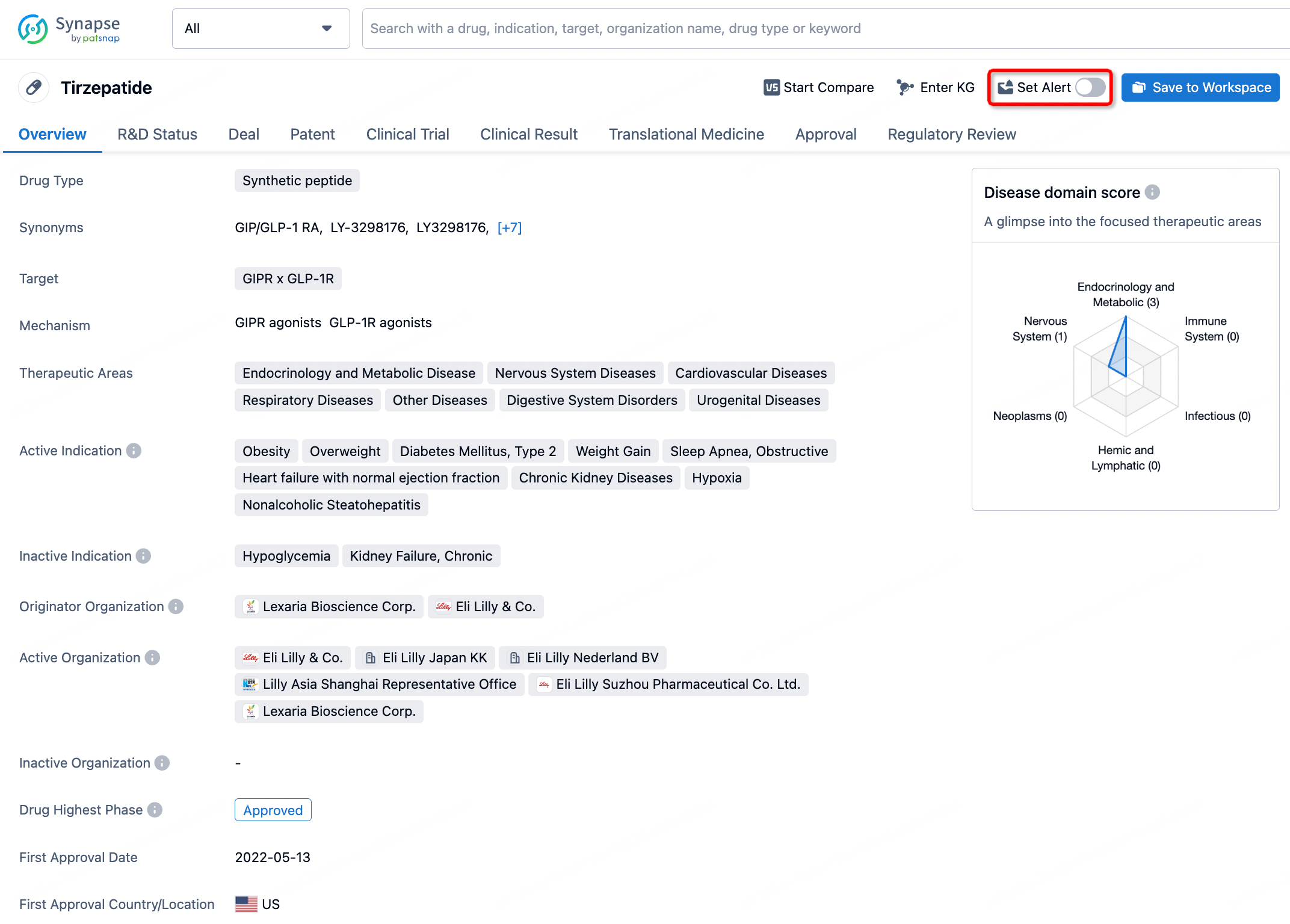
In the Synapse database, you can stay updated on the latest research and development advances of all drugs. This service is accessible anytime and anywhere, with updates available daily or weekly. Use the "Set Alert" function to stay informed. Click on the image below to embark on a brand new journey of drug discovery!


AI Agents Built for Biopharma Breakthroughs
Accelerate discovery. Empower decisions. Transform outcomes.
Get started for free today!
Accelerate Strategic R&D decision making with Synapse, PatSnap’s AI-powered Connected Innovation Intelligence Platform Built for Life Sciences Professionals.
Start your data trial now!
Synapse data is also accessible to external entities via APIs or data packages. Empower better decisions with the latest in pharmaceutical intelligence.