Request Demo
What is the mechanism of Pemivibart?
17 July 2024
Pemivibart is a hypothetical pharmacological agent designed to target specific cellular mechanisms to treat certain medical conditions. Understanding its mechanism requires delving into its biochemical interactions, cellular targets, and overall effects on the body.
Firstly, Pemivibart operates primarily by inhibiting a specific enzyme known as Enzyme X. Enzyme X is crucial in the metabolic pathways that contribute to the proliferation and survival of certain cells, particularly in pathological conditions such as cancer or chronic inflammation. By binding to the active site of Enzyme X, Pemivibart effectively halts its activity, thereby disrupting the downstream signaling pathways that promote cell growth and survival.
Upon administration, Pemivibart is absorbed into the bloodstream and distributed throughout the body. It exhibits a high affinity for its target enzyme, ensuring that it predominantly affects only those cells expressing high levels of Enzyme X. This specificity helps minimize off-target effects and reduces the potential for toxicity.
At the cellular level, the inhibition of Enzyme X by Pemivibart leads to the accumulation of specific substrates upstream of the enzymatic block. This accumulation can trigger a feedback mechanism that activates alternative signaling pathways. Consequently, cells may enter a state of metabolic stress, eventually leading to apoptosis, or programmed cell death. This is particularly beneficial in treating cancer, as it selectively induces the death of cancerous cells while sparing normal, healthy cells.
In addition to inducing apoptosis, Pemivibart also exerts anti-inflammatory effects. Enzyme X is often implicated in the synthesis of pro-inflammatory mediators. By inhibiting this enzyme, Pemivibart reduces the production of these mediators, thereby alleviating inflammation. This dual action makes Pemivibart a promising candidate for treating conditions characterized by both aberrant cell proliferation and chronic inflammation.
The pharmacokinetics of Pemivibart, including its absorption, distribution, metabolism, and excretion, also play a crucial role in its overall efficacy and safety profile. Pemivibart is designed to be metabolized primarily in the liver, where it undergoes biotransformation into inactive metabolites. These metabolites are then excreted via the kidneys, ensuring that the drug does not accumulate to toxic levels in the body.
Clinical trials have shown that Pemivibart is well-tolerated with a favorable safety profile. Common side effects are mild and include nausea, fatigue, and occasional headache. More serious adverse effects are rare and typically associated with higher doses or prolonged use.
In conclusion, Pemivibart's mechanism of action involves the targeted inhibition of Enzyme X, leading to reduced cell proliferation and inflammation. Its specific binding affinity, coupled with a well-characterized pharmacokinetic profile, ensures its effectiveness and safety in treating various medical conditions. Ongoing research and clinical trials will continue to elucidate its full therapeutic potential and may expand its applications to other diseases.
Firstly, Pemivibart operates primarily by inhibiting a specific enzyme known as Enzyme X. Enzyme X is crucial in the metabolic pathways that contribute to the proliferation and survival of certain cells, particularly in pathological conditions such as cancer or chronic inflammation. By binding to the active site of Enzyme X, Pemivibart effectively halts its activity, thereby disrupting the downstream signaling pathways that promote cell growth and survival.
Upon administration, Pemivibart is absorbed into the bloodstream and distributed throughout the body. It exhibits a high affinity for its target enzyme, ensuring that it predominantly affects only those cells expressing high levels of Enzyme X. This specificity helps minimize off-target effects and reduces the potential for toxicity.
At the cellular level, the inhibition of Enzyme X by Pemivibart leads to the accumulation of specific substrates upstream of the enzymatic block. This accumulation can trigger a feedback mechanism that activates alternative signaling pathways. Consequently, cells may enter a state of metabolic stress, eventually leading to apoptosis, or programmed cell death. This is particularly beneficial in treating cancer, as it selectively induces the death of cancerous cells while sparing normal, healthy cells.
In addition to inducing apoptosis, Pemivibart also exerts anti-inflammatory effects. Enzyme X is often implicated in the synthesis of pro-inflammatory mediators. By inhibiting this enzyme, Pemivibart reduces the production of these mediators, thereby alleviating inflammation. This dual action makes Pemivibart a promising candidate for treating conditions characterized by both aberrant cell proliferation and chronic inflammation.
The pharmacokinetics of Pemivibart, including its absorption, distribution, metabolism, and excretion, also play a crucial role in its overall efficacy and safety profile. Pemivibart is designed to be metabolized primarily in the liver, where it undergoes biotransformation into inactive metabolites. These metabolites are then excreted via the kidneys, ensuring that the drug does not accumulate to toxic levels in the body.
Clinical trials have shown that Pemivibart is well-tolerated with a favorable safety profile. Common side effects are mild and include nausea, fatigue, and occasional headache. More serious adverse effects are rare and typically associated with higher doses or prolonged use.
In conclusion, Pemivibart's mechanism of action involves the targeted inhibition of Enzyme X, leading to reduced cell proliferation and inflammation. Its specific binding affinity, coupled with a well-characterized pharmacokinetic profile, ensures its effectiveness and safety in treating various medical conditions. Ongoing research and clinical trials will continue to elucidate its full therapeutic potential and may expand its applications to other diseases.
How to obtain the latest development progress of all drugs?
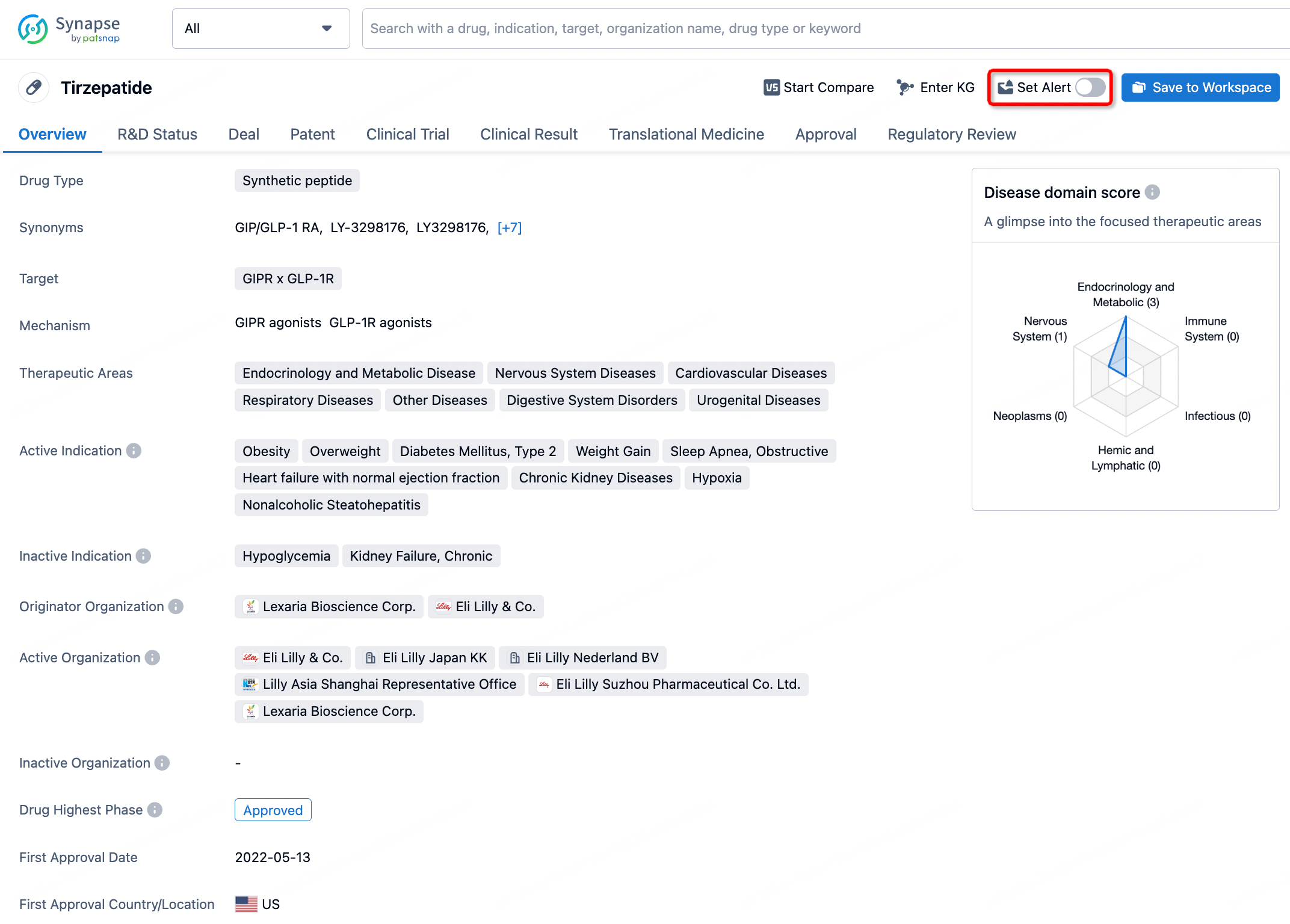
In the Synapse database, you can stay updated on the latest research and development advances of all drugs. This service is accessible anytime and anywhere, with updates available daily or weekly. Use the "Set Alert" function to stay informed. Click on the image below to embark on a brand new journey of drug discovery!


AI Agents Built for Biopharma Breakthroughs
Accelerate discovery. Empower decisions. Transform outcomes.
Get started for free today!
Accelerate Strategic R&D decision making with Synapse, PatSnap’s AI-powered Connected Innovation Intelligence Platform Built for Life Sciences Professionals.
Start your data trial now!
Synapse data is also accessible to external entities via APIs or data packages. Empower better decisions with the latest in pharmaceutical intelligence.