Request Demo
What is the mechanism of Trenonacog alfa?
17 July 2024
Trenonacog alfa, also known as recombinant factor IX, is a genetically engineered protein used in the management of hemophilia B, a genetic disorder characterized by the deficiency of factor IX. This clotting factor plays a critical role in the coagulation cascade, a complex series of events required for blood clot formation. Understanding the mechanism of Trenonacog alfa involves delving into the biological processes it influences and the molecular basis behind its therapeutic effects.
Hemophilia B, also known as Christmas disease, is a result of mutations in the F9 gene, which encodes the factor IX protein. This deficiency leads to impaired blood clotting, causing patients to suffer from prolonged bleeding episodes even after minor injuries. Traditionally, patients have managed this condition with plasma-derived or earlier generations of recombinant factor IX, but these treatments often require frequent administrations due to their shorter half-life.
Recombinant factor IX like Trenonacog alfa is produced using genetic engineering techniques in a controlled laboratory environment. This approach ensures a high level of purity and reduces the risk of contamination with blood-borne pathogens. The production process typically involves inserting the human factor IX gene into a host cell line, commonly Chinese hamster ovary (CHO) cells. These cells then produce the factor IX protein, which is subsequently purified for therapeutic use.
Once administered, Trenonacog alfa circulates in the bloodstream and integrates into the coagulation cascade. The coagulation process can be summarized in a series of steps: initiation, amplification, and propagation. Factor IX is part of the amplification phase, where it gets activated (factor IXa) and forms a complex with factor VIIIa on the surface of activated platelets. This complex, known as the tenase complex, is crucial for the activation of factor X to factor Xa. Factor Xa then converts prothrombin to thrombin, which ultimately leads to the formation of a fibrin clot, stabilizing the platelet plug and halting bleeding.
An essential aspect of Trenonacog alfa's therapeutic benefit is its pharmacokinetic profile. Advances in recombinant technology have enabled the design of factor IX variants with extended half-lives. This means that Trenonacog alfa can remain active in the bloodstream for a longer period compared to earlier treatments. The extended half-life is achieved through various modifications, such as glycoPEGylation, which attach polyethylene glycol (PEG) chains to the protein. These modifications not only enhance the stability of factor IX but also reduce the frequency of dosing, improving patient compliance and quality of life.
Clinical studies have demonstrated the efficacy of Trenonacog alfa in preventing and controlling bleeding episodes in patients with hemophilia B. Its use as a prophylactic treatment has significantly reduced the frequency of spontaneous bleeds and has been shown to maintain adequate factor IX levels, effectively mimicking the natural coagulation process. Furthermore, the safety profile of Trenonacog alfa has been favorable, with low incidence of adverse reactions and immunogenicity, which is crucial for long-term management.
In conclusion, Trenonacog alfa represents a significant advancement in the treatment of hemophilia B. Through its recombinant production, extended half-life, and effective integration into the coagulation cascade, it offers a reliable and safer alternative to traditional therapies. By addressing the underlying factor IX deficiency, Trenonacog alfa not only manages bleeding episodes effectively but also enhances the overall well-being of patients living with hemophilia B.
Hemophilia B, also known as Christmas disease, is a result of mutations in the F9 gene, which encodes the factor IX protein. This deficiency leads to impaired blood clotting, causing patients to suffer from prolonged bleeding episodes even after minor injuries. Traditionally, patients have managed this condition with plasma-derived or earlier generations of recombinant factor IX, but these treatments often require frequent administrations due to their shorter half-life.
Recombinant factor IX like Trenonacog alfa is produced using genetic engineering techniques in a controlled laboratory environment. This approach ensures a high level of purity and reduces the risk of contamination with blood-borne pathogens. The production process typically involves inserting the human factor IX gene into a host cell line, commonly Chinese hamster ovary (CHO) cells. These cells then produce the factor IX protein, which is subsequently purified for therapeutic use.
Once administered, Trenonacog alfa circulates in the bloodstream and integrates into the coagulation cascade. The coagulation process can be summarized in a series of steps: initiation, amplification, and propagation. Factor IX is part of the amplification phase, where it gets activated (factor IXa) and forms a complex with factor VIIIa on the surface of activated platelets. This complex, known as the tenase complex, is crucial for the activation of factor X to factor Xa. Factor Xa then converts prothrombin to thrombin, which ultimately leads to the formation of a fibrin clot, stabilizing the platelet plug and halting bleeding.
An essential aspect of Trenonacog alfa's therapeutic benefit is its pharmacokinetic profile. Advances in recombinant technology have enabled the design of factor IX variants with extended half-lives. This means that Trenonacog alfa can remain active in the bloodstream for a longer period compared to earlier treatments. The extended half-life is achieved through various modifications, such as glycoPEGylation, which attach polyethylene glycol (PEG) chains to the protein. These modifications not only enhance the stability of factor IX but also reduce the frequency of dosing, improving patient compliance and quality of life.
Clinical studies have demonstrated the efficacy of Trenonacog alfa in preventing and controlling bleeding episodes in patients with hemophilia B. Its use as a prophylactic treatment has significantly reduced the frequency of spontaneous bleeds and has been shown to maintain adequate factor IX levels, effectively mimicking the natural coagulation process. Furthermore, the safety profile of Trenonacog alfa has been favorable, with low incidence of adverse reactions and immunogenicity, which is crucial for long-term management.
In conclusion, Trenonacog alfa represents a significant advancement in the treatment of hemophilia B. Through its recombinant production, extended half-life, and effective integration into the coagulation cascade, it offers a reliable and safer alternative to traditional therapies. By addressing the underlying factor IX deficiency, Trenonacog alfa not only manages bleeding episodes effectively but also enhances the overall well-being of patients living with hemophilia B.
How to obtain the latest development progress of all drugs?
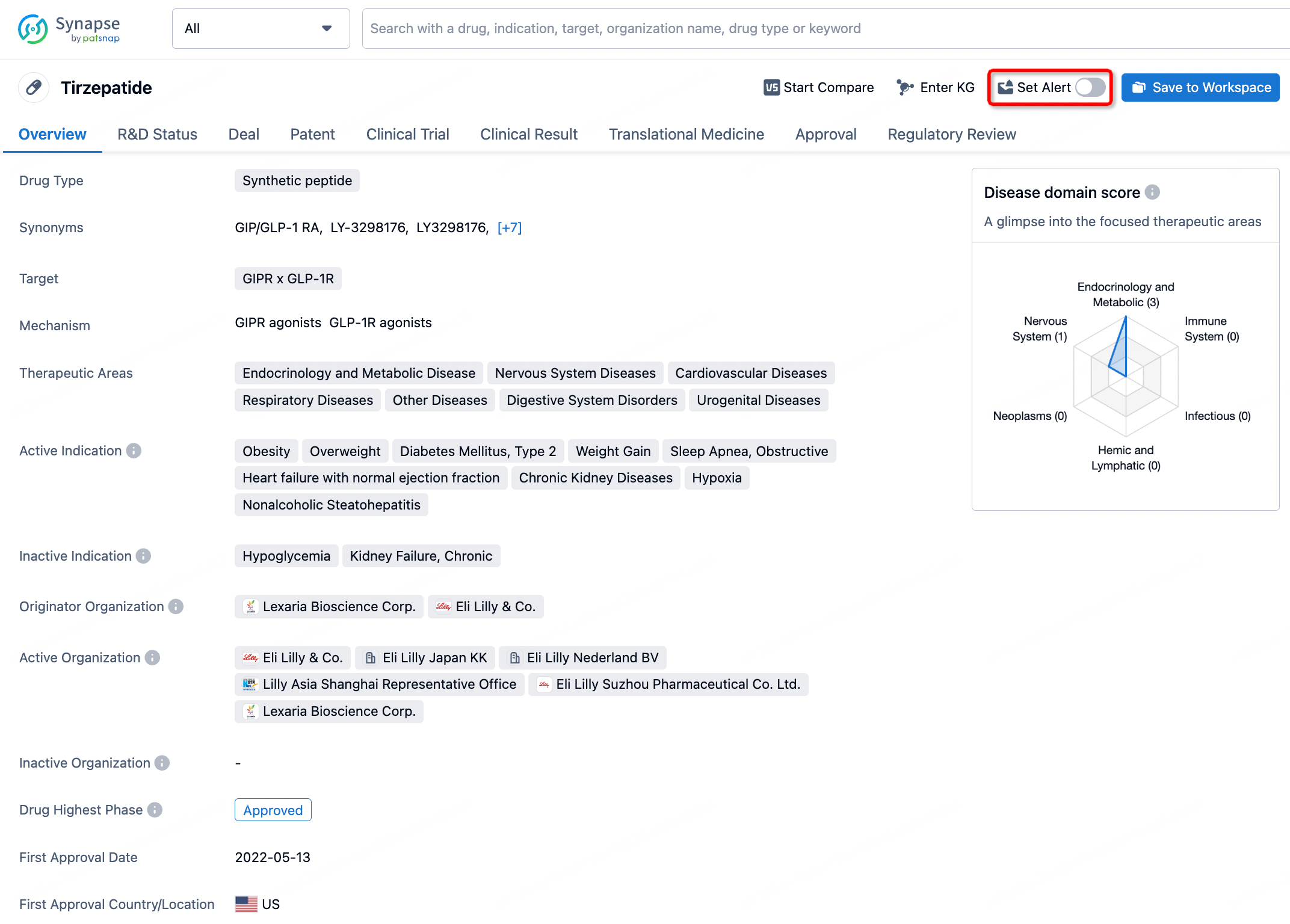
In the Synapse database, you can stay updated on the latest research and development advances of all drugs. This service is accessible anytime and anywhere, with updates available daily or weekly. Use the "Set Alert" function to stay informed. Click on the image below to embark on a brand new journey of drug discovery!


AI Agents Built for Biopharma Breakthroughs
Accelerate discovery. Empower decisions. Transform outcomes.
Get started for free today!
Accelerate Strategic R&D decision making with Synapse, PatSnap’s AI-powered Connected Innovation Intelligence Platform Built for Life Sciences Professionals.
Start your data trial now!
Synapse data is also accessible to external entities via APIs or data packages. Empower better decisions with the latest in pharmaceutical intelligence.