Request Demo
What is UI-063 used for?
28 June 2024
UI-063: A Promising New Compound in the Fight Against Neurodegenerative Diseases
The relentless pursuit of effective treatments for neurodegenerative diseases has led to the discovery and development of numerous compounds. Among these is UI-063, a novel therapeutic candidate that has been generating considerable interest within the scientific community. Developed by a consortium of leading research institutions worldwide, UI-063 is being studied for its potential to address some of the most challenging neurodegenerative conditions, including Alzheimer's disease and Parkinson's disease. As a small-molecule drug, UI-063 represents a new class of compounds designed to target specific pathways implicated in these disorders. Early-phase clinical trials have shown promising results, and the compound is currently advancing through the research pipeline with great anticipation.
UI-063 Mechanism of Action
Central to the excitement around UI-063 is its unique mechanism of action. Neurodegenerative diseases are often characterized by the accumulation of toxic proteins that lead to neuronal death and cognitive decline. For instance, Alzheimer's disease is marked by the build-up of amyloid-beta plaques and tau tangles, while Parkinson's disease involves the accumulation of alpha-synuclein. UI-063 has been designed to target these pathological features directly.
UI-063 operates by modulating specific cellular pathways involved in protein aggregation and clearance. One of its primary mechanisms is the enhancement of autophagy, a natural process by which cells degrade and recycle damaged components. By promoting autophagy, UI-063 helps in the clearance of toxic protein aggregates, thereby potentially slowing disease progression. Additionally, UI-063 has been shown to inhibit the activity of certain kinases that are implicated in the phosphorylation and accumulation of tau proteins. This dual action not only helps in reducing the immediate toxic load on neurons but also prevents further aggregation of pathological proteins.
Moreover, UI-063 exhibits neuroprotective properties by modulating inflammatory pathways. Chronic inflammation is a common feature in neurodegenerative diseases, contributing to neuronal damage and disease progression. UI-063 inhibits the activation of microglia, the brain's resident immune cells, which are often overactive in these conditions. By dampening the inflammatory response, UI-063 helps create a more conducive environment for neuronal survival and function.
What is the indication of UI-063?
Given its multifaceted mechanism of action, UI-063 is being investigated for multiple indications within the realm of neurodegenerative diseases. The primary focus of current research is on Alzheimer's disease, the most common form of dementia affecting millions worldwide. Preclinical studies have demonstrated that UI-063 can effectively reduce amyloid-beta and tau pathology in animal models of Alzheimer's disease, leading to improved cognitive performance and reduced neuronal loss.
In addition to Alzheimer's disease, UI-063 is also being studied for its potential application in Parkinson's disease. Parkinson's disease is characterized by the death of dopamine-producing neurons and the presence of Lewy bodies composed of alpha-synuclein. UI-063's ability to enhance autophagy and reduce alpha-synuclein accumulation could provide significant therapeutic benefits for patients suffering from this debilitating condition. Early-stage clinical trials are currently underway to evaluate the safety and efficacy of UI-063 in patients with Parkinson's disease, and preliminary results are eagerly awaited.
The versatility of UI-063 extends beyond these two major indications. Researchers are exploring its potential in other neurodegenerative conditions such as Huntington's disease and amyotrophic lateral sclerosis (ALS). Both diseases involve the accumulation of toxic proteins and neuroinflammation, making UI-063 a promising candidate for broader therapeutic application. The ability of UI-063 to target multiple pathological processes simultaneously makes it an attractive option for diseases that currently have limited treatment options and poor prognoses.
In conclusion, UI-063 represents a beacon of hope in the fight against neurodegenerative diseases. Its unique mechanism of action, targeting both protein aggregation and inflammation, positions it as a versatile and potent therapeutic candidate. While further research is needed to fully understand its potential and safety profile, the progress made so far is promising. As scientists and clinicians continue to unravel the complexities of neurodegenerative diseases, UI-063 stands out as a promising contender in the quest for effective treatments. The journey ahead is long, but the strides made with UI-063 bring us closer to alleviating the burden of these devastating conditions.
The relentless pursuit of effective treatments for neurodegenerative diseases has led to the discovery and development of numerous compounds. Among these is UI-063, a novel therapeutic candidate that has been generating considerable interest within the scientific community. Developed by a consortium of leading research institutions worldwide, UI-063 is being studied for its potential to address some of the most challenging neurodegenerative conditions, including Alzheimer's disease and Parkinson's disease. As a small-molecule drug, UI-063 represents a new class of compounds designed to target specific pathways implicated in these disorders. Early-phase clinical trials have shown promising results, and the compound is currently advancing through the research pipeline with great anticipation.
UI-063 Mechanism of Action
Central to the excitement around UI-063 is its unique mechanism of action. Neurodegenerative diseases are often characterized by the accumulation of toxic proteins that lead to neuronal death and cognitive decline. For instance, Alzheimer's disease is marked by the build-up of amyloid-beta plaques and tau tangles, while Parkinson's disease involves the accumulation of alpha-synuclein. UI-063 has been designed to target these pathological features directly.
UI-063 operates by modulating specific cellular pathways involved in protein aggregation and clearance. One of its primary mechanisms is the enhancement of autophagy, a natural process by which cells degrade and recycle damaged components. By promoting autophagy, UI-063 helps in the clearance of toxic protein aggregates, thereby potentially slowing disease progression. Additionally, UI-063 has been shown to inhibit the activity of certain kinases that are implicated in the phosphorylation and accumulation of tau proteins. This dual action not only helps in reducing the immediate toxic load on neurons but also prevents further aggregation of pathological proteins.
Moreover, UI-063 exhibits neuroprotective properties by modulating inflammatory pathways. Chronic inflammation is a common feature in neurodegenerative diseases, contributing to neuronal damage and disease progression. UI-063 inhibits the activation of microglia, the brain's resident immune cells, which are often overactive in these conditions. By dampening the inflammatory response, UI-063 helps create a more conducive environment for neuronal survival and function.
What is the indication of UI-063?
Given its multifaceted mechanism of action, UI-063 is being investigated for multiple indications within the realm of neurodegenerative diseases. The primary focus of current research is on Alzheimer's disease, the most common form of dementia affecting millions worldwide. Preclinical studies have demonstrated that UI-063 can effectively reduce amyloid-beta and tau pathology in animal models of Alzheimer's disease, leading to improved cognitive performance and reduced neuronal loss.
In addition to Alzheimer's disease, UI-063 is also being studied for its potential application in Parkinson's disease. Parkinson's disease is characterized by the death of dopamine-producing neurons and the presence of Lewy bodies composed of alpha-synuclein. UI-063's ability to enhance autophagy and reduce alpha-synuclein accumulation could provide significant therapeutic benefits for patients suffering from this debilitating condition. Early-stage clinical trials are currently underway to evaluate the safety and efficacy of UI-063 in patients with Parkinson's disease, and preliminary results are eagerly awaited.
The versatility of UI-063 extends beyond these two major indications. Researchers are exploring its potential in other neurodegenerative conditions such as Huntington's disease and amyotrophic lateral sclerosis (ALS). Both diseases involve the accumulation of toxic proteins and neuroinflammation, making UI-063 a promising candidate for broader therapeutic application. The ability of UI-063 to target multiple pathological processes simultaneously makes it an attractive option for diseases that currently have limited treatment options and poor prognoses.
In conclusion, UI-063 represents a beacon of hope in the fight against neurodegenerative diseases. Its unique mechanism of action, targeting both protein aggregation and inflammation, positions it as a versatile and potent therapeutic candidate. While further research is needed to fully understand its potential and safety profile, the progress made so far is promising. As scientists and clinicians continue to unravel the complexities of neurodegenerative diseases, UI-063 stands out as a promising contender in the quest for effective treatments. The journey ahead is long, but the strides made with UI-063 bring us closer to alleviating the burden of these devastating conditions.
How to obtain the latest development progress of all drugs?
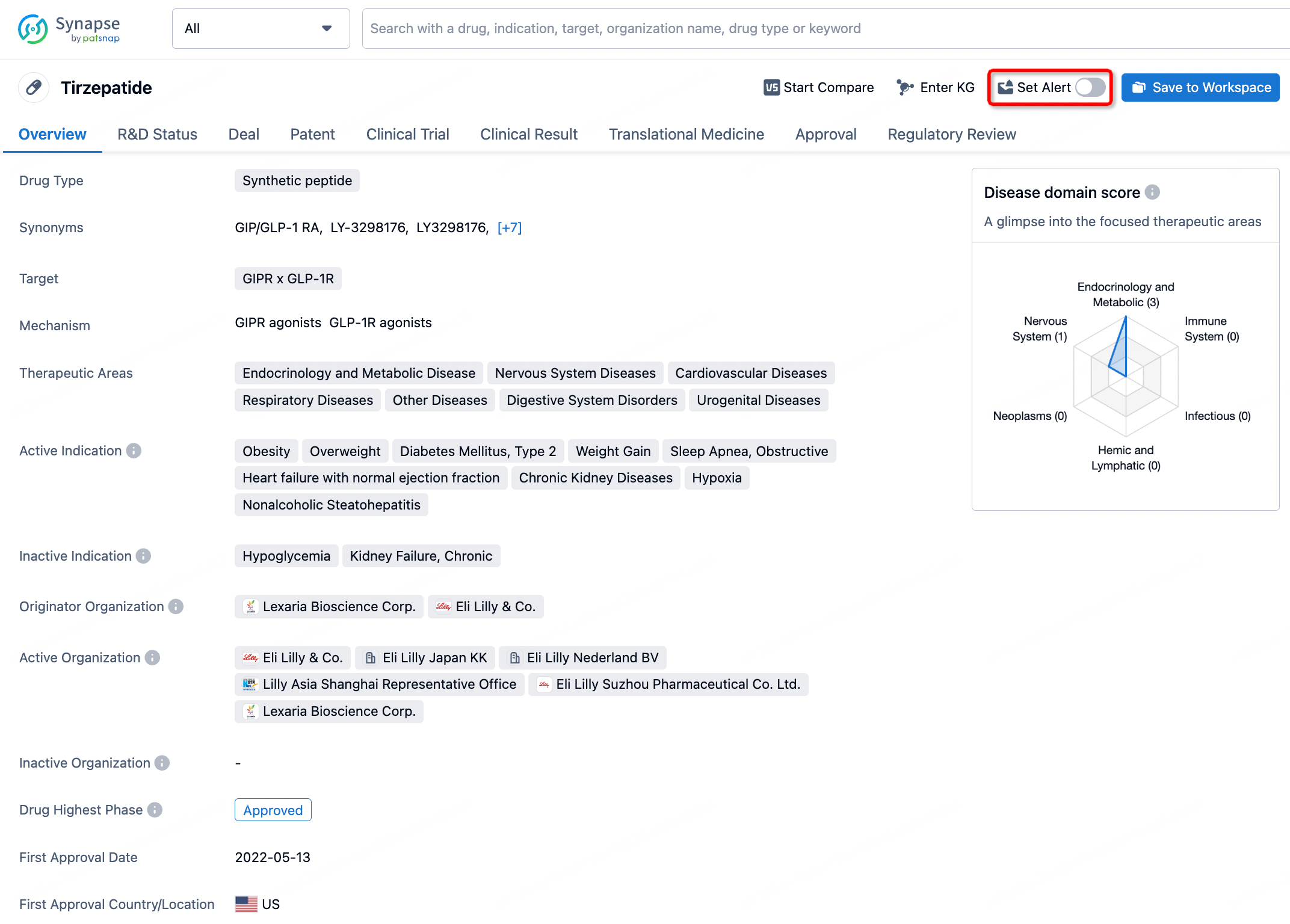
In the Synapse database, you can stay updated on the latest research and development advances of all drugs. This service is accessible anytime and anywhere, with updates available daily or weekly. Use the "Set Alert" function to stay informed. Click on the image below to embark on a brand new journey of drug discovery!


AI Agents Built for Biopharma Breakthroughs
Accelerate discovery. Empower decisions. Transform outcomes.
Get started for free today!
Accelerate Strategic R&D decision making with Synapse, PatSnap’s AI-powered Connected Innovation Intelligence Platform Built for Life Sciences Professionals.
Start your data trial now!
Synapse data is also accessible to external entities via APIs or data packages. Empower better decisions with the latest in pharmaceutical intelligence.