ALK Target Evaluation Report: Biology, Validation, Competition, IP, and R&D Strategy
ALK Target Evaluation Report: Biology, Validation, Competition, IP, and R&D Strategy
This ALK target evaluation report is generated based on structured data from PatSnap Target & Disease MCP and PatSnap Clinical Trials MCP. It turns target biology, disease context, clinical validation, competitive intensity, and IP strategy into a repeatable target evaluation workflow for life sciences AI agents.
Explore PatSnap Life Sciences MCP Servers
Target ALK Q9UM73 | Target-linked drugs 187 144 active development drugs in Target & Disease MCP | NSCLC trials 355 registered ALK + NSCLC trials in Clinical Trials MCP | Released results 504 Clinical result query |
Executive View
This Target Evaluation Report was generated from PatSnap Life Sciences MCP Servers: Target & Disease MCP for ALK biology and disease context, and Clinical Trials MCP for validation signals and clinical competition. In NSCLC, ALK remains a highly actionable kinase target with mature clinical validation, intense inhibitor competition, and ongoing room for next-generation differentiation around CNS activity, resistance mutations, sequencing, and combination strategy.
- Biology: ALK is a receptor tyrosine kinase that activates MAPK and NF-kappa-B related signaling through substrates including SHC1, IRS1, CBL, FRS2, ERK1/2, and AKT-pathway nodes.
- Disease context: NSCLC is a heterogeneous lung cancer category that includes adenocarcinoma, squamous-cell carcinoma, and large-cell carcinoma; ALK-rearranged NSCLC represents a molecularly defined segment where targeted therapy has reshaped treatment expectations.
- Validation: Clinical Trials MCP returns 355 ALK + Non-Small Cell Lung Cancer trials and 504 released result records.
- Strategy: Attractiveness is high, but new entrants need a sharp positioning thesis rather than another undifferentiated ALK inhibitor.
Scorecard
Biology confidence: Strong oncogenic driver biology and clean molecular selection.
Clinical validation: Large body of registered trials and published results.
Competitive pressure: Very crowded ALK inhibitor market.
White-space potential: Residual space in CNS, resistance, tolerability, and sequencing.
Biology and Disease Rationale
Target & Disease MCP describes ALK as a receptor tyrosine kinase whose activation triggers downstream MAPK signaling and can connect to NF-kappa-B through IRS1/AKT-related biology. This supports a direct mechanistic bridge from genomic alteration to cell growth and survival, which is exactly the kind of biology that makes a target suitable for biomarker-led development.
The NSCLC disease context returned by Target & Disease MCP describes a broad clinical category unified by lung epithelial malignancy and shared treatment strategy, but subdivided by molecular drivers. For ALK, the most relevant clinical question is not whether the target is validated; it is how a program can improve on existing standards in specific patient segments.
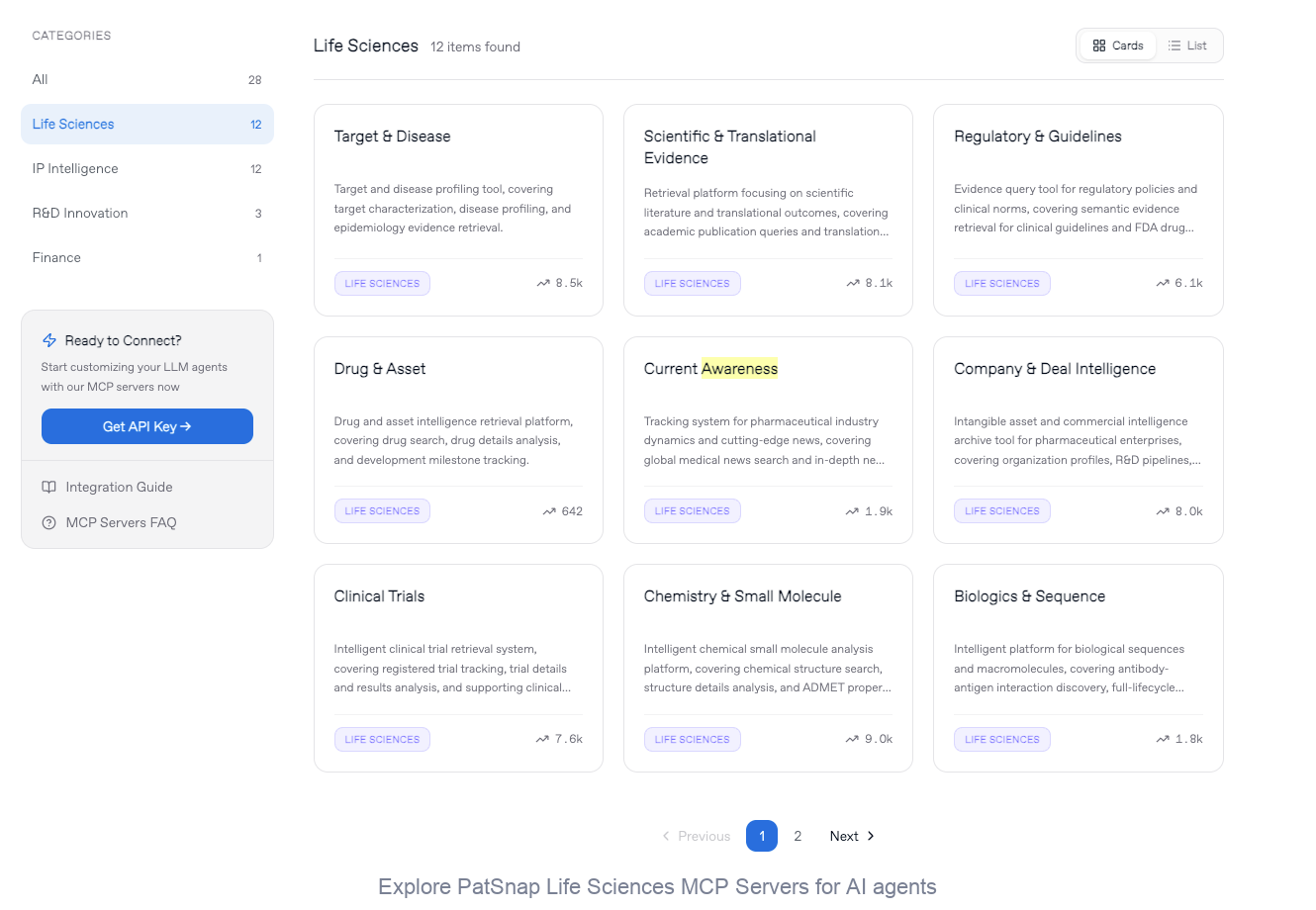
Explore PatSnap Life Sciences MCP Servers for AI agents
Selected Trial and Result Evidence
IP and R&D Recommendation
ALK IP strategy should prioritize chemistry around differentiated resistance coverage, brain exposure, tolerability margins, and companion diagnostic workflows. Broad ALK inhibition alone is unlikely to be enough; freedom-to-operate review should map core scaffolds, salt/crystal forms, CNS claims, mutation-specific claims, and combination-use claims.
Recommendation
Pursue only if the program has a credible differentiator: CNS penetration, activity against defined resistance mutations, better safety for chronic dosing, or a clinically testable sequencing niche. Otherwise, use ALK as a benchmark target for evaluating kinase-agent workflows built with MCP data rather than as a low-barrier new-entry opportunity.

Start building target evaluation agents with PatSnap Life Sciences MCP Servers
Data note: Target biology, disease profile, clinical trial counts, trial examples, and result evidence were generated from PatSnap Target & Disease MCP and PatSnap Clinical Trials MCP queries performed on July 9, 2026.


