Request Demo
Last update 14 May 2026
JSKN016
Last update 14 May 2026
Overview
Basic Info
Drug Type Antibody drug conjugate (ADC) |
Synonyms JSKN016SC, JSKN016 |
Target |
Action antagonists, modulators, inhibitors |
Mechanism HER3 antagonists(Receptor tyrosine-protein kinase erbB-3 antagonists), HER3 modulators(Receptor tyrosine-protein kinase erbB-3 modulators), Trop-2 inhibitors(Tumor-associated calcium signal transducer 2 inhibitors) |
Therapeutic Areas |
Inactive Indication- |
Originator Organization |
Active Organization |
Inactive Organization- |
License Organization- |
Drug Highest PhasePhase 3 |
First Approval Date- |
Regulation- |

Login to view timeline
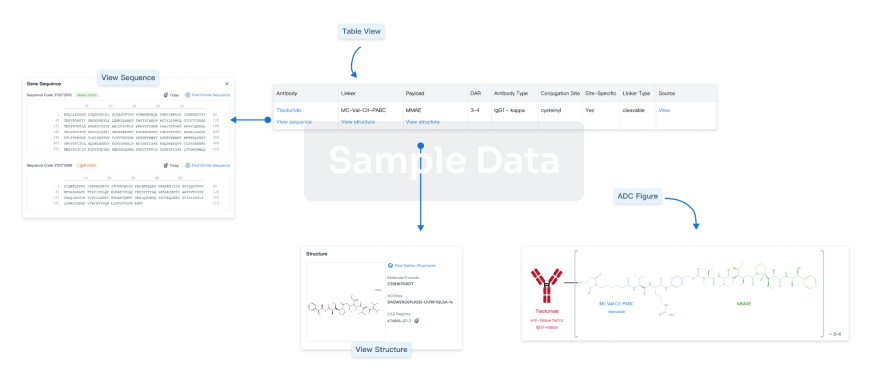
Structure/Sequence
Boost your research with our ADC technology data.
login
or
Related
8
Clinical Trials associated with JSKN016NCT07533123
A Randomized, Controlled, Open-Label Study of JSKN016 Versus Treatment of Physician's Choice in Patients With Unresectable Locally Advanced, Recurrent, or Metastatic Triple-Negative Breast Cancer Who Have Failed at Least Two Lines of Prior Systemic Therapy
NCT07493980
Study on the Efficacy and Safety of JSKN016 Combined With Toripalimab and Carboplatin as Neoadjuvant Therapy in Resectable Stage II-III Non-small Cell Lung Cancer Patients
NCT07336771
A Multicenter, Open-Label, Phase Ib/II Randomized Study of JSKN016 in Combination With D-0502 in Patients With Locally Advanced or Metastatic Hormone Receptor-Positive, HER2-Negative Breast Cancer
100 Clinical Results associated with JSKN016
Login to view more data
100 Translational Medicine associated with JSKN016
Login to view more data
100 Patents (Medical) associated with JSKN016
Login to view more data
100 Deals associated with JSKN016
Login to view more data
R&D Status
10 top R&D records. to view more data
Login
| Indication | Highest Phase | Country/Location | Organization | Date |
|---|---|---|---|---|
| Triple Negative Breast Cancer | Phase 3 | China | 09 Mar 2026 | |
| Hormone receptor positive HER2 negative breast cancer | Phase 2 | China | 01 Jan 2026 | |
| Locally advanced breast cancer | Phase 2 | China | 01 Jan 2026 | |
| Metastatic breast cancer | Phase 2 | China | 01 Jan 2026 | |
| HER2-negative breast cancer | Phase 2 | China | 01 Jun 2025 | |
| Metastatic HER2-Negative Breast Carcinoma | Phase 2 | China | 01 Jun 2025 | |
| Adenocarcinoma of Esophagus | Phase 2 | China | 25 Apr 2025 | |
| Advanced Gastroesophageal Junction Adenocarcinoma | Phase 2 | China | 25 Apr 2025 | |
| stomach adenocarcinoma | Phase 2 | China | 25 Apr 2025 | |
| Advanced Lung Non-Small Cell Carcinoma | Phase 2 | - | 17 Jan 2025 |
Login to view more data
Clinical Result
Clinical Result
Indication
Phase
Evaluation
View All Results
Phase 1 | HER2-negative breast cancer HER2-negative | 82 | tuojdmgesz(jkilgredzq) = gwsdjlxvqb hybheyyxnp (etwwnzrqqo, 66.3 - 94.5) View more | Positive | 10 Dec 2025 | ||
waloadnrkp(iojinkjruh) = pgxegpjkvx msdlvdmitq (lglnhawono ) View more | |||||||
Phase 1 | Metastatic Triple-Negative Breast Carcinoma TROP2 | HER3 | 19 | dqsiqbdgqk(gwqsghseqo) = Manageable hemotoxicity was observed with ≥ G3 events only occurred in 2 (10.5%) pts, including 1 G3 neutropenia and 1 G3 lymphopenia dprfvrzmai (cpyolylngk ) View more | Positive | 30 May 2025 |
Login to view more data
Translational Medicine
Boost your research with our translational medicine data.
login
or

Deal
Boost your decision using our deal data.
login
or

Core Patent
Boost your research with our Core Patent data.
login
or

Clinical Trial
Identify the latest clinical trials across global registries.
login
or

Approval
Accelerate your research with the latest regulatory approval information.
login
or

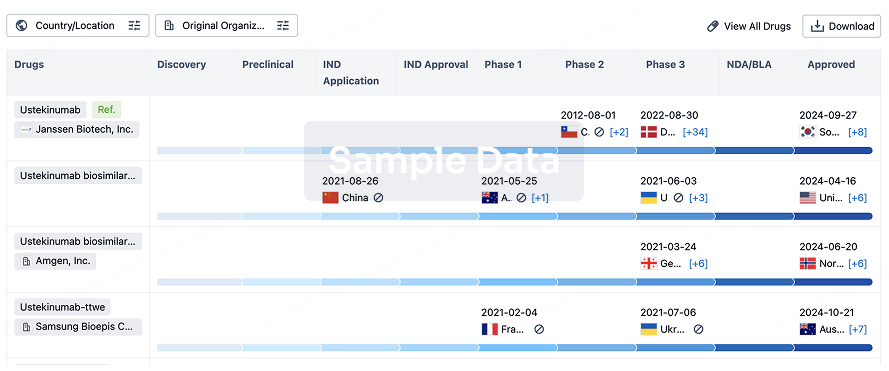
Biosimilar
Competitive landscape of biosimilars in different countries/locations. Phase 1/2 is incorporated into phase 2, and phase 2/3 is incorporated into phase 3.
login
or
Regulation
Understand key drug designations in just a few clicks with Synapse.
login
or

AI Agents Built for Biopharma Breakthroughs
Accelerate discovery. Empower decisions. Transform outcomes.
Get started for free today!
Accelerate Strategic R&D decision making with Synapse, PatSnap’s AI-powered Connected Innovation Intelligence Platform Built for Life Sciences Professionals.
Start your data trial now!
Synapse data is also accessible to external entities via APIs or data packages. Empower better decisions with the latest in pharmaceutical intelligence.
Bio
Bio Sequences Search & Analysis
Sign up for free
Chemical
Chemical Structures Search & Analysis
Sign up for free