Request Demo
Last update 08 May 2025
ACAT1 x FXR
Last update 08 May 2025
Related
Target |
Mechanism |
Active Org. |
Originator Org. |
Active Indication |
Inactive Indication |
Drug Highest Phase |
First Approval Ctry. / Loc. |
First Approval Date |

NCT00078026
A Phase I/II Randomized Study of the Short-Term Effects of APOMINE vs Placebo in Postmenopausal Women With Osteoporosis or Low Bone Mass
NCT00004049
A Phase I and Pharmacokinetic Study of SR-45023A Administered Once Every 7 Days
NCT00003822
A Phase I and Pharmacokinetic Study of SR-45023A During a 14-Day Treatment Schedule
100 Clinical Results associated with ACAT1 x FXR
Login to view more data
100 Translational Medicine associated with ACAT1 x FXR
Login to view more data
Login to view more data
Analysis
Perform a panoramic analysis of this field.
login
or
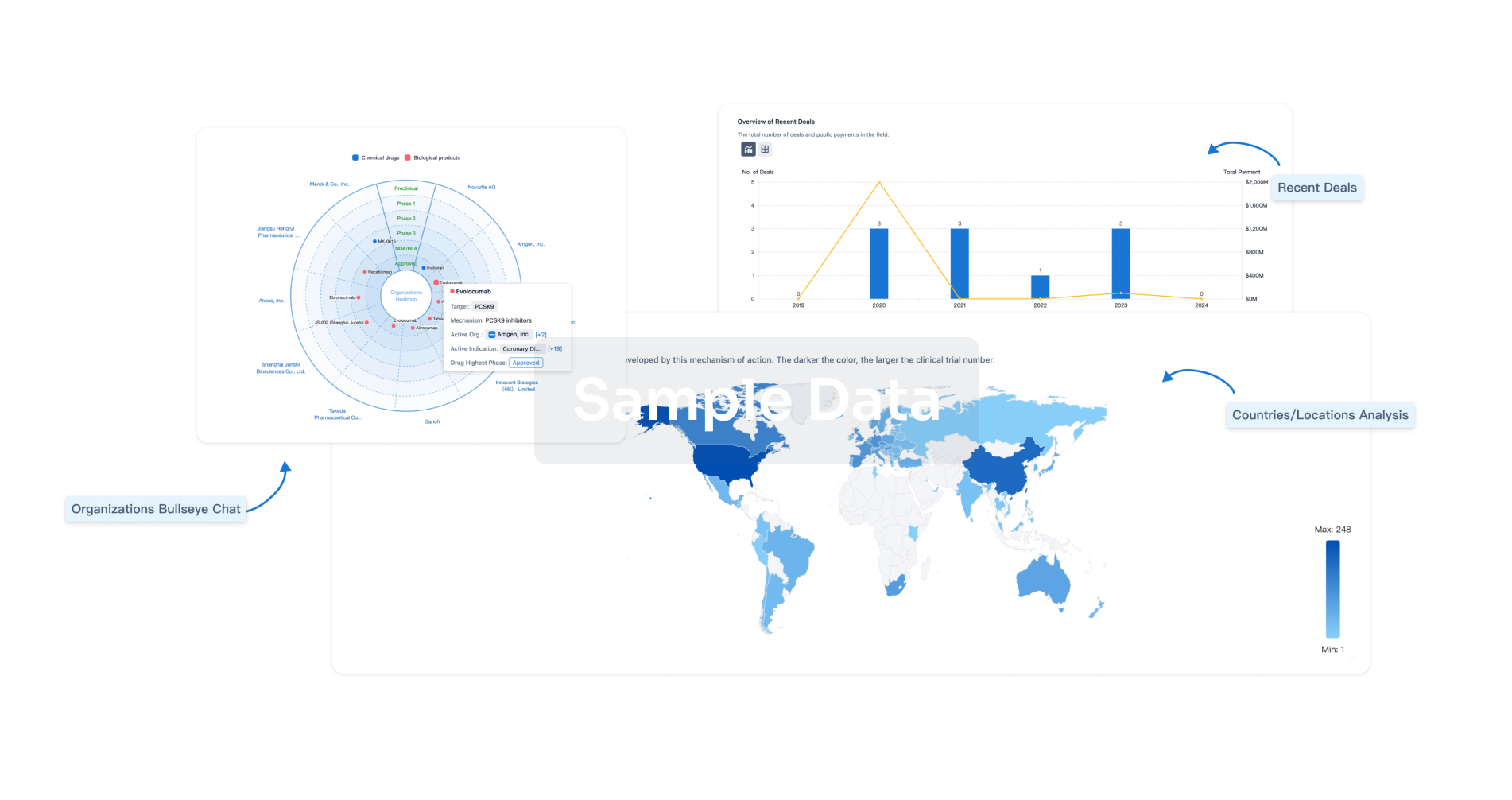
AI Agents Built for Biopharma Breakthroughs
Accelerate discovery. Empower decisions. Transform outcomes.
Get started for free today!
Accelerate Strategic R&D decision making with Synapse, PatSnap’s AI-powered Connected Innovation Intelligence Platform Built for Life Sciences Professionals.
Start your data trial now!
Synapse data is also accessible to external entities via APIs or data packages. Empower better decisions with the latest in pharmaceutical intelligence.
Bio
Bio Sequences Search & Analysis
Sign up for free
Chemical
Chemical Structures Search & Analysis
Sign up for free