Request Demo
What are AICARFT agonists and how do they work?
25 June 2024
In recent years, the scientific community has shown growing interest in AICARFT agonists due to their potential therapeutic applications. These compounds have emerged as promising agents in various medical fields, ranging from cardiovascular diseases to metabolic disorders. In this blog post, we will delve into the fundamentals of AICARFT agonists, exploring how they function and the potential they hold for future treatments.
Introduction to AICARFT agonists
AICARFT, or 5-Aminoimidazole-4-carboxamide ribonucleotide formyltransferase, is an enzyme that plays a pivotal role in cellular metabolism and energy regulation. AICARFT agonists are compounds that stimulate the activity of this enzyme, leading to a cascade of biochemical reactions that can modulate various physiological processes. The discovery of these agonists has opened up new avenues for research and therapeutic development, particularly in areas where conventional treatments have proven inadequate.
How do AICARFT agonists work?
To understand how AICARFT agonists work, it is essential to first grasp the role of AICARFT in the body. AICARFT is a key enzyme in the purine biosynthesis pathway, which is crucial for the production of nucleotides—the building blocks of DNA and RNA. By enhancing the activity of AICARFT, these agonists can influence the synthesis of purines and, consequently, affect cellular proliferation and energy metabolism.
When AICARFT agonists bind to their target enzyme, they facilitate the conversion of 5-aminoimidazole-4-carboxamide ribonucleotide (AICAR) to 10-formyl-5-aminoimidazole-4-carboxamide ribonucleotide (FAICAR). This reaction is a critical step in the purine biosynthesis pathway. By accelerating this process, AICARFT agonists can enhance the overall production of purines, thereby supporting cellular growth and function.
Moreover, AICARFT agonists have been found to activate AMP-activated protein kinase (AMPK), a vital regulator of cellular energy homeostasis. AMPK activation helps to balance energy expenditure and intake, making these agonists particularly interesting in the context of metabolic disorders. By promoting AMPK activity, AICARFT agonists can improve energy utilization, reduce inflammation, and enhance insulin sensitivity.
What are AICARFT agonists used for?
The multifaceted mechanisms of AICARFT agonists have made them attractive candidates for a wide range of therapeutic applications. Here, we will explore some of the most promising areas of research and potential clinical uses.
Cardiovascular Diseases: One of the most exciting applications of AICARFT agonists is in the treatment of cardiovascular diseases. AMPK activation by these agonists can enhance cardiac energy metabolism, improve endothelial function, and reduce the risk of atherosclerosis. Preclinical studies have shown that AICARFT agonists can protect against myocardial ischemia and reduce the severity of heart failure, making them promising candidates for future cardiac therapies.
Metabolic Disorders: AICARFT agonists also hold potential in the management of metabolic disorders such as type 2 diabetes and obesity. By activating AMPK, these compounds can improve insulin sensitivity, enhance glucose uptake, and promote lipid oxidation. This can lead to better glucose control and weight management, offering a novel approach to treating these prevalent conditions.
Cancer: The role of AICARFT in nucleotide synthesis has sparked interest in its potential application in cancer therapy. Cancer cells have a high demand for nucleotides to support rapid proliferation, and AICARFT agonists could potentially disrupt this process. By modulating purine biosynthesis, these agonists could inhibit cancer cell growth and enhance the efficacy of existing chemotherapeutic agents.
Neurodegenerative Diseases: Emerging research suggests that AICARFT agonists may also have neuroprotective properties. AMPK activation has been linked to improved neuronal survival and reduced neuroinflammation, indicating that these agonists could be beneficial in treating conditions like Alzheimer’s disease and Parkinson’s disease.
In conclusion, AICARFT agonists represent a promising frontier in medical research, with potential applications spanning cardiovascular, metabolic, oncological, and neurodegenerative diseases. As our understanding of these compounds continues to grow, so too does the possibility of developing novel, targeted therapies that could significantly improve patient outcomes across a variety of conditions.
Introduction to AICARFT agonists
AICARFT, or 5-Aminoimidazole-4-carboxamide ribonucleotide formyltransferase, is an enzyme that plays a pivotal role in cellular metabolism and energy regulation. AICARFT agonists are compounds that stimulate the activity of this enzyme, leading to a cascade of biochemical reactions that can modulate various physiological processes. The discovery of these agonists has opened up new avenues for research and therapeutic development, particularly in areas where conventional treatments have proven inadequate.
How do AICARFT agonists work?
To understand how AICARFT agonists work, it is essential to first grasp the role of AICARFT in the body. AICARFT is a key enzyme in the purine biosynthesis pathway, which is crucial for the production of nucleotides—the building blocks of DNA and RNA. By enhancing the activity of AICARFT, these agonists can influence the synthesis of purines and, consequently, affect cellular proliferation and energy metabolism.
When AICARFT agonists bind to their target enzyme, they facilitate the conversion of 5-aminoimidazole-4-carboxamide ribonucleotide (AICAR) to 10-formyl-5-aminoimidazole-4-carboxamide ribonucleotide (FAICAR). This reaction is a critical step in the purine biosynthesis pathway. By accelerating this process, AICARFT agonists can enhance the overall production of purines, thereby supporting cellular growth and function.
Moreover, AICARFT agonists have been found to activate AMP-activated protein kinase (AMPK), a vital regulator of cellular energy homeostasis. AMPK activation helps to balance energy expenditure and intake, making these agonists particularly interesting in the context of metabolic disorders. By promoting AMPK activity, AICARFT agonists can improve energy utilization, reduce inflammation, and enhance insulin sensitivity.
What are AICARFT agonists used for?
The multifaceted mechanisms of AICARFT agonists have made them attractive candidates for a wide range of therapeutic applications. Here, we will explore some of the most promising areas of research and potential clinical uses.
Cardiovascular Diseases: One of the most exciting applications of AICARFT agonists is in the treatment of cardiovascular diseases. AMPK activation by these agonists can enhance cardiac energy metabolism, improve endothelial function, and reduce the risk of atherosclerosis. Preclinical studies have shown that AICARFT agonists can protect against myocardial ischemia and reduce the severity of heart failure, making them promising candidates for future cardiac therapies.
Metabolic Disorders: AICARFT agonists also hold potential in the management of metabolic disorders such as type 2 diabetes and obesity. By activating AMPK, these compounds can improve insulin sensitivity, enhance glucose uptake, and promote lipid oxidation. This can lead to better glucose control and weight management, offering a novel approach to treating these prevalent conditions.
Cancer: The role of AICARFT in nucleotide synthesis has sparked interest in its potential application in cancer therapy. Cancer cells have a high demand for nucleotides to support rapid proliferation, and AICARFT agonists could potentially disrupt this process. By modulating purine biosynthesis, these agonists could inhibit cancer cell growth and enhance the efficacy of existing chemotherapeutic agents.
Neurodegenerative Diseases: Emerging research suggests that AICARFT agonists may also have neuroprotective properties. AMPK activation has been linked to improved neuronal survival and reduced neuroinflammation, indicating that these agonists could be beneficial in treating conditions like Alzheimer’s disease and Parkinson’s disease.
In conclusion, AICARFT agonists represent a promising frontier in medical research, with potential applications spanning cardiovascular, metabolic, oncological, and neurodegenerative diseases. As our understanding of these compounds continues to grow, so too does the possibility of developing novel, targeted therapies that could significantly improve patient outcomes across a variety of conditions.
How to obtain the latest development progress of all targets?
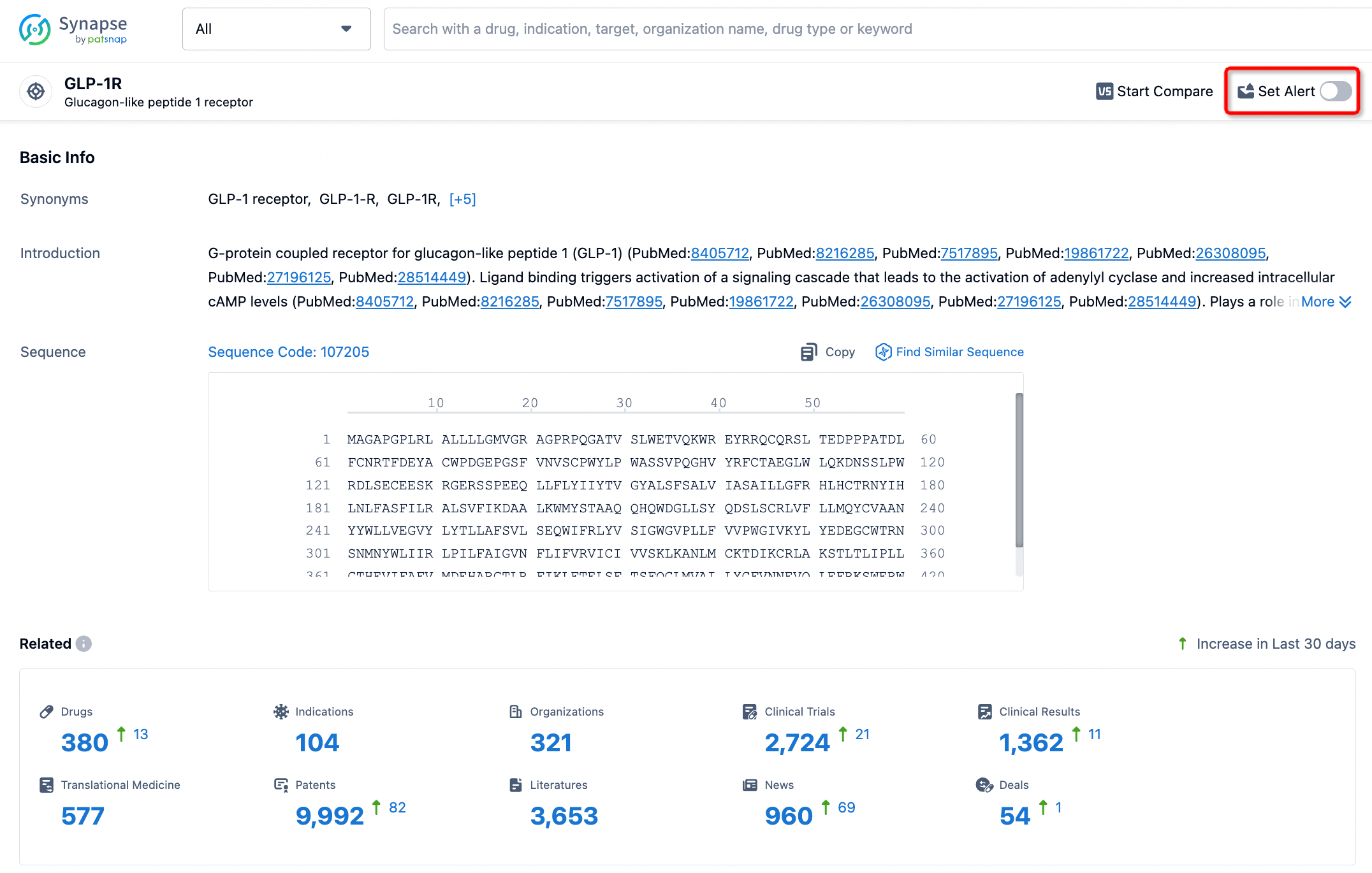
In the Synapse database, you can stay updated on the latest research and development advances of all targets. This service is accessible anytime and anywhere, with updates available daily or weekly. Use the "Set Alert" function to stay informed. Click on the image below to embark on a brand new journey of drug discovery!

AI Agents Built for Biopharma Breakthroughs
Accelerate discovery. Empower decisions. Transform outcomes.
Get started for free today!
Accelerate Strategic R&D decision making with Synapse, PatSnap’s AI-powered Connected Innovation Intelligence Platform Built for Life Sciences Professionals.
Start your data trial now!
Synapse data is also accessible to external entities via APIs or data packages. Empower better decisions with the latest in pharmaceutical intelligence.