Request Demo
What is Marstacimab used for?
28 June 2024
Marstacimab is an emerging biopharmaceutical agent designed to address the needs of patients with specific blood clotting disorders. Developed by Pfizer, this innovative drug has shown promise in treating hemophilia, a genetic disorder that impairs the blood's ability to clot properly. Hemophilia can lead to excessive bleeding even from minor injuries, and managing this condition has been a significant challenge in the medical community. Marstacimab is classified as a monoclonal antibody, a type of drug engineered to target specific proteins or cells in the body. The drug is currently in the advanced stages of clinical trials, with Phase 3 studies underway to evaluate its efficacy and safety in humans.
Marstacimab works by targeting tissue factor pathway inhibitor (TFPI), a protein that plays a critical role in regulating blood coagulation. Under normal circumstances, TFPI helps to maintain a balance between clot formation and clot prevention, ensuring that blood can clot to stop bleeding but does not clot excessively, leading to thrombosis. In patients with hemophilia, this balance is disrupted due to deficiencies in clotting factors VIII or IX. By inhibiting TFPI, Marstacimab aims to enhance clot formation, compensating for the deficient clotting factors and thereby reducing the risk of bleeding. This mechanism is particularly promising because it offers a different approach compared to traditional hemophilia treatments, which typically involve replacing the missing clotting factors directly through regular infusions.
The primary indication for Marstacimab is the treatment of hemophilia A and B. Hemophilia A is characterized by a deficiency in factor VIII, while hemophilia B involves a deficiency in factor IX. Both conditions can lead to spontaneous bleeding episodes, prolonged bleeding after injuries, and in severe cases, bleeding into joints and muscles, which can cause long-term damage and disability. Current treatments for hemophilia include factor replacement therapy, which involves regular infusions of the missing clotting factor to prevent bleeding episodes. While effective, this approach has limitations, including the need for frequent infusions, the development of inhibitors that neutralize the infused clotting factors, and the risk of infections from intravenous administration.
Marstacimab offers a novel approach by targeting TFPI, potentially providing a more convenient and effective treatment option for hemophilia patients. Preclinical studies and early-phase clinical trials have shown that Marstacimab can reduce bleeding episodes in hemophilia patients, with a favorable safety profile. Phase 3 clinical trials are currently evaluating the long-term efficacy, safety, and optimal dosing regimen of Marstacimab in a larger population of hemophilia patients. These trials are crucial for determining whether Marstacimab can become a viable alternative or adjunct to existing hemophilia treatments.
In addition to hemophilia, there is potential for Marstacimab to be explored for other bleeding disorders that involve disruptions in the coagulation pathway. While hemophilia is the primary focus, researchers are also investigating the broader implications of TFPI inhibition in coagulation and its potential therapeutic applications.
In conclusion, Marstacimab represents a significant advancement in the treatment of hemophilia, offering a new mechanism of action that could address some of the limitations of current therapies. By targeting TFPI, Marstacimab has the potential to improve the quality of life for hemophilia patients by reducing the frequency and severity of bleeding episodes and offering a more convenient treatment regimen. As Phase 3 clinical trials progress, the medical community is eagerly awaiting the results, which will determine the future of Marstacimab as a cornerstone treatment for hemophilia and possibly other bleeding disorders. This innovative approach underscores the importance of continued research and development in biopharmaceuticals to address unmet medical needs and improve patient outcomes.
Marstacimab works by targeting tissue factor pathway inhibitor (TFPI), a protein that plays a critical role in regulating blood coagulation. Under normal circumstances, TFPI helps to maintain a balance between clot formation and clot prevention, ensuring that blood can clot to stop bleeding but does not clot excessively, leading to thrombosis. In patients with hemophilia, this balance is disrupted due to deficiencies in clotting factors VIII or IX. By inhibiting TFPI, Marstacimab aims to enhance clot formation, compensating for the deficient clotting factors and thereby reducing the risk of bleeding. This mechanism is particularly promising because it offers a different approach compared to traditional hemophilia treatments, which typically involve replacing the missing clotting factors directly through regular infusions.
The primary indication for Marstacimab is the treatment of hemophilia A and B. Hemophilia A is characterized by a deficiency in factor VIII, while hemophilia B involves a deficiency in factor IX. Both conditions can lead to spontaneous bleeding episodes, prolonged bleeding after injuries, and in severe cases, bleeding into joints and muscles, which can cause long-term damage and disability. Current treatments for hemophilia include factor replacement therapy, which involves regular infusions of the missing clotting factor to prevent bleeding episodes. While effective, this approach has limitations, including the need for frequent infusions, the development of inhibitors that neutralize the infused clotting factors, and the risk of infections from intravenous administration.
Marstacimab offers a novel approach by targeting TFPI, potentially providing a more convenient and effective treatment option for hemophilia patients. Preclinical studies and early-phase clinical trials have shown that Marstacimab can reduce bleeding episodes in hemophilia patients, with a favorable safety profile. Phase 3 clinical trials are currently evaluating the long-term efficacy, safety, and optimal dosing regimen of Marstacimab in a larger population of hemophilia patients. These trials are crucial for determining whether Marstacimab can become a viable alternative or adjunct to existing hemophilia treatments.
In addition to hemophilia, there is potential for Marstacimab to be explored for other bleeding disorders that involve disruptions in the coagulation pathway. While hemophilia is the primary focus, researchers are also investigating the broader implications of TFPI inhibition in coagulation and its potential therapeutic applications.
In conclusion, Marstacimab represents a significant advancement in the treatment of hemophilia, offering a new mechanism of action that could address some of the limitations of current therapies. By targeting TFPI, Marstacimab has the potential to improve the quality of life for hemophilia patients by reducing the frequency and severity of bleeding episodes and offering a more convenient treatment regimen. As Phase 3 clinical trials progress, the medical community is eagerly awaiting the results, which will determine the future of Marstacimab as a cornerstone treatment for hemophilia and possibly other bleeding disorders. This innovative approach underscores the importance of continued research and development in biopharmaceuticals to address unmet medical needs and improve patient outcomes.
How to obtain the latest development progress of all drugs?
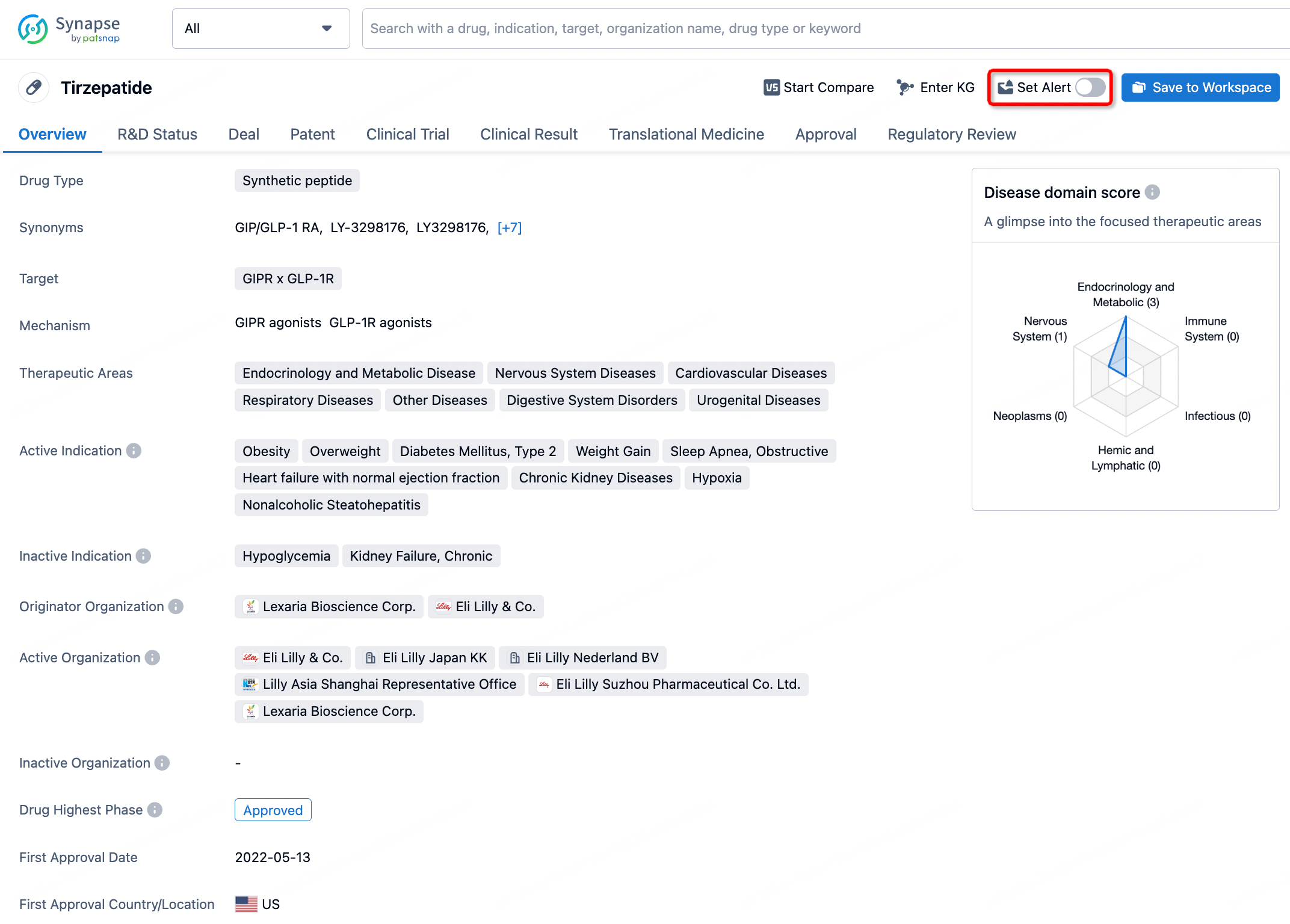
In the Synapse database, you can stay updated on the latest research and development advances of all drugs. This service is accessible anytime and anywhere, with updates available daily or weekly. Use the "Set Alert" function to stay informed. Click on the image below to embark on a brand new journey of drug discovery!


AI Agents Built for Biopharma Breakthroughs
Accelerate discovery. Empower decisions. Transform outcomes.
Get started for free today!
Accelerate Strategic R&D decision making with Synapse, PatSnap’s AI-powered Connected Innovation Intelligence Platform Built for Life Sciences Professionals.
Start your data trial now!
Synapse data is also accessible to external entities via APIs or data packages. Empower better decisions with the latest in pharmaceutical intelligence.