Request Demo
What is the mechanism of Gadobenate Dimeglumine?
17 July 2024
Gadobenate Dimeglumine, often referred to by its trade name MultiHance, is a gadolinium-based contrast agent (GBCA) used in magnetic resonance imaging (MRI). Its primary function is to enhance the quality of MRI images, thereby improving the diagnostic accuracy of the scans. Understanding the mechanism of Gadobenate Dimeglumine involves delving into its pharmacodynamics, pharmacokinetics, and how it interacts with the body and MRI technology.
The active component of Gadobenate Dimeglumine is gadobenic acid, which is a complex formed between gadolinium ions (Gd^3+) and the ligand DTPA-BMA (diethylenetriaminepentaacetic acid-bis(methylamide)). Gadolinium is a heavy metal and a member of the lanthanide series that possesses paramagnetic properties, meaning it has unpaired electrons that create a magnetic moment. However, free gadolinium ions are highly toxic, so they are chelated with ligands like DTPA-BMA to form a stable, non-toxic complex that can be excreted from the body safely.
Once administered intravenously, Gadobenate Dimeglumine distributes rapidly throughout the extracellular fluid compartments, including blood vessels and interstitial spaces. The gadolinium ion's paramagnetic properties are crucial as they affect the relaxation times of nearby hydrogen protons in water molecules, thereby enhancing the contrast in MRI images. Specifically, gadolinium ions shorten the T1 relaxation time, making tissues where the contrast agent accumulates appear brighter on T1-weighted MRI images. This property is especially useful for visualizing blood vessels, organs, and tissues with high vascularity or abnormal blood-brain barrier permeability.
One unique aspect of Gadobenate Dimeglumine compared to other GBCAs is its partial hepatobiliary excretion. Besides being eliminated renally, a significant portion of Gadobenate Dimeglumine is taken up by hepatocytes and excreted into the bile. This dual elimination pathway allows for enhanced imaging of liver lesions, as well as biliary structures. In liver imaging, it can differentiate between benign and malignant lesions more effectively, providing valuable information for diagnosis and treatment planning.
The pharmacokinetics of Gadobenate Dimeglumine involve its rapid distribution phase, where it quickly reaches peak concentration in blood plasma, followed by a slower elimination phase. The half-life of the agent is typically around 1.5 hours in individuals with normal renal function. Due to its dual elimination via renal and hepatobiliary routes, patients with impaired kidney function may still benefit from its use, although caution is always warranted, and alternative imaging strategies may be considered.
Safety is a critical consideration when using any contrast agent. While Gadobenate Dimeglumine is generally well-tolerated, it carries risks common to all GBCAs, such as nephrogenic systemic fibrosis (NSF) in patients with severe renal impairment. Therefore, renal function should be assessed before administration, and the lowest effective dose should be used to mitigate potential risks.
In summary, the mechanism of Gadobenate Dimeglumine involves its paramagnetic properties, which enhance MRI image contrast by shortening the T1 relaxation time of nearby hydrogen protons. Its unique dual elimination pathway via renal and hepatobiliary routes makes it particularly useful for imaging the liver and biliary system. Understanding these mechanisms allows healthcare providers to utilize Gadobenate Dimeglumine effectively and safely, optimizing diagnostic accuracy in MRI procedures.
The active component of Gadobenate Dimeglumine is gadobenic acid, which is a complex formed between gadolinium ions (Gd^3+) and the ligand DTPA-BMA (diethylenetriaminepentaacetic acid-bis(methylamide)). Gadolinium is a heavy metal and a member of the lanthanide series that possesses paramagnetic properties, meaning it has unpaired electrons that create a magnetic moment. However, free gadolinium ions are highly toxic, so they are chelated with ligands like DTPA-BMA to form a stable, non-toxic complex that can be excreted from the body safely.
Once administered intravenously, Gadobenate Dimeglumine distributes rapidly throughout the extracellular fluid compartments, including blood vessels and interstitial spaces. The gadolinium ion's paramagnetic properties are crucial as they affect the relaxation times of nearby hydrogen protons in water molecules, thereby enhancing the contrast in MRI images. Specifically, gadolinium ions shorten the T1 relaxation time, making tissues where the contrast agent accumulates appear brighter on T1-weighted MRI images. This property is especially useful for visualizing blood vessels, organs, and tissues with high vascularity or abnormal blood-brain barrier permeability.
One unique aspect of Gadobenate Dimeglumine compared to other GBCAs is its partial hepatobiliary excretion. Besides being eliminated renally, a significant portion of Gadobenate Dimeglumine is taken up by hepatocytes and excreted into the bile. This dual elimination pathway allows for enhanced imaging of liver lesions, as well as biliary structures. In liver imaging, it can differentiate between benign and malignant lesions more effectively, providing valuable information for diagnosis and treatment planning.
The pharmacokinetics of Gadobenate Dimeglumine involve its rapid distribution phase, where it quickly reaches peak concentration in blood plasma, followed by a slower elimination phase. The half-life of the agent is typically around 1.5 hours in individuals with normal renal function. Due to its dual elimination via renal and hepatobiliary routes, patients with impaired kidney function may still benefit from its use, although caution is always warranted, and alternative imaging strategies may be considered.
Safety is a critical consideration when using any contrast agent. While Gadobenate Dimeglumine is generally well-tolerated, it carries risks common to all GBCAs, such as nephrogenic systemic fibrosis (NSF) in patients with severe renal impairment. Therefore, renal function should be assessed before administration, and the lowest effective dose should be used to mitigate potential risks.
In summary, the mechanism of Gadobenate Dimeglumine involves its paramagnetic properties, which enhance MRI image contrast by shortening the T1 relaxation time of nearby hydrogen protons. Its unique dual elimination pathway via renal and hepatobiliary routes makes it particularly useful for imaging the liver and biliary system. Understanding these mechanisms allows healthcare providers to utilize Gadobenate Dimeglumine effectively and safely, optimizing diagnostic accuracy in MRI procedures.
How to obtain the latest development progress of all drugs?
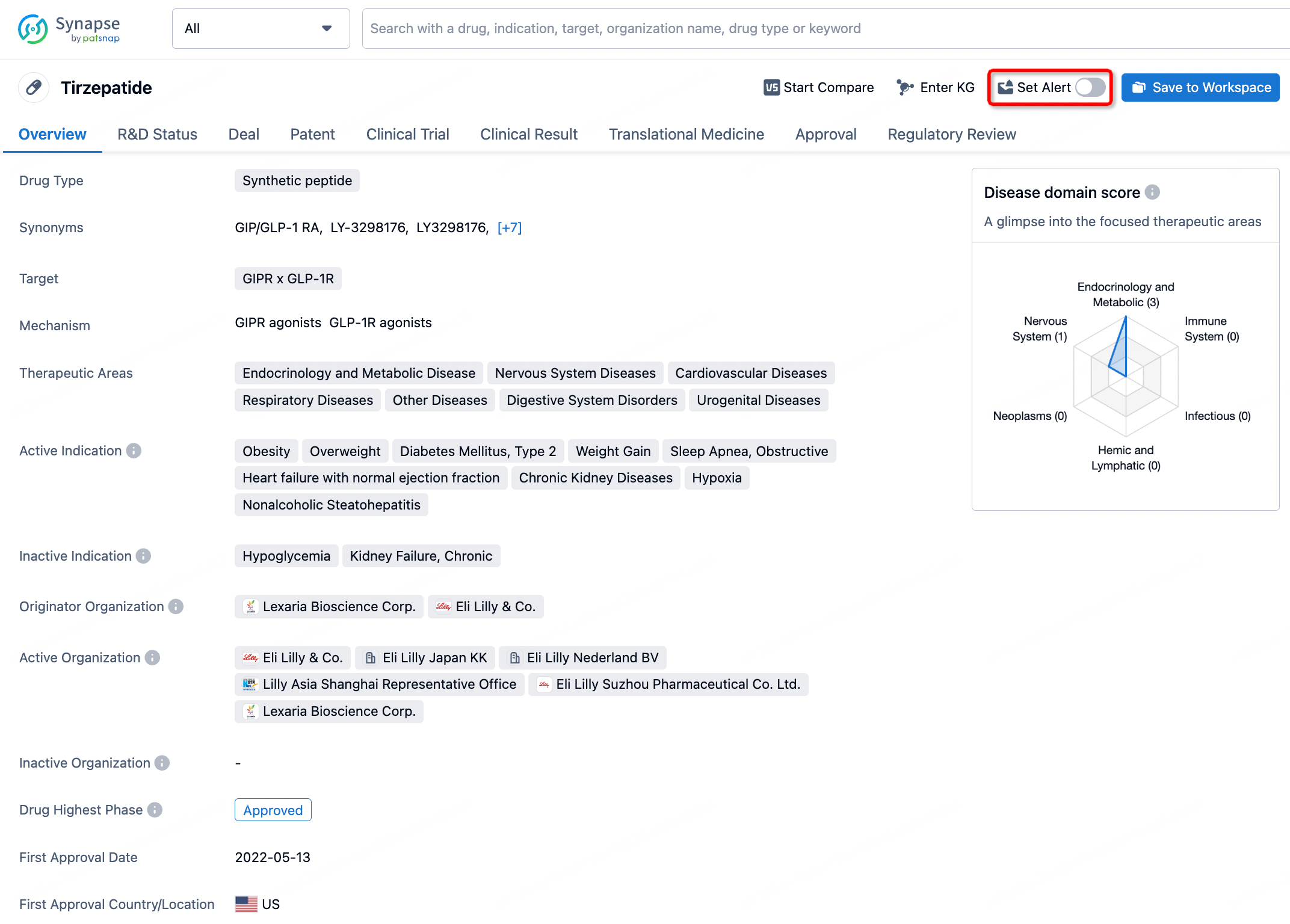
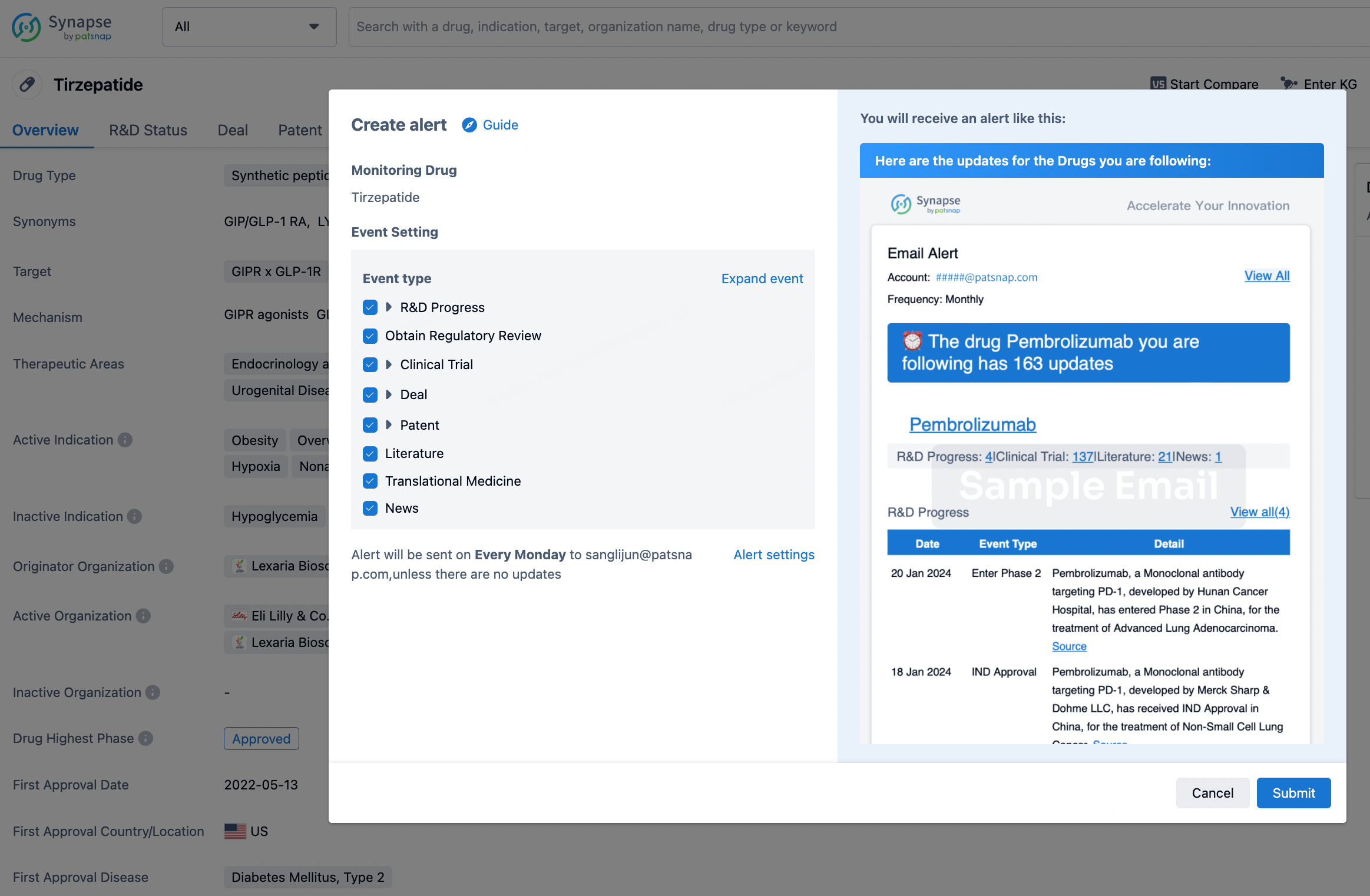
In the Synapse database, you can stay updated on the latest research and development advances of all drugs. This service is accessible anytime and anywhere, with updates available daily or weekly. Use the "Set Alert" function to stay informed. Click on the image below to embark on a brand new journey of drug discovery!

AI Agents Built for Biopharma Breakthroughs
Accelerate discovery. Empower decisions. Transform outcomes.
Get started for free today!
Accelerate Strategic R&D decision making with Synapse, PatSnap’s AI-powered Connected Innovation Intelligence Platform Built for Life Sciences Professionals.
Start your data trial now!
Synapse data is also accessible to external entities via APIs or data packages. Empower better decisions with the latest in pharmaceutical intelligence.