Request Demo
What is the mechanism of Vebreltinib?
17 July 2024
Vebreltinib is a novel therapeutic agent that has garnered significant attention in the field of oncology due to its promising mechanism of action. This drug is a small molecule inhibitor that targets specific kinases involved in cancer cell proliferation and survival, making it a potent weapon in the fight against various types of cancers.
At the core of Vebreltinib’s mechanism lies its ability to inhibit the activity of certain receptor tyrosine kinases (RTKs). RTKs are proteins found on the surface of cells that play a crucial role in the regulation of key cellular processes, including growth, differentiation, and metabolism. In many cancers, these RTKs are abnormally activated, leading to uncontrolled cell division and tumor progression. Vebreltinib works by binding to the ATP-binding site of these kinases, thereby preventing their activation and subsequent signal transduction pathways that promote cancer cell growth.
One of the primary targets of Vebreltinib is the epidermal growth factor receptor (EGFR). EGFR is often overexpressed or mutated in various cancers, including non-small cell lung cancer, colorectal cancer, and head and neck cancers. By inhibiting EGFR, Vebreltinib disrupts downstream signaling pathways such as the RAS-RAF-MEK-ERK pathway and the PI3K-AKT-mTOR pathway. These pathways are critical for cell proliferation and survival, and their inhibition results in the induction of apoptosis (programmed cell death) and decreased tumor growth.
Another important target of Vebreltinib is the anaplastic lymphoma kinase (ALK). ALK rearrangements are commonly seen in certain subsets of non-small cell lung cancer and other malignancies. The inhibition of ALK by Vebreltinib leads to the blockade of oncogenic signaling and induces tumor regression. This dual inhibition of both EGFR and ALK pathways makes Vebreltinib especially effective in cancers that exhibit co-alterations of these kinases.
Additionally, Vebreltinib has been shown to inhibit other RTKs such as MET and ROS1, broadening its therapeutic scope. MET amplification and ROS1 rearrangements are implicated in various cancers, and their inhibition contributes to the overall antitumor activity of Vebreltinib.
Vebreltinib’s efficacy is also supported by its favorable pharmacokinetic properties. The drug is orally bioavailable, allowing for convenient administration. It has a good safety profile, with manageable side effects, which is crucial for maintaining the quality of life in patients undergoing long-term cancer treatment.
In summary, Vebreltinib operates through a multi-targeted approach, inhibiting key receptor tyrosine kinases such as EGFR, ALK, MET, and ROS1. By blocking these critical signaling pathways, it effectively suppresses cancer cell proliferation and induces apoptosis. This multi-faceted mechanism of action not only enhances its therapeutic potential but also provides a robust strategy to overcome resistance mechanisms that often limit the efficacy of single-target treatments. As research progresses, Vebreltinib holds promise for becoming an integral part of combination therapy regimens, potentially offering improved outcomes for patients with various types of cancers.
At the core of Vebreltinib’s mechanism lies its ability to inhibit the activity of certain receptor tyrosine kinases (RTKs). RTKs are proteins found on the surface of cells that play a crucial role in the regulation of key cellular processes, including growth, differentiation, and metabolism. In many cancers, these RTKs are abnormally activated, leading to uncontrolled cell division and tumor progression. Vebreltinib works by binding to the ATP-binding site of these kinases, thereby preventing their activation and subsequent signal transduction pathways that promote cancer cell growth.
One of the primary targets of Vebreltinib is the epidermal growth factor receptor (EGFR). EGFR is often overexpressed or mutated in various cancers, including non-small cell lung cancer, colorectal cancer, and head and neck cancers. By inhibiting EGFR, Vebreltinib disrupts downstream signaling pathways such as the RAS-RAF-MEK-ERK pathway and the PI3K-AKT-mTOR pathway. These pathways are critical for cell proliferation and survival, and their inhibition results in the induction of apoptosis (programmed cell death) and decreased tumor growth.
Another important target of Vebreltinib is the anaplastic lymphoma kinase (ALK). ALK rearrangements are commonly seen in certain subsets of non-small cell lung cancer and other malignancies. The inhibition of ALK by Vebreltinib leads to the blockade of oncogenic signaling and induces tumor regression. This dual inhibition of both EGFR and ALK pathways makes Vebreltinib especially effective in cancers that exhibit co-alterations of these kinases.
Additionally, Vebreltinib has been shown to inhibit other RTKs such as MET and ROS1, broadening its therapeutic scope. MET amplification and ROS1 rearrangements are implicated in various cancers, and their inhibition contributes to the overall antitumor activity of Vebreltinib.
Vebreltinib’s efficacy is also supported by its favorable pharmacokinetic properties. The drug is orally bioavailable, allowing for convenient administration. It has a good safety profile, with manageable side effects, which is crucial for maintaining the quality of life in patients undergoing long-term cancer treatment.
In summary, Vebreltinib operates through a multi-targeted approach, inhibiting key receptor tyrosine kinases such as EGFR, ALK, MET, and ROS1. By blocking these critical signaling pathways, it effectively suppresses cancer cell proliferation and induces apoptosis. This multi-faceted mechanism of action not only enhances its therapeutic potential but also provides a robust strategy to overcome resistance mechanisms that often limit the efficacy of single-target treatments. As research progresses, Vebreltinib holds promise for becoming an integral part of combination therapy regimens, potentially offering improved outcomes for patients with various types of cancers.
How to obtain the latest development progress of all drugs?
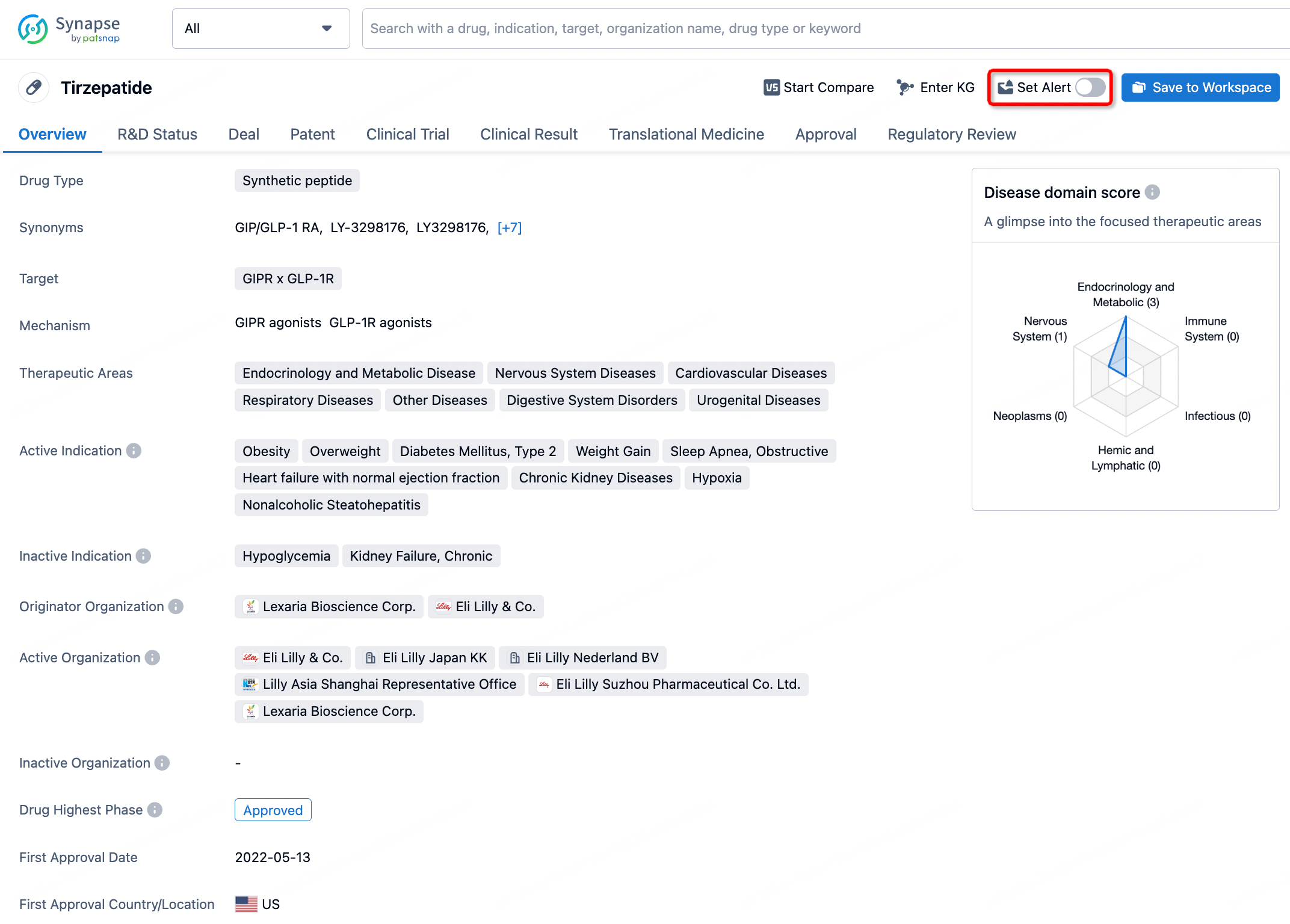
In the Synapse database, you can stay updated on the latest research and development advances of all drugs. This service is accessible anytime and anywhere, with updates available daily or weekly. Use the "Set Alert" function to stay informed. Click on the image below to embark on a brand new journey of drug discovery!


AI Agents Built for Biopharma Breakthroughs
Accelerate discovery. Empower decisions. Transform outcomes.
Get started for free today!
Accelerate Strategic R&D decision making with Synapse, PatSnap’s AI-powered Connected Innovation Intelligence Platform Built for Life Sciences Professionals.
Start your data trial now!
Synapse data is also accessible to external entities via APIs or data packages. Empower better decisions with the latest in pharmaceutical intelligence.