ROS1 Target Evaluation Report: Biology, Validation, Competition, IP, and R&D Strategy
ROS1 Target Evaluation Report: Biology, Validation, Competition, IP, and R&D Strategy
This ROS1 target evaluation report is generated based on structured data from PatSnap Target & Disease MCP and PatSnap Clinical Trials MCP. It turns target biology, disease context, clinical validation, competitive intensity, and IP strategy into a repeatable target evaluation workflow for life sciences AI agents.
Explore PatSnap Life Sciences MCP Servers
Target ROS1 P08922 | Target-linked drugs 74 62 active development drugs in Target & Disease MCP | NSCLC trials 326 registered ROS1 + NSCLC trials in Clinical Trials MCP; repotrectinib-specific subset: 6 | Released results 470 Clinical result query |
Executive View
This Target Evaluation Report was generated from PatSnap Life Sciences MCP Servers. Target & Disease MCP identifies ROS1 as a receptor tyrosine kinase with PI3K-mTOR, STAT3, MAPK, and AKT-linked signaling, while Clinical Trials MCP shows a broad ROS1 + NSCLC evidence base and a more focused repotrectinib clinical cluster. ROS1 is attractive because of biomarker-driven precision oncology, but programs must separate ROS1-specific value from broader ALK/NTRK kinase-inhibitor overlap.
- Biology: ROS1 is a receptor tyrosine kinase linked to NELL2 ligand biology and downstream PI3K-mTOR, STAT3, AKT, and MAPK signaling.
- Disease context: ROS1-positive NSCLC is a rare but actionable molecular segment where clinical value depends on fusion detection, CNS control, and resistance management.
- Validation: Clinical Trials MCP returns 326 ROS1 + Non-Small Cell Lung Cancer trials and 470 released result records.
- Strategy: Attractiveness is strongest for differentiated inhibitors or lifecycle studies that prove ROS1-specific value.
Scorecard
Biology confidence: Strong kinase-driver biology in selected patients.
Clinical validation: Meaningful NSCLC evidence base with focused repotrectinib validation.
Competitive pressure: Overlap with ALK/NTRK inhibitor classes complicates positioning.
White-space potential: CNS disease, resistance, and frail/elderly populations offer niches.
Biology and Disease Rationale
Target & Disease MCP describes ROS1 as a receptor tyrosine kinase that can activate PI3K-mTOR signaling and phosphorylate signaling molecules including STAT3, VAV3, AKT1, MAPK1, MAPK3, IRS1, and PLCG2. This supports a mechanistic case for ROS1 as a driver target when tumor biology is fusion-selected.
Within NSCLC, ROS1 creates a precision-oncology segment where trial design should be built around confirmed rearrangement status, previous tyrosine kinase inhibitor exposure, CNS involvement, and comparator selection. Because several agents have multi-kinase activity, clean evidence mapping is important.
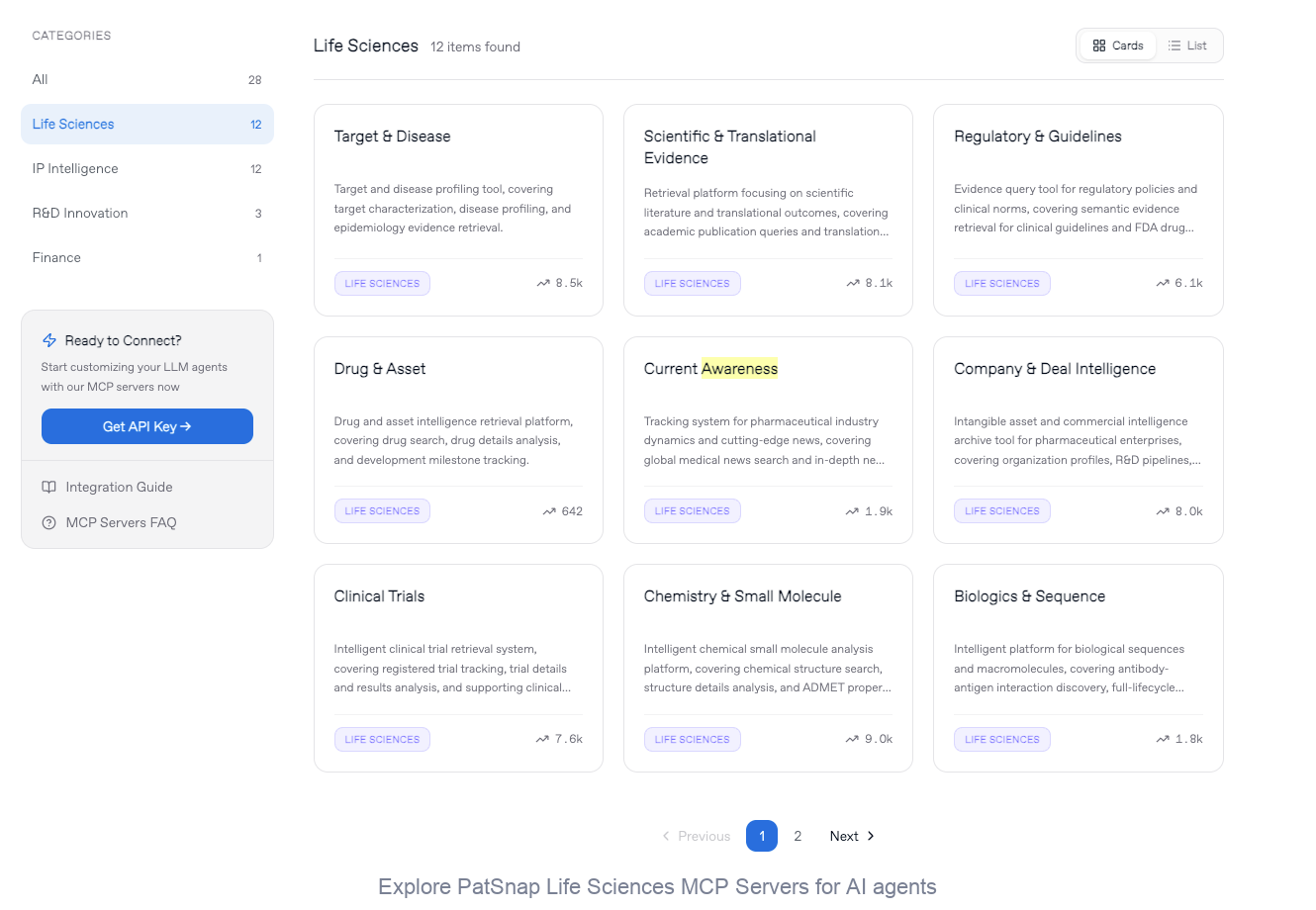
Explore PatSnap Life Sciences MCP Servers for AI agents
Selected Trial and Result Evidence
IP and R&D Recommendation
ROS1 IP should be mapped around kinase selectivity, resistance mutation coverage, brain penetration, NTRK/ALK cross-target claims, and clinical-use claims by line of therapy. Multi-target inhibitor overlap can create both opportunity and FTO complexity.
Recommendation
Advance ROS1 programs with a clear biomarker and differentiation plan: intracranial disease, resistance after earlier TKIs, better tolerability, or specific first-line comparative evidence. For MCP-based AI agents, ROS1 is a good example of why target-level searches should be refined by drug, disease, and trial context before drawing strategic conclusions.

Start building target evaluation agents with PatSnap Life Sciences MCP Servers
Data note: Target biology, disease profile, clinical trial counts, trial examples, and result evidence were generated from PatSnap Target & Disease MCP and PatSnap Clinical Trials MCP queries performed on July 9, 2026.