TOP1 Target Evaluation Report: Biology, Validation, Competition, IP, and R&D Strategy
This TOP1 target evaluation report was generated from PatSnap Life Sciences MCP data workflows, combining Target & Disease MCP Server outputs for biology and disease context with Clinical Trials MCP Server checks for clinical development signals. The goal is to show how an AI agent can turn structured life-science data into a decision-ready target assessment.
For TOP1, the main question is not simply whether the biology is interesting. It is whether the biology, validation evidence, competitive intensity, IP surface, and indication strategy leave enough room for a differentiated R&D program.
647 Tracked drugs 647 drug records were returned by Target & Disease MCP for this target. | 519 Development-stage drugs 519 development records suggest an extremely mature topoisomerase payload and inhibitor field. | 499 Linked diseases 499 disease associations frame the indication search space. | 79 Target score 79/100 reflects the combined biology, validation, competition and room-to-win readout. |
Executive Readout
TOP1 is one of the most clinically validated DNA-damage targets, but that validation comes with extreme competitive density. The opportunity is not a simple TOP1 inhibitor; it is differentiated delivery, payload engineering, tumor selection, or combination strategy.
Biology confidence88/100
Validation maturity92/100
Competition pressure96/100
Room for differentiation48/100
Why MCP Data Matters Here
A target report becomes useful when the evidence is traceable. In this workflow, Target & Disease MCP supplies the target profile, aliases, UniProt-linked biology, drug count, development count and disease-linkage context. Clinical Trials MCP is then used as a validation layer to check whether the competitive story is supported by trial activity and named development programs. When a clinical query returns broad or noisy matches, the report keeps the claim conservative instead of overstating the signal.
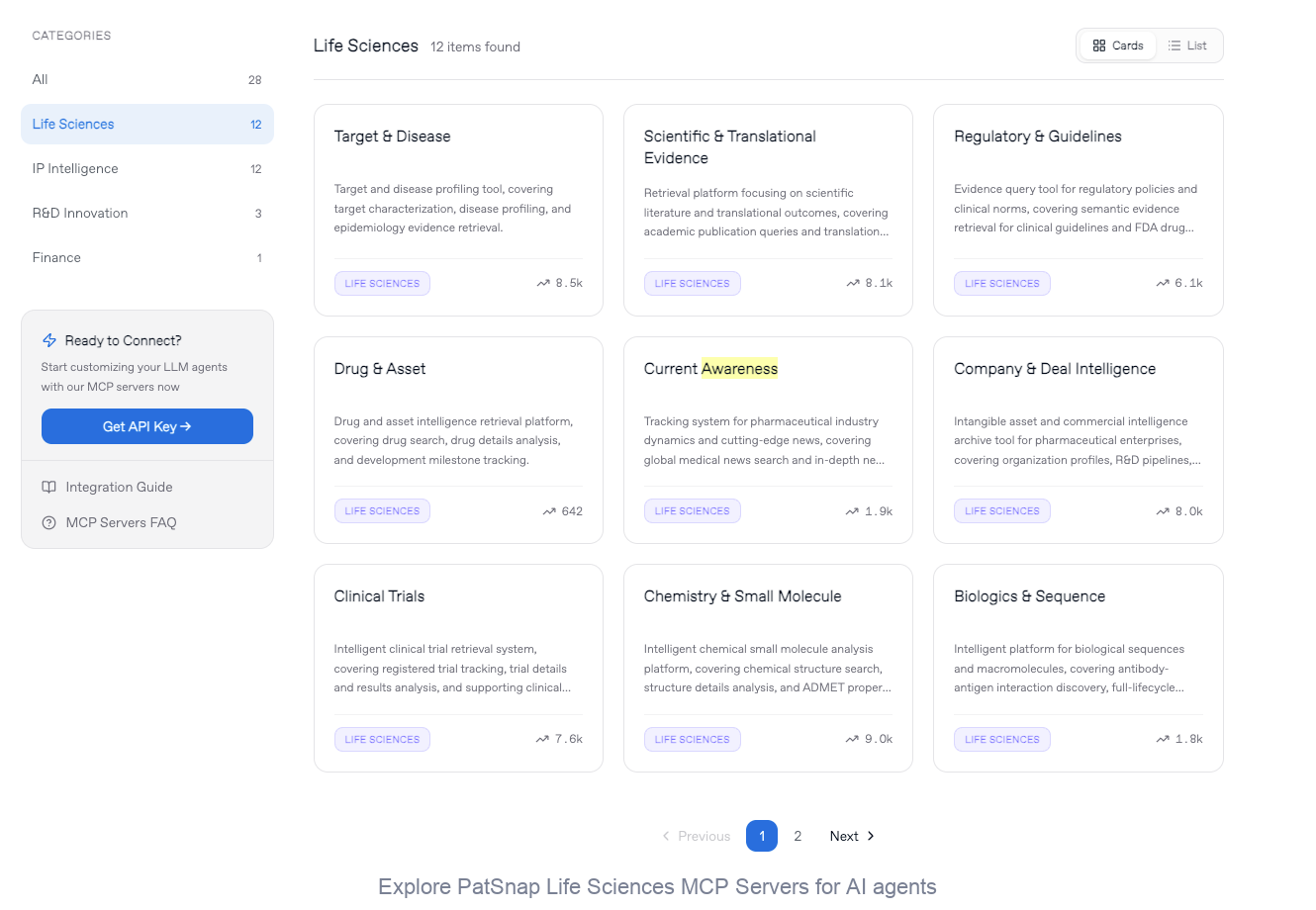
Explore PatSnap Life Sciences MCP Servers for AI agents
Biology: What the Target Controls
Target & Disease MCP describes TOP1 as a DNA topoisomerase that relieves supercoiling and torsional tension during DNA replication and transcription by transiently cleaving and rejoining one DNA strand. That biology makes TOP1 a direct lever on replication stress and DNA damage in proliferating tumor cells.
Mechanistic anchorTOP1 creates transient single-strand DNA breaks to relax supercoils; trapped TOP1-DNA complexes can convert replication stress into tumor cell death. | Disease logicThe 499 linked disease associations and 647 tracked drug records indicate very broad oncology relevance and a mature clinical evidence base. | Translational caveatHigh validation also means high competition, class toxicity concerns and limited room for an undifferentiated small-molecule program. |
Validation Evidence
Validation is very high. Target MCP returned 647 tracked drug records and 519 development-stage records, making TOP1 one of the densest targets in this campaign.
From an AI-agent perspective, this is a useful pattern: one MCP call provides the biological rationale, while the next call checks whether that rationale has already translated into assets, trials, or clinical-stage development. The output is not a final investment decision, but it narrows the review queue quickly.
Clinical and Competitive Landscape
Competition is extreme across camptothecin-derived drugs, TOP1 inhibitor payloads and ADC programs. New entrants must compete on delivery, bystander effect, therapeutic index, resistance profile and combination setting.
Known development examplesIrinotecan, topotecan and modern TOP1 ADC payload strategies are the practical development benchmarks. | Competitive implicationA generic TOP1 inhibitor is weakly differentiated; ADC payload design or tumor-targeted delivery is the more credible route. | Where to look nextPrioritize ADC payload platforms, tumor-antigen pairing, resistance biomarkers and combination settings with DNA damage response agents. |
IP and Freedom-to-Operate Lens
IP density is high around payload structures, linkers, conjugation, dosing, combinations and indications. FTO must be modality-specific.
For IP review, the practical next step is to connect target evidence with modality, chemotype, sequence space, formulation, combinations and indication-specific claims. A target with many assets is not automatically blocked, but it needs a sharper claim strategy.
R&D Recommendation
Advance TOP1 only through a differentiated modality strategy, especially ADC payload engineering or biomarker-selected combinations.

Start building target evaluation agents with PatSnap Life Sciences MCP Servers
Data workflow note: target biology, drug counts, development counts and disease associations are based on PatSnap Target & Disease MCP Server outputs retrieved on 9 July 2026. Clinical development commentary is written conservatively when trial-query outputs are broad, and should be refreshed before investment or BD decisions.

