Request Demo
Last update 15 Aug 2026
Clavulanic Acid
Last update 15 Aug 2026
Overview
Basic Info
Drug Type Small molecule drug |
Synonyms (Z)-(2R,5R)-3-(2-Hydroxyethylidene)-7-oxo-4-oxa-1-azabicyclo(3.2.0)heptane-2-carboxylic acid, Clavulanate, Clavulanic acid (INN) + [10] |
Target |
Action inhibitors |
Mechanism PSMA inhibitors(Prostate-specific membrane antigen inhibitors) |
Therapeutic Areas |
Active Indication- |
Originator Organization- |
Active Organization- |
Inactive Organization |
License Organization- |
Drug Highest PhaseDiscontinuedPhase 2 |
First Approval Date- |
Regulation- |

Login to view timeline
Structure/Sequence
Molecular FormulaC8H9NO5 |
InChIKeyHZZVJAQRINQKSD-PBFISZAISA-N |
CAS Registry58001-44-8 |
Related
52
Clinical Trials associated with Clavulanic AcidChiCTR2500112845
Effect of Vonoprazan-Amoxicillin Combined with Compound Lactobacillus acidophilus on Symptoms and Gut Microbiome in Patients with Functional Constipation
CTIS2025-522562-70-00
A single-dose, open-label, randomized, two-period, two-sequence, crossover pivotal bioequivalence study on 400 mg / 5 mL amoxicillin + 57 mg / 5 mL of clavulanic acid powder for oral suspension in healthy volunteers under fed conditions.

CTIS2025-521718-24-00
A single-dose, open-label, randomized, two-period, two-sequence, crossover pivotal bioequivalence study on two amoxicillin-clavulanic acid film-coated tablet formulations in healthy volunteers under fed conditions.
100 Clinical Results associated with Clavulanic Acid
Login to view more data
100 Translational Medicine associated with Clavulanic Acid
Login to view more data
100 Patents (Medical) associated with Clavulanic Acid
Login to view more data
11,184
Literatures (Medical) associated with Clavulanic Acid01 Dec 2026MOLECULAR BIOLOGY REPORTS
High prevalence and co-existence of SHV and CTX-M genes in extensively drug-resistant (XDR) Gram-negative bacteria isolated from hospital settings in Faisalabad District, Pakistan
Article
Author: Shaukat, Amir ; Duarte, Tania Da Silva ; Sattar, Azfar ; Blaskovich, Mark A T ; Zuegg, Johannes ; Ahmad, Zaheer ; Ali, Aamir ; Sarwar, Yasra ; Shehzad, Khurram ; Abbas, Umair ; Sajjad, Huma
BACKGROUND: Hospital-acquired infections (HAIs) associated with increasing antimicrobial resistance (AMR) are becoming a global health challenge, causing AMR spread and a serious health threat. This study was designed to evaluate the phenotypic and genotypic status of AMR in Gram-negative HAI-associated bacteria, to gain a current insight into the local settings. METHODS AND RESULTS: Kirby-Bauer method and Double Disc Synergy Test were used for phenotypic assessment of AMR and extended-spectrum β-lactamase (ESBL) producers, respectively. Genes encoding antimicrobial resistance, ESBLs, and carbapenemases were identified by PCR followed by Sanger sequencing. Among 102 HAI samples, 62 were Gram-negative, identified as Escherichia coli (E. coli) (42.2%), Klebsiella pneumoniae (K. pneumoniae) (21.1%), and Pseudomonas aeruginosa (P. aeruginosa) (6.6%) by PCR. All K. pneumoniae and (95%) E. coli isolates exhibited multidrug resistance. K. pneumoniae isolates (95%) showed resistance against ceftazidime, cefotaxime, ceftriaxone, and aztreonam, and (89%) isolates were resistant to amoxicillin-clavulanic acid, ofloxacin, and cefepime (E. coli isolates (84%), (84%), (78%), (76%), (76%), and (73%) were resistant against cefotaxime, ceftriaxone, aztreonam, ceftazidime, doripenem, and colistin, respectively. Genotypically, the mcr-2 gene was detected in 5% K. pneumoniae isolates. Phenotypically, 63% isolates were identified as ESBL producers with high genetic prevalence of SHV-12 (78.9%) and SHV-1 (57.8%) in K. pneumoniae and CTX-M1 (60.5%) in E. coli. Notably, one K. pneumoniae isolate harbored all class-A ESBL genes, which is a novel finding. Co-existence of CTX-M1 + SHV-1 + TEM-1, SHV-1 + SHV-12 + TEM-1, and CTX-M1 + CTX-M15 + TEM-1 genes was dominant. CONCLUSION: The HAIs caused by extensively drug-resistant and ESBL-producing K. pneumoniae and E. coli were dominant, with less prevalence of moderately drug-resistant Pseudomonas isolates.
01 Dec 2026One Health
Genomic epidemiology to investigate the origins and zoonotic implications of antibiotic-resistant Escherichia coli on beef and lamb meat sold by independent butchers in Wales
Article
Author: Moiseienko, Yelyzaveta ; Mounsey, Oliver ; Peltonen, Noora ; Taylor, Jasmine ; Sealey, Jordan E ; Williams, Philip ; Wright, Laura ; Avison, Matthew B ; Llamazares, Beatriz
Many studies have identified antibiotic resistant (ABR) Escherichia coli on meat. Appropriate hand hygiene and cooking practices should minimize the risk of gastrointestinal colonisation with ABR E. coli found on meat, and the subsequent chance of causing resistant opportunistic extraintestinal infection. There are large gaps in our understanding of the prevalence, origins and zoonotic potential of ABR E. coli found on meat, however, and particularly for meat reared in extensive farming systems. Wales is a devolved nation within the United Kingdom having large populations of extensively-reared sheep and beef cattle. To help address knowledge gaps around ABR E. coli on extensively reared meat, therefore, beef mince and lamb loin/leg steaks/chops were purchased from 50 (beef) and 46 (lamb) independent butchers across Wales. Following enrichment culture, 200 g meat samples were found to be positive for E. coli resistant to amoxicillin (31% positivity), streptomycin (28%), spectinomycin (29%), amoxicillin-clavulanate (11%), 3rd generation cephalosporins (2%) and fluoroquinolones (5%). Phylogenetic analysis confirmed that Welsh lamb meat ABR E. coli isolates (n = 78) are more closely related to those found in faecal samples collected around sheep (n = 352) than around beef cattle (n = 361) on Welsh farms. This suggests that faecal contamination at or around slaughter is their primary origin. We found no closely related meat/infection clones (<20 SNPs distant and the same antibiotic resistance genes) when comparing ABR E. coli from Welsh meat (n = 91) and those causing extraintestinal infections in people (n = 2387) in an English region bordering Wales. We conclude, therefore, that the wider zoonotic implications of finding ABR E coli on beef and lamb meat sold at independent butchers in Wales are small, though a more geographically and temporarily contemporaneous survey is warranted to address this further.
01 Sep 2026Exploratory research in clinical and social pharmacy
Feasibility, fidelity and initial effects of an app-based service for short-term antibiotic therapy: A pilot study in a primary care setting
Article
Author: Sutter, Vanessa ; Arnet, Isabelle ; Messner, Kirstin ; Allemann, Samuel
Background:
Short-term antibiotic treatments show medication non-adherence rates around 40%, limiting therapy success and increasing risk for recurring infections. Smartphone applications offer simple solutions to support patients' medication adherence.
Objective:
To evaluate service and trial feasibility of a smartphone-based adherence support delivered by community pharmacists and to explore initial effects.
Methods:
We conducted a cluster-randomized pilot trial. Community pharmacies recruited eligible patients with newly prescribed amoxicillin/clavulanic acid therapy when dispensing the prescription. Participants used an app to confirm medication intakes. The intervention group received intake reminders and text messages. We evaluated feasibility and fidelity based on data quality, participant satisfaction, and extent to which service activities were delivered as planned. For exploratory analyses, we used the Mann-Whitney U test, and calculated effect sizes.
Results:
Fifty-seven community pharmacies and 34 patients participated in the study (17 per group). Twenty-nine participants (85%) fully completed the study. Twenty-one participants (62%) used and returned the symptom diary. For 30 participants (88%), the app was installed correctly and twenty-five (83%) participants consistently used the app. We observed small, non-significant effects for taking adherence (r = 0.158) and timing adherence (r = 0.147), and small-medium (r = 0.294) for dosing adherence.
Conclusion:
This study demonstrated feasibility and fidelity of a smartphone-based therapy support in the community pharmacy setting. Trends suggest a potential improvement in adherence rates through smartphone reminders and text messages. These findings highlight the need for a fully powered trial.
35
News (Medical) associated with Clavulanic Acid23 Mar 2026
Drug ApprovalPhase 3Accelerated Approval


100 Deals associated with Clavulanic Acid
Login to view more data
External Link
| KEGG | Wiki | ATC | Drug Bank |
|---|---|---|---|
| D07711 | Clavulanic Acid |
R&D Status
10 top R&D records. to view more data
Login
| Indication | Highest Phase | Country/Location | Organization | Date |
|---|---|---|---|---|
| Depressive Disorder, Major | Phase 2 | United States | 01 Jan 2009 | |
| Major depressive disorder, moderate (MDD) | Phase 2 | United States | 01 Jan 2009 | |
| Erectile Dysfunction | Phase 2 | United States | 01 Jun 2008 |
Login to view more data
Clinical Result
Clinical Result
Indication
Phase
Evaluation
View All Results
Phase 1 | - | bjiaowulam(ohncgsdrvr) = oilcmvyngz ihsnfdrlwx (qsvqasvxyg ) | Positive | 12 Aug 2025 | |||
Phase 1 | - | pwzsxudsek(idlsmlrgzr) = zulmueuulz ywwkptilhh (snzkrzrkvq ) | Positive | 04 Apr 2024 | |||
Phase 2 | 112 | (Rifampin Resistant A) | upswkehufz(qsuiatfune) = ytzxzoobmm jvkcdpygje (myumzafsat, fgobhuslxb - teuhfzolhz) View more | - | 19 Jul 2023 | ||
(Rifampin Resistant B) | upswkehufz(qsuiatfune) = afncgpxzsu jvkcdpygje (myumzafsat, flxumwedkr - usogohdxqq) View more |
Login to view more data
Translational Medicine
Boost your research with our translational medicine data.
login
or

Deal
Boost your decision using our deal data.
login
or

Core Patent
Boost your research with our Core Patent data.
login
or

Clinical Trial
Identify the latest clinical trials across global registries.
login
or

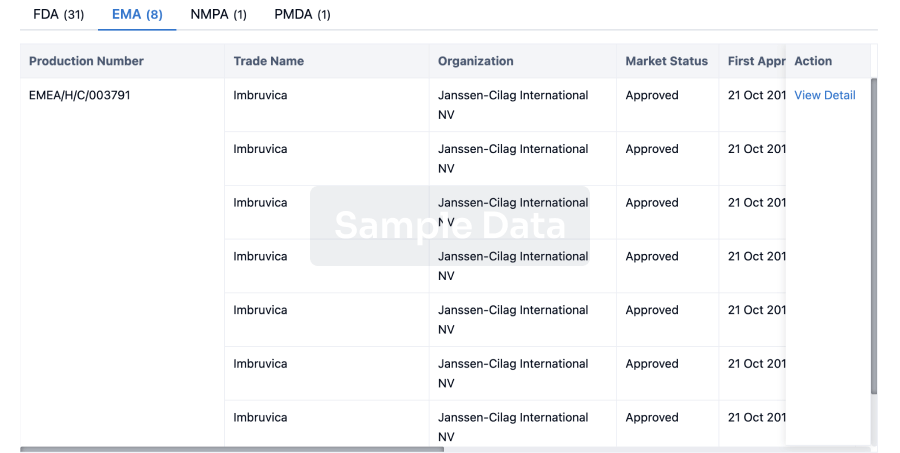
Approval
Accelerate your research with the latest regulatory approval information.
login
or
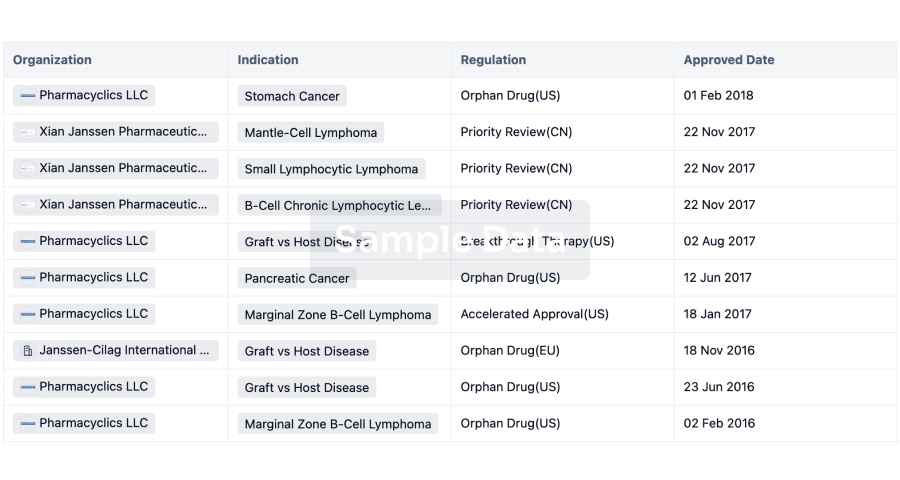
Regulation
Understand key drug designations in just a few clicks with Synapse.
login
or
Hiro LS Researcher
The AI Search Engine Built to Accelerate Biopharma Decisions
Search across billion-scale life sciences data to uncover signals, validate evidence, and act with confidence.
Ask any biopharma research question→
Get started for free today!
Accelerate Strategic R&D decision making with Synapse, Patsnap’s AI-powered Connected Innovation Intelligence Platform Built for Life Sciences Professionals.
Discover Synapse Data Servers
Synapse data is now integrated into the PatSnap LS Model Context Protocol (MCP) service. Customize your LLM agent now using our MCP server!
Bio
Bio Sequences Search & Analysis
Sign up for free
Chemical
Chemical Structures Search & Analysis
Sign up for free