Request Demo
What is the mechanism of Eptaplatin?
17 July 2024
Eptaplatin, also known as JM216, is a member of the platinum-based antineoplastic agents, a class of chemotherapy drugs that target cancer cells by damaging their DNA and thus inhibiting their ability to divide and grow. These agents have been a cornerstone in the treatment of various cancers, including testicular, ovarian, and colorectal cancers. Unlike its predecessors like cisplatin and carboplatin, eptaplatin was developed to overcome some of the common resistance mechanisms and side effects associated with these earlier drugs. Understanding the mechanism of eptaplatin requires delving into its chemical structure, its interaction with cellular components, and its overall pharmacodynamics and pharmacokinetics.
Eptaplatin is a platinum(IV) complex characterized by its ability to exist in a less reactive state compared to the platinum(II) complexes. This stability allows it to be administered orally, which is a significant advantage over cisplatin and carboplatin, which require intravenous administration. Eptaplatin's chemical structure includes two ammine groups and two acetato ligands, which contribute to its stability and reactivity profile.
Once eptaplatin enters the body, it undergoes biotransformation to a platinum(II) complex. This activation primarily occurs in the intracellular environment where the reducing conditions facilitate the conversion. The activated platinum(II) species is highly reactive and interacts with cellular DNA. This interaction predominantly involves the formation of intrastrand and interstrand crosslinks within the DNA helix. These platinum-DNA adducts interfere with the cell's replication machinery by distorting the DNA structure and inhibiting essential processes like transcription and replication.
The formation of DNA adducts triggers a series of cellular responses aimed at repairing the damage. However, the nature of the crosslinks often makes repair challenging. The cell cycle is arrested at the G2/M phase as the cell attempts to rectify the damage, but if the repair mechanisms are overwhelmed or unsuccessful, the cell undergoes apoptosis, or programmed cell death. This cytotoxic effect is the primary means by which eptaplatin exerts its antitumor activity.
Resistance to platinum-based drugs, including eptaplatin, can occur through several mechanisms. One common resistance mechanism involves the increased expression of DNA repair enzymes that can recognize and excise platinum-induced DNA adducts. Another mechanism is the increased efflux of the drug from cancer cells through membrane transporters, reducing intracellular drug concentrations. Additionally, cancer cells can increase the levels of intracellular thiol-containing molecules like glutathione, which can bind to the platinum drug and deactivate it before it reaches the DNA.
Eptaplatin's formulation and delivery also play a crucial role in its effectiveness. The oral administration of eptaplatin offers a more convenient and less invasive option for patients, potentially improving compliance and quality of life. Moreover, its pharmacokinetic properties, including absorption, distribution, metabolism, and excretion, have been optimized to enhance its antitumor activity while minimizing systemic toxicity.
In conclusion, eptaplatin is a promising platinum-based chemotherapeutic agent that operates through the formation of DNA crosslinks, leading to cell cycle arrest and apoptosis in cancer cells. Its development as an orally-administered drug represents a significant advancement in chemotherapy, offering improved patient convenience and compliance. However, like all chemotherapy agents, its effectiveness can be limited by resistance mechanisms, necessitating ongoing research to optimize its use and overcome these challenges.
Eptaplatin is a platinum(IV) complex characterized by its ability to exist in a less reactive state compared to the platinum(II) complexes. This stability allows it to be administered orally, which is a significant advantage over cisplatin and carboplatin, which require intravenous administration. Eptaplatin's chemical structure includes two ammine groups and two acetato ligands, which contribute to its stability and reactivity profile.
Once eptaplatin enters the body, it undergoes biotransformation to a platinum(II) complex. This activation primarily occurs in the intracellular environment where the reducing conditions facilitate the conversion. The activated platinum(II) species is highly reactive and interacts with cellular DNA. This interaction predominantly involves the formation of intrastrand and interstrand crosslinks within the DNA helix. These platinum-DNA adducts interfere with the cell's replication machinery by distorting the DNA structure and inhibiting essential processes like transcription and replication.
The formation of DNA adducts triggers a series of cellular responses aimed at repairing the damage. However, the nature of the crosslinks often makes repair challenging. The cell cycle is arrested at the G2/M phase as the cell attempts to rectify the damage, but if the repair mechanisms are overwhelmed or unsuccessful, the cell undergoes apoptosis, or programmed cell death. This cytotoxic effect is the primary means by which eptaplatin exerts its antitumor activity.
Resistance to platinum-based drugs, including eptaplatin, can occur through several mechanisms. One common resistance mechanism involves the increased expression of DNA repair enzymes that can recognize and excise platinum-induced DNA adducts. Another mechanism is the increased efflux of the drug from cancer cells through membrane transporters, reducing intracellular drug concentrations. Additionally, cancer cells can increase the levels of intracellular thiol-containing molecules like glutathione, which can bind to the platinum drug and deactivate it before it reaches the DNA.
Eptaplatin's formulation and delivery also play a crucial role in its effectiveness. The oral administration of eptaplatin offers a more convenient and less invasive option for patients, potentially improving compliance and quality of life. Moreover, its pharmacokinetic properties, including absorption, distribution, metabolism, and excretion, have been optimized to enhance its antitumor activity while minimizing systemic toxicity.
In conclusion, eptaplatin is a promising platinum-based chemotherapeutic agent that operates through the formation of DNA crosslinks, leading to cell cycle arrest and apoptosis in cancer cells. Its development as an orally-administered drug represents a significant advancement in chemotherapy, offering improved patient convenience and compliance. However, like all chemotherapy agents, its effectiveness can be limited by resistance mechanisms, necessitating ongoing research to optimize its use and overcome these challenges.
How to obtain the latest development progress of all drugs?
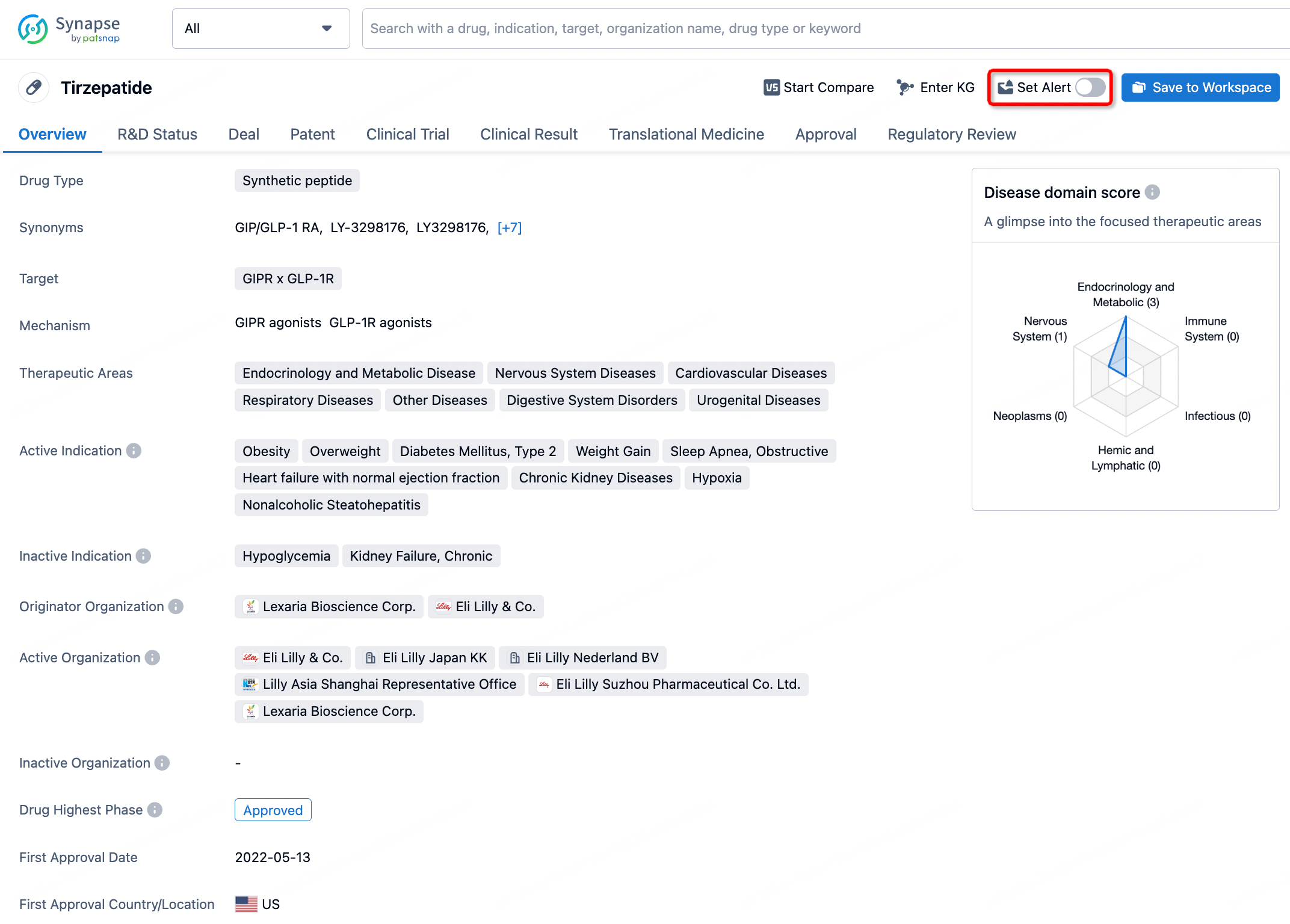
In the Synapse database, you can stay updated on the latest research and development advances of all drugs. This service is accessible anytime and anywhere, with updates available daily or weekly. Use the "Set Alert" function to stay informed. Click on the image below to embark on a brand new journey of drug discovery!

AI Agents Built for Biopharma Breakthroughs
Accelerate discovery. Empower decisions. Transform outcomes.
Get started for free today!
Accelerate Strategic R&D decision making with Synapse, PatSnap’s AI-powered Connected Innovation Intelligence Platform Built for Life Sciences Professionals.
Start your data trial now!
Synapse data is also accessible to external entities via APIs or data packages. Empower better decisions with the latest in pharmaceutical intelligence.