Request Demo
What are PTGFR agonists and how do they work?
21 June 2024
Prostaglandin F2α receptor (PTGFR) agonists are a class of drugs that interact with the prostaglandin F receptor. These compounds mimic the action of prostaglandin F2α (PGF2α), a naturally occurring fatty acid involved in various physiological functions. Understanding the role and mechanisms of PTGFR agonists can provide insights into their therapeutic applications and potential benefits.
PTGFR agonists function by binding to and activating the prostaglandin F receptor located on the surface of target cells. This receptor is a part of the G-protein-coupled receptor (GPCR) family, which plays a crucial role in transmitting signals from the outside of the cell to its interior. When a PTGFR agonist binds to the receptor, it triggers a cascade of intracellular events, primarily involving the activation of phospholipase C (PLC). This leads to the production of inositol triphosphate (IP3) and diacylglycerol (DAG), second messengers that promote the release of calcium ions from intracellular stores and activate protein kinase C (PKC).
The increase in intracellular calcium concentration and PKC activation initiate various cellular responses, including smooth muscle contraction, cell proliferation, and modulation of inflammatory processes. By mimicking PGF2α, PTGFR agonists can effectively regulate these physiological functions, which forms the basis for their therapeutic applications.
One of the primary uses of PTGFR agonists is in the management of glaucoma and ocular hypertension. In these conditions, elevated intraocular pressure (IOP) can lead to optic nerve damage and vision loss. PTGFR agonists, such as latanoprost, travoprost, and bimatoprost, reduce IOP by increasing the outflow of aqueous humor from the eye through the uveoscleral pathway. These medications are often prescribed as first-line treatments due to their efficacy and relatively few systemic side effects.
Beyond ocular applications, PTGFR agonists have shown promise in reproductive medicine. For instance, dinoprost (a synthetic version of PGF2α) is used to induce labor by promoting uterine contractions. Similarly, these agents can be employed in veterinary medicine to synchronize estrus cycles in livestock, thereby improving breeding efficiency.
In the realm of dermatology, PTGFR agonists are gaining attention for their role in promoting hair growth. Bimatoprost, originally developed for glaucoma treatment, has been found to stimulate eyelash and eyebrow growth. This discovery led to the development of topical formulations aimed at treating conditions like hypotrichosis, where there is inadequate hair growth.
Another interesting area of research involves the potential use of PTGFR agonists in managing fibrotic diseases. Fibrosis, characterized by excessive tissue scarring, can occur in various organs, including the lungs, liver, and kidneys. Studies suggest that PTGFR activation may help regulate extracellular matrix production and deposition, thereby mitigating fibrosis development. While this application is still under investigation, it highlights the versatility and therapeutic potential of PTGFR agonists.
Despite their benefits, PTGFR agonists are not without side effects. Common adverse effects include ocular hyperemia (eye redness), eyelash changes, and periocular skin pigmentation in the context of glaucoma treatment. Systemic side effects are rare but can include respiratory complications when used for labor induction.
In conclusion, PTGFR agonists represent a significant advancement in medical therapeutics, offering benefits in the treatment of glaucoma, reproductive health, dermatology, and potentially fibrotic diseases. Their ability to mimic the action of prostaglandin F2α and modulate various physiological processes underscores their importance in clinical practice. Ongoing research and development will likely expand their applications, providing new avenues for treating a range of conditions.
PTGFR agonists function by binding to and activating the prostaglandin F receptor located on the surface of target cells. This receptor is a part of the G-protein-coupled receptor (GPCR) family, which plays a crucial role in transmitting signals from the outside of the cell to its interior. When a PTGFR agonist binds to the receptor, it triggers a cascade of intracellular events, primarily involving the activation of phospholipase C (PLC). This leads to the production of inositol triphosphate (IP3) and diacylglycerol (DAG), second messengers that promote the release of calcium ions from intracellular stores and activate protein kinase C (PKC).
The increase in intracellular calcium concentration and PKC activation initiate various cellular responses, including smooth muscle contraction, cell proliferation, and modulation of inflammatory processes. By mimicking PGF2α, PTGFR agonists can effectively regulate these physiological functions, which forms the basis for their therapeutic applications.
One of the primary uses of PTGFR agonists is in the management of glaucoma and ocular hypertension. In these conditions, elevated intraocular pressure (IOP) can lead to optic nerve damage and vision loss. PTGFR agonists, such as latanoprost, travoprost, and bimatoprost, reduce IOP by increasing the outflow of aqueous humor from the eye through the uveoscleral pathway. These medications are often prescribed as first-line treatments due to their efficacy and relatively few systemic side effects.
Beyond ocular applications, PTGFR agonists have shown promise in reproductive medicine. For instance, dinoprost (a synthetic version of PGF2α) is used to induce labor by promoting uterine contractions. Similarly, these agents can be employed in veterinary medicine to synchronize estrus cycles in livestock, thereby improving breeding efficiency.
In the realm of dermatology, PTGFR agonists are gaining attention for their role in promoting hair growth. Bimatoprost, originally developed for glaucoma treatment, has been found to stimulate eyelash and eyebrow growth. This discovery led to the development of topical formulations aimed at treating conditions like hypotrichosis, where there is inadequate hair growth.
Another interesting area of research involves the potential use of PTGFR agonists in managing fibrotic diseases. Fibrosis, characterized by excessive tissue scarring, can occur in various organs, including the lungs, liver, and kidneys. Studies suggest that PTGFR activation may help regulate extracellular matrix production and deposition, thereby mitigating fibrosis development. While this application is still under investigation, it highlights the versatility and therapeutic potential of PTGFR agonists.
Despite their benefits, PTGFR agonists are not without side effects. Common adverse effects include ocular hyperemia (eye redness), eyelash changes, and periocular skin pigmentation in the context of glaucoma treatment. Systemic side effects are rare but can include respiratory complications when used for labor induction.
In conclusion, PTGFR agonists represent a significant advancement in medical therapeutics, offering benefits in the treatment of glaucoma, reproductive health, dermatology, and potentially fibrotic diseases. Their ability to mimic the action of prostaglandin F2α and modulate various physiological processes underscores their importance in clinical practice. Ongoing research and development will likely expand their applications, providing new avenues for treating a range of conditions.
How to obtain the latest development progress of all targets?
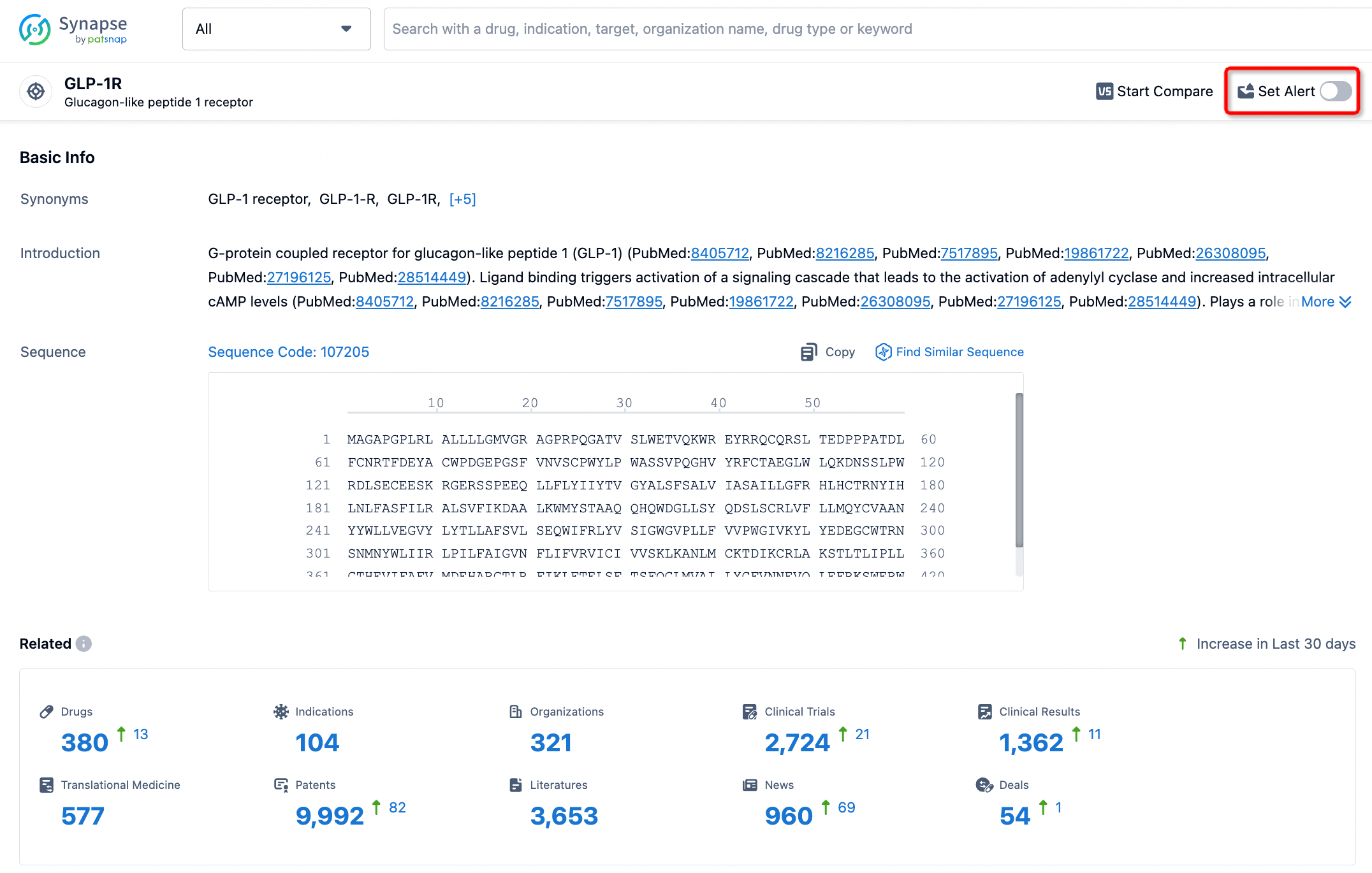
In the Synapse database, you can stay updated on the latest research and development advances of all targets. This service is accessible anytime and anywhere, with updates available daily or weekly. Use the "Set Alert" function to stay informed. Click on the image below to embark on a brand new journey of drug discovery!


AI Agents Built for Biopharma Breakthroughs
Accelerate discovery. Empower decisions. Transform outcomes.
Get started for free today!
Accelerate Strategic R&D decision making with Synapse, PatSnap’s AI-powered Connected Innovation Intelligence Platform Built for Life Sciences Professionals.
Start your data trial now!
Synapse data is also accessible to external entities via APIs or data packages. Empower better decisions with the latest in pharmaceutical intelligence.